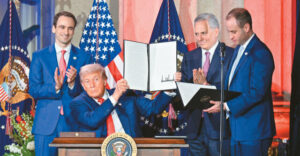
Until just two weeks ago, Donald Trump’s knowledge of Artificial Intelligence seemed limited to commissioning and sharing outrageous deepfakes—like the notorious video of Barack Obama’s supposed arrest and removal from the White House.
However, on Wednesday, July 23, the U.S. government released a comprehensive and ambitious strategic plan for AI, aiming to “Make America Great” in this rapidly advancing digital domain.
The AI Action Plan was crafted personally by Michael Kratsios, Trump’s 39-year-old Greek-American science advisor at the White House. Despite not being a scientist in the traditional (STEM) sense—he graduated from Princeton with degrees in Political Science and Hellenic Studies—Kratsios is deeply rooted in the Greek Orthodox diaspora and holds the honorary title of Archon of the Ecumenical Patriarchate.
A Samurai for Trump in the AI Wars
Kratsios has been entrusted with a mission akin to a front-line commander—some even call him a “samurai” for Trump—charged with ensuring America’s dominance in Artificial Intelligence, particularly against China. AI today is not merely a technological issue; it has transformed into a multidimensional power struggle with vast economic, commercial, and political implications.
That’s why Kratsios is currently considered one of Trump’s most critical advisors. He cannot afford to fail—he’s effectively leading a bloodless but brutally competitive campaign to secure U.S. superiority in the world of chatbots and robotics.

Targeting the $1 Trillion Prize
The plan Kratsios drafted is built on three main pillars:
- Accelerating innovation
- Creating AI infrastructure
- Launching global diplomatic and security initiatives
Its priorities include:
- a/ Protecting and promoting the human capital in the U.S. AI sector.
- b/ Ensuring AI systems are trustworthy and ideologically neutral.
- c/ Guarding AI from malicious use, theft, or exploitation for illegal purposes.
While objectivity may not be Trump’s strong suit, Kratsios’ plan places a clear emphasis on impartial AI—a requirement for the U.S. to gain the upper hand over China in the global market.
The AI Action Plan is a sweeping strategy that extends well beyond tech. It touches on commerce, national security, cybersecurity, energy, labor markets, education, environmental protection, antitrust policy, science, and—above all—economic growth.
Even if Trump is not a man of science or technology, he clearly recognizes the financial stakes: with annual growth over 25%, the global AI market is projected to exceed $1 trillion by 2031. This astronomical figure only reinforces the critical nature of Kratsios’ role and responsibilities.
Backed by Trump’s Inner Circle
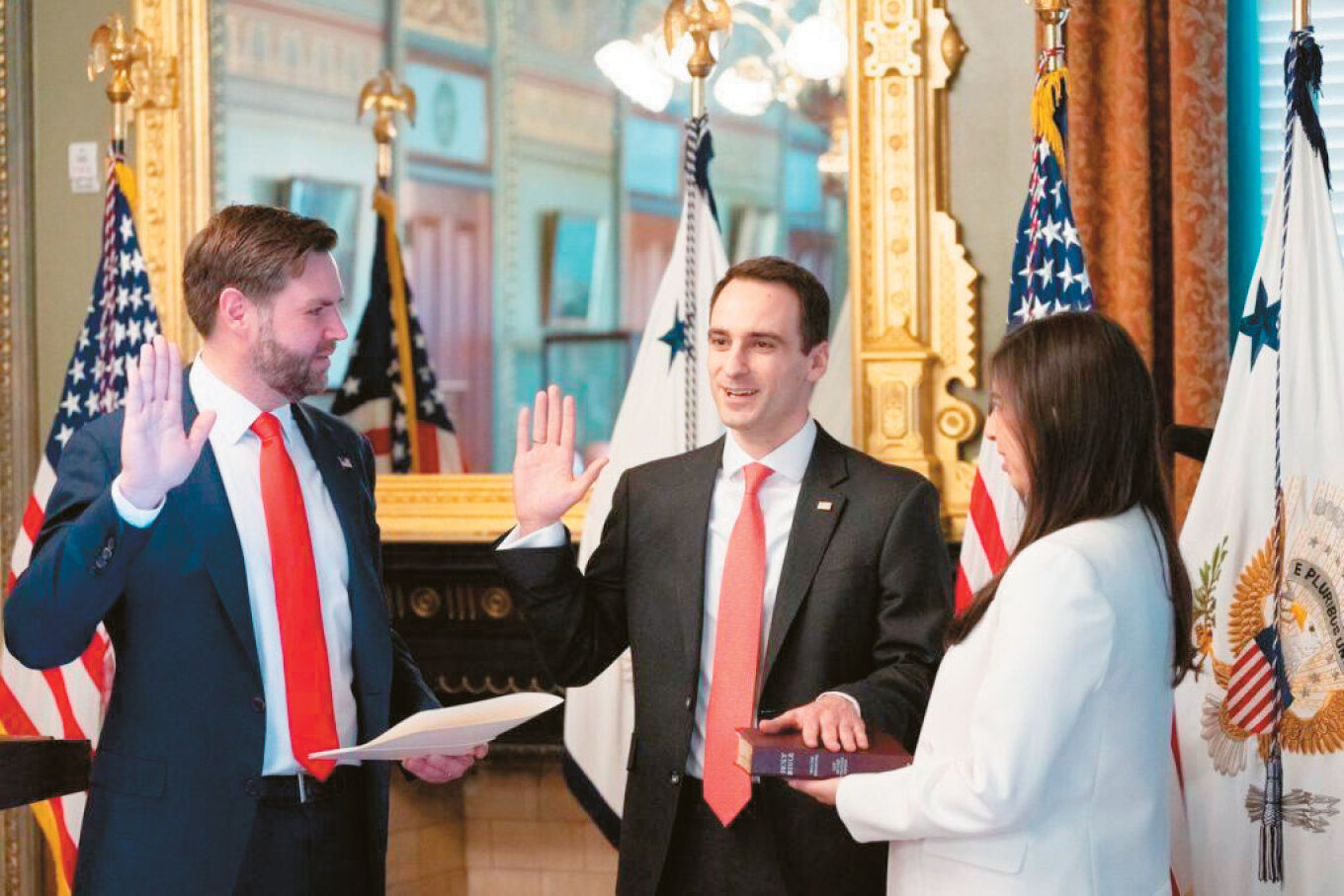
Before being officially adopted by President Trump, Kratsios’ plan had to gain approval from David Sacks, assistant to the president for Science, Technology, AI, and Cryptocurrencies, as well as from Secretary of Defense Pete Hegseth.
Kratsios infused the AI Action Plan with Trump’s MAGA philosophy, which is why its subtitle is “Winning the Race”—a project of national importance and prestige. The plan is structured around three strategic pillars, 90 governmental actions, and three emergency executive orders.
Trump’s rhetorical influence is evident in Kratsios’ words:
“If most countries in the world are using AI systems that aren’t American—and are perhaps made by adversaries [a reference to China]—then we have a serious problem. The U.S. makes the best chips, the best cloud infrastructure, the best AI models, the best digital applications. The entire world should be using our technology. And we, for our part, must make access to American AI as easy as possible. We want the world developing AI applications using American tools.”
Tough Measures Against China
In recent public comments, Kratsios echoed Trump’s stance on stricter export controls of high-tech products to China. The Trump administration has already imposed tight restrictions on U.S.-made microchips, which are the core components of any AI system. Companies like Nvidia—a global AI chip leader—are constantly under scrutiny due to their shipments to Chinese firms.
Kratsios supports even tighter control:
“Top-tier semiconductors should remain under U.S. government control. In fact, we might even need to ban their export to China. Many components for AI machines are made in the U.S., so controlling chip exports effectively means controlling the entire AI market. Every Nvidia shipment intended for China should undergo specialized review by the Bureau of Industry and Security at the Commerce Department, weighing potential benefits and risks.”
Kratsios also defends this position by citing his prior experience, noting that Trump didn’t choose him randomly:
“I’ve spent countless hours in countries around the world, effectively serving as the U.S. Secretary of Technology. I met with ministers to persuade them to abandon Huawei. The West has superior technology, but many countries are reluctant to buy American because we haven’t yet created the right ecosystem or export incentives.”
Ask me anything
Explore related questions