





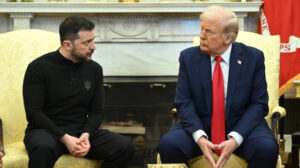
Developments in the war in Ukraine are unfolding rapidly, with diplomatic activity in overdrive following Trump’s meeting with Putin in Alaska.
All eyes now turn to the White House, where the American president will host Volodymyr Zelensky, along with European leaders from the so-called “Coalition of the Willing.” There, Donald Trump is expected to convey directly not only what the Russian president has demanded, but also to outline a U.S. strategy for how the front might be closed. As he has indicated, the most viable outcome would be a comprehensive peace agreement. The question now is: at what cost?
Who will be at the White House – and their relationship with Trump
Aside from Zelensky, members of the “Coalition of the Willing” will also attend.
- European Commission President Ursula von der Leyen
Negotiated with Trump over his proposed tariffs on the EU. The two met at Turnberry golf course, where last month they struck a trade deal. Trump commented: “This will bring us closer… it’s a partnership in the truest sense.” - NATO Secretary General Mark Rutte
Publicly praised “Father Trump” for his handling of the Israel–Iran crisis, while Trump in turn lauded NATO under Rutte’s leadership after members pledged to raise defense spending to 5% of GDP. - French President Emmanuel Macron
Developed an unexpected closeness with Trump during his first presidency. Macron continued to praise him during a visit to the White House in February, even admitting that Trump had been right to build a relationship with Vladimir Putin. - Italian Prime Minister Giorgia Meloni
Visited the White House in April. The two enjoy a well-known cordial relationship and have exchanged praise in the past. Trump has called her a “fantastic woman” who has “truly conquered Europe.” She was also the only European leader to attend his inauguration in January. - German Chancellor Friedrich Merz
A month after taking office, Merz traveled to the White House, where he won the president’s favor by presenting him with his grandfather Friedrich’s birth certificate, showing he was born in Bavaria. - Finnish President Alexander Stubb
Shares Trump’s love of golf – the two even played a round together at Mar-a-Lago in Florida in March. During the “unofficial” visit, they also discussed Ukraine and U.S.–Finnish relations over lunch. - UK Prime Minister Keir Starmer
Last met Trump during the U.S. president’s visit to Scotland in July. Upon landing in the UK, Trump told reporters: “I like your Prime Minister,” and he has often praised the much-touted U.S.–UK “special relationship.”
The key issues on the agenda – Security guarantees and territory
Trump’s ambition to move quickly toward a peace process between Moscow and Kyiv is met with skepticism in European capitals, which seek to ensure that no concessions are made at the expense of Ukraine or European security. EU leaders are drawing three red lines:
- Security guarantees: Europe demands binding and robust security guarantees for Ukraine, as well as protection of European interests. They welcome Trump’s willingness to contribute to a “Coalition of the Willing” arrangement providing Article 5-style security guarantees, in which the EU would also participate.
- Territorial issues: Europe stresses that any discussion of territorial changes must be based on legality, international law, and the principle of non-violation of Ukraine’s territorial integrity.
- Continued support for Ukraine: European countries remain committed to military, economic, and political support for Kyiv until a fair and sustainable solution is reached.
Witkoff’s remarks and the next step
At the same time, remarks by Trump’s special envoy Steve Witkoff drew attention. In an interview with CNN, he revealed that Moscow has allegedly made “certain concessions” regarding five critical Ukrainian regions, which he described as “at the core of the deal.”
According to the BBC, these are Crimea, Luhansk, Donetsk, Zaporizhzhia, and Kherson – regions that have been at the heart of the conflict and Russian ambitions since 2014.
“The Russians made some concessions on these five regions,” Witkoff said, adding: “Donetsk is a crucial issue that will be discussed tomorrow.” He expressed hope that the White House talks, with Trump and Zelensky present, would lead to “on-the-spot decisions.”
His comments fuel speculation about an informal “trade-off agreement” that could secure a fragile ceasefire, without however resolving the core differences between Kyiv and Moscow.
Zelensky: We are shaping a common line with Europeans
In a social media post, Ukrainian President Volodymyr Zelensky voiced satisfaction with today’s meeting in Brussels, which included members of the “Coalition of the Willing.”
“I am grateful to all the participants of the Coalition of the Willing for today’s conversation in Brussels – on the eve of tomorrow’s meeting in Washington with President Trump. It was very useful. We continue to coordinate our common positions. There is clear support for Ukraine’s independence and sovereignty. Everyone agrees that borders must not be changed by force,” he wrote.
Zelensky also stressed that “everyone supports that the key issues must be resolved with Ukraine’s participation in a trilateral format – Ukraine, the U.S., and the Russian leader.”
He called it a “historic decision” that the United States is ready to take part in security guarantees for Ukraine: “The security guarantees, as the result of our joint work, must be truly practical – offering protection on land, in the air, and at sea – and must be developed with Europe’s participation.”
Concluding his post, Zelensky added that the issue of an immediate cessation of hostilities had also been discussed: “Of course, we also talked about how to stop the killings as soon as possible. We are working on a common vision of what a peace agreement should be – truly fair, swift, and effective,” he wrote, thanking Ukraine’s partners.
Ask me anything
Explore related questions




