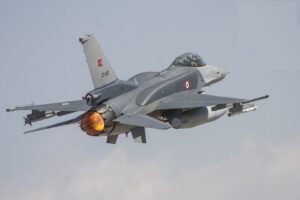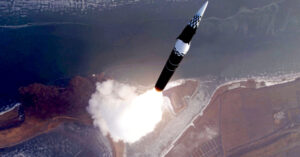
The presentation of China’s DF-17 missiles at a military parade in Beijing on October 1, 2019, marked a new chapter in the great powers’ race to develop hypersonic missiles.
Since then, China has accelerated the upgrade of its systems, Russia has used the war in Ukraine as a live testing ground, while the U.S. has been trying to make up for lost ground. The race for weapons that travel at speeds five times faster than sound, change trajectory, and are nearly impossible to intercept evokes a new Cold War.
Russia and China in the lead, US in pursuit
According to the BBC, China is now considered the leading power in hypersonic weapons, followed by Russia. The U.S. has intensified its investments, developing the “Dark Eagle” as a countermeasure, while countries such as France, Japan, Israel, and Iran are also working on the technology.
Experts say Moscow and Beijing’s lead is due to massive, early investments made years ago, at a time when Western nations were focused on terrorism and counterinsurgency wars. The result, as former MI6 chief Sir Alex Younger admitted in 2020, was that the West “overlooked the massive rise of China as a military power.”
“This is only one part of the broader framework of emerging geopolitical competition we’re seeing among state actors,” says William Freer, national security researcher at the Council on Geostrategy think tank. “It’s something we haven’t seen since the Cold War.”
Freer, whose think tank receives partial funding from defense companies, the UK Ministry of Defence, and others, argues that the reason China and Russia are ahead is relatively simple: “They decided to put a lot of money into these programs several years ago.”
Russia’s “super weapons”
Russia promotes two “super weapons” as an undeniable advantage:
Avangard: A hypersonic glide vehicle which, according to Moscow, can reach speeds of Mach 27 (around 20,700 mph), though estimates place its real performance closer to Mach 12. Its maneuverability makes it nearly impossible to intercept, with Putin calling it “invincible.”
Oreshnik: A missile tested in Ukraine in 2024, reaching Mach 10–11. In experimental launches, its payload split into multiple warheads, simulating Cold War-era tactics. Putin has said it will enter mass production, capable of “turning any target into ashes.”
Russia also fields the Kinzhal (Dagger), initially touted as “unstoppable,” but in practice has often been intercepted in Ukraine.
But speed is not enough. For a missile to be truly “hypersonic” in the military sense, it must be maneuverable in flight. In other words, the launching force must be able to change its path suddenly and unpredictably—even while heading toward its target at extremely high speeds. That makes interception extraordinarily difficult. Most ground-based radar is unreliable in detecting hypersonic weapons until the final phase of flight.
“Flying below the radar horizon, they can avoid early detection and appear on sensors only in the last stage of their flight, limiting interception opportunities,” says Patrycja Bazylczyk, research associate in the Missile Defense Project at the Center for Strategic and International Studies in Washington, which is partly funded by U.S. government agencies and defense firms. She believes the answer lies in boosting Western space-based sensors to overcome the limitations of ground radars.
The threat to Europe from Russia
For Europe, the NATO threat comes mainly from Russia’s missiles, some of which are stationed in Kaliningrad on the Baltic coast. What if Putin ordered a strike on Kyiv with an Oreshnik, this time armed with a full load of high explosives, the BBC asks.
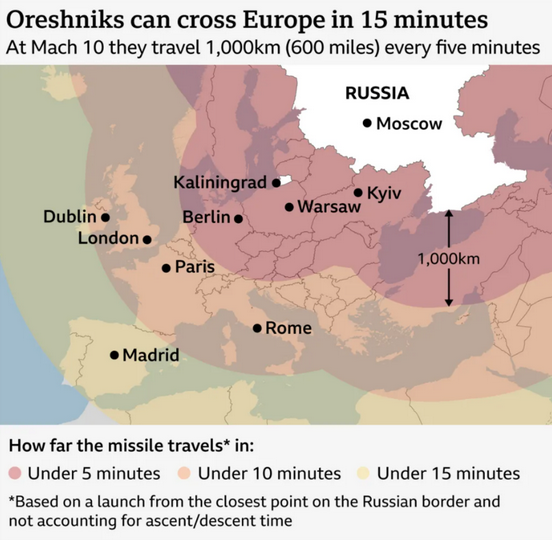
The Russian leader has claimed that this weapon will enter mass production and that they have the capability, as he put it, to turn targets “into dust.”
Russia also has other missiles traveling at hypersonic speeds. Putin has heavily promoted the Kinzhal air-launched missile, claiming it flies so fast it cannot be intercepted. Since then, he has launched many of them against Ukraine.
Arms race
“The ultimate outcome is that we did not understand the huge rise of China as a military power,” admitted Sir Alex Younger, shortly after stepping down as head of Britain’s Secret Intelligence Service in 2020.
Other countries are also advancing quickly: Israel has the Arrow 3, a hypersonic missile designed as an interceptor. Iran claims to possess hypersonic weapons and said it launched one against Israel during their short but intense 12-day war in June. (The missile did travel at extremely high speed, but was not maneuverable enough in flight to be classified as truly hypersonic.) Meanwhile, North Korea has been working on its own versions since 2021 and claims to have an operational system.
What makes hypersonic missiles so dangerous
Their difference from conventional ballistic missiles is not just speed, but also their unpredictable trajectory. Glide vehicles can maneuver in the terminal phase, making detection and interception extremely difficult. Ground-based radar spots them too late, leaving minimal reaction time.
Beyond striking power, their strategic value lies in uncertainty: a state under attack does not know if the strike is nuclear or conventional, increasing the risk of escalation.
The nightmare scenario—and possible defenses
In real-time war, the terrifying question facing a targeted nation is: is this a nuclear or conventional strike? “Hypersonic weapons haven’t changed the nature of war as much as they’ve changed the timeframes in which you can operate,” says Tom Sharpe, former Royal Navy commander and missile defense specialist.
“The basics—spotting the enemy, firing at him, and then slowly guiding a missile to hit a moving target (the great advantage of ships)—are the same as before, whether the weapons are ballistic, hypersonic, or subsonic. Likewise, the defender’s need to detect and jam or destroy an incoming hypersonic missile is the same as before—only now you have less time.”
There are signs that Washington is worried. A report published in February this year by the U.S. Congressional Research Service warns: “U.S. defense officials have stated that both terrestrial and current space-based sensor architectures are inadequate for detecting and tracking hypersonic weapons.”
The West’s response and the “race to space”
The U.S. and its allies are trying to catch up, investing in both offensive programs and early-warning systems using space-based sensors. Britain announced in 2025 that it had achieved a “milestone” with tests in cooperation with NASA, though it remains years behind Russia and China.
The West acknowledges that effective defense will require a mix of better detection, artificial intelligence, and new interception technologies. Meanwhile, the development of hypersonic weapons by Iran, North Korea, and others shows the “club” is expanding, making the competition even more dangerous.
A new Cold War unfolding
Russia and China have already fielded hypersonic missiles, Washington is accelerating, and Europe is struggling to find a role. At the center are two Russian “super weapons” that, according to Putin, can turn any target into dust.
This arms race is not just about firepower. It concerns the balance of the planet itself: a high-stakes game where speed is measured in miles per second, and global security hangs on fragile balances of technology, diplomacy, and restraint.
Ask me anything
Explore related questions