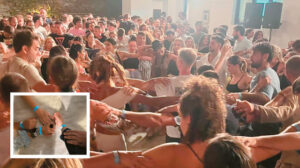
This summer, Greek and foreign tourists abandoned tavernas and clubs and flooded every square where a festival (panigyri) was held. From one end of the country to the other, the scene was the same: full tables, orchestras playing until dawn, locals and visitors merging in celebrations that resembled less the old local custom and more an authentic summer festival.
But this trend has not gone unnoticed and is closely monitored by AADE “commando units” as part of “Operation Summer”, targeting around 70,000 festivals, with initial inspections producing “big catches.” For instance, a few days ago in a provincial town, some opportunists tried to secure VAT exemption for organizing a concert with a top Greek singer, under the pretense of a local association’s non-profit status.
Influencers and Partygoers
In the squares, lights hang between trees above festival-goers’ heads. On paper-covered tables, plastic cups and bottles sparkle in the dim light, creating a scene reminiscent of traditional celebrations from decades past. Yet, the image has changed. Instead of familiar regulars, you see people who could be at a bar in Athens or a trendy Mykonos restaurant: branded clothing and sneakers, linen shirts open at the chest, freshly styled hair, perfumes filling the air. The festival is no longer purely local or traditional; it’s the new trend for Generation Z (ages 13–28).

Just as they discover new beaches for Instagram posts or hunt for hidden restaurants and destinations, young people have discovered local festivals as a new way to have fun.
Here, flirting happens, stories and reels fill social media, and the event goes viral the next day. From wannabe influencers to sophisticated seekers of authentic experiences, festivals have become crossroads of experience: locals, tourists, partygoers, and young people eager to post content online.
Tinos: €12 Entrance
This trend has an economic dimension as well. For example, this year the caper festival in Tinos resembled a club more than a religious custom. Entrance cost €12, with a wristband on the wrist marking you as a participant — almost like a VIP club entry. Yet entertainment was inexpensive: the price included a full menu, wine cost €5 per small bottle, and tsipouro or raki in 200ml bottles was the same price.

In an era where a taverna might cost €25–30 per person without music, festivals are a clever solution: half the price, live music, dancing. Why choose a taverna when, for the same cost, you can enjoy music, dance, and an experience combining tradition with contemporary entertainment? This new business brings significant profits to organizers, with young people treating it as a highlight of summer rather than an obligation.
Safety Concerns
Behind the lively scene, some issues arise. With 7–8 Beaufort winds on the islands and crowded squares, safety conditions were questionable. Organizers cannot fully control the dense crowds. While impressive, images of packed squares also highlight risks: what if something unexpected happens? Despite club-like vibes, these festivals lack the organization and safety standards of licensed venues. People gather in squares, churchyards, or open fields, where one wrong move can turn the celebration dangerous.
Ikaria: Lagkada Festival
One festival that has gone viral in recent years is Lagkada in Ikaria on August 15. The hillside fills with tables, barrels of wine never empty, and music plays until dawn. This year’s photos revealed thousands dancing in a square resembling a massive arena. Young people showed how tradition met Generation Z.

This is not a nostalgic revival event but a festival without tickets, attracting students, tourists, influencers, and locals alike. Meat costs €26/kg, wine €8, and large beers €5. Prices were slightly higher than previous years but still cheaper than a night in a taverna or bar. At festivals, food is secondary; the focus is on drinks, dancing, and live music.
Astypalea: “Tsoula” Festival
Organizers in Astypalea took it further. By naming the festival “Tsoula”, they brought an old symbol into modern times. Traditionally, “Tsoula” was a silver triangular amulet with small bells, worn on the back to protect women from evil thoughts and negative energy.

Today, this old amulet becomes a vehicle for expression: a festival connecting local tradition with urban culture, where young people dance alongside elders, violins meet DJ sets, and arts and people converge. The Tsoula festival became the starting point for blending old and new.
Mykonos: Whole Island at the Festival
While Mykonos is synonymous with luxury nightlife, VIP tables, and overpriced drinks, Ano Mera wrote a different story this year. Drone footage showed the entire island dancing together, uniting locals, tourists, and workers. It was a victory of tradition over pretentiousness: no hookahs, no “reserve only” tables, just violins and lutes creating an authentic Greek celebration.

Booming Shadow Economy
Operation Summer is in full swing, with hundreds of inspections across tourist destinations and summer events nationwide. Its goal is combating tax evasion, especially in provincial festivals, where large sums circulate outside the official economy.
Tax evasion is widespread: performers often underreport earnings, and food sold on-site — from souvlaki to roasted pigs — is often served without receipts. Major festivals can involve hundreds of thousands of euros that never appear officially. Many are organized under cultural associations or non-profits, exempting revenues from taxes if reinvested in the organization.

However, this raises legal questions: if revenues are diverted to private profits rather than reinvested, tax evasion could be established. Meanwhile, restaurant owners complain about unfair competition, as festivals operate under looser rules, impacting their sales. In Tinos, many establishments saw a notable drop in revenue due to frequent festivals absorbing customers.
Inspection and Artist Fees
AADE maps over 70,000 festivals annually, collecting information about performers, food, and organizers. If a festival is “large,” inspection teams are dispatched.
Artist fees range from €1,000 for less-known names up to €10,000 for top performers. Sound engineers and equipment rentals cost €3,000–7,000 depending on scale. Inspections also cover food stalls, where transactions are often done on scraps of paper rather than receipts. Hygiene concerns have also prompted collaboration with the State General Laboratory.
VAT Loophole Scheme
Recently, a music association in a provincial town tried to avoid taxes by creating a new entity nearly identical to the original, claiming VAT exemption for a concert with a top Greek singer. AADE quickly identified that the same people ran both associations, leading to new fines on top of previous penalties.
This demonstrates that schemes to create “virtual associations” for tax benefits not only persist but are evolving to bypass public obligations.
Ask me anything
Explore related questions