“I don’t have much time left, help me.” With these words, an elderly woman addressed the dozens gathered at the annual meeting of Greek adoptees, held a few weeks ago in Las Vegas, Nevada. Her words shocked the audience.
“It was an event that shook me more than anything else in all the years I have been working to support adopted men and women of Greek origin who have lived in the United States for decades and are searching for their biological roots in their homeland,” says Panagiota Vrysioti, vice president of the Eftychia Project, to Proto Thema.
It was the lament of a 70-year-old woman, adopted as a baby by an American family, now with her own children and grandchildren, who suffers from a serious illness and whose only hope is to find some of her biological relatives—if they exist, wherever they may be. Her family tree. With tears in her eyes she says: “All I want now is to find my family.” A vivid portrayal of the unanswered questions about her beginnings, as she feels life approaching its end. But her ultimate wish is to learn “where I truly come from.” Who gave birth to her, when, and where—to see them if they are alive, or at least meet some relatives. To understand the why and how of her adoption. She knows the rest.
Her name does not matter. The story does. She learned about the Eftychia Project, an organization founded by Eftychia Noula—also known as Linda Carol Trotter—which now fights to bring joy to dozens of adoptees, often given up under murky and troubling circumstances. She turned to it for help.
Her origins trace back to a village near Aigio. On her first attempt to connect with her biological roots, she found some very distant cousins. But they offered no help in finding closer relatives, nor did they show willingness to warm up the new acquaintance. Disappointment followed. That is why she made her desperate plea. The people at the Eftychia Project promised to help—and they are already doing so. Her hope remains alive.
Thanks to the team’s tireless efforts, 39 reunions with biological families have already been achieved. A drop in the ocean, some may say—just 1% of verified cases. “It’s a big deal,” replies founder Eftychia Noula to Proto Thema. Each reunion required enormous effort, dedication, and the voluntary work of those supporting this sacred cause, all while facing significant obstacles.
4,000 adoptees
At the Las Vegas meeting—the fourth annual gathering—dozens of adoptees shared their stories: some already reunited with their biological roots, others still searching. All stories were different. They represent just a fraction of the estimated 3,500–4,000 children born in Greece and sent across the Atlantic decades ago, without their consent and without anyone asking them. Another 600 or so were sent to the Netherlands.
But there’s more. Some estimates suggest the real number of illegally adopted Greek infants and children could be as high as 50,000—essentially stolen children, with strong indications that many were sold abroad.
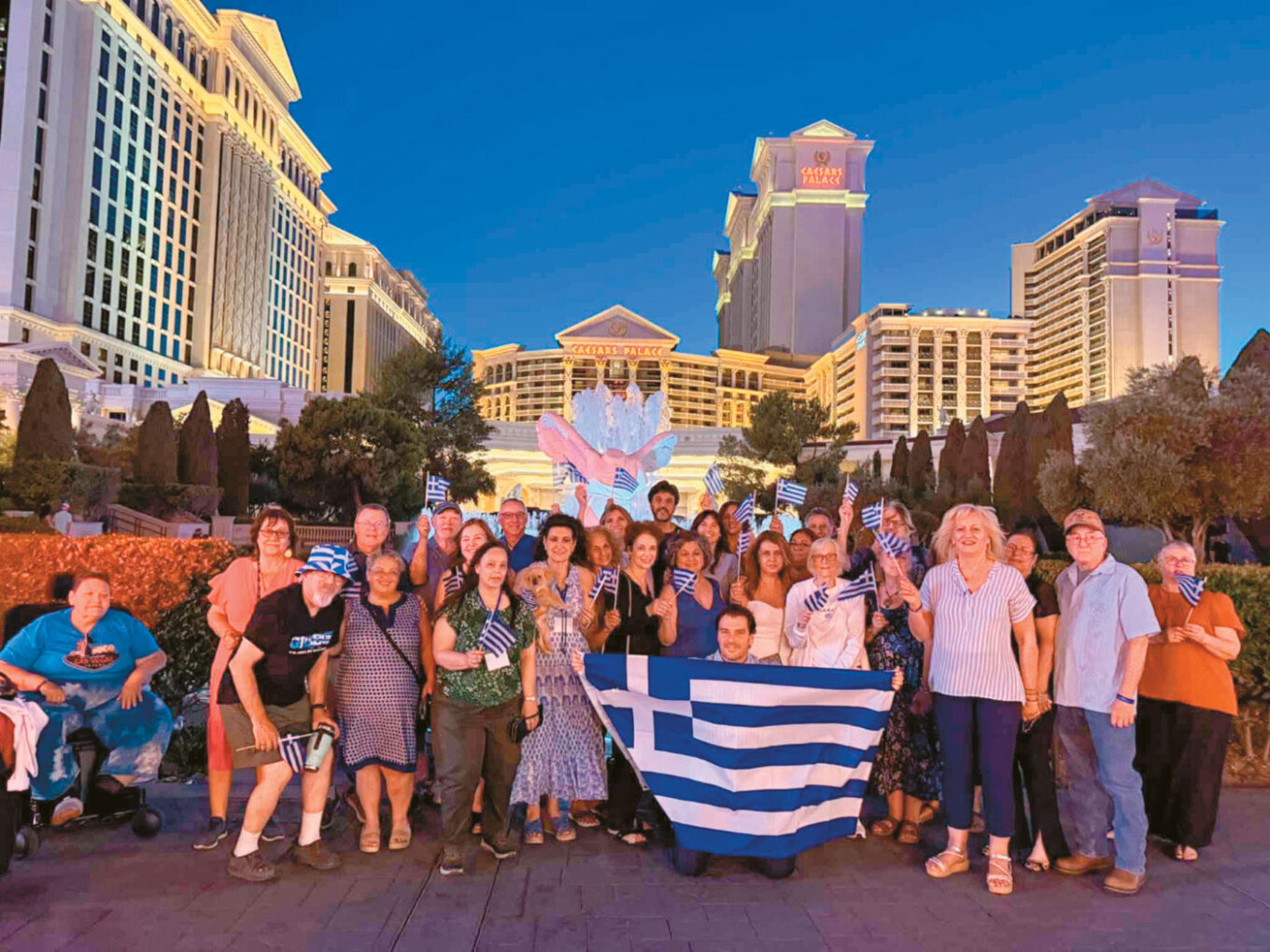
In Las Vegas, 70 adoptees and researchers of their family trees attended, along with their families, spouses, and children. They came from 13 U.S. states, from New York to Alaska.
Many of those children were given up for adoption by their biological parents in hopes of survival and a better future in far-off America. Poverty and hardship pushed parents to give up their children to wealthy families. Others were handed over by relatives after losing parents in the Civil War, leaving them orphans. Some were born out of wedlock, and the social mores of the time could not tolerate it. But many were given away for money—the ugliest form of transaction, where the pain and longing of childless couples were exploited by opportunists.
Networks of lawyers, obstetricians, nurses, orphanage workers, and police facilitated these adoptions in exchange for hefty payments.
On May 5, 1959, The New York Times ran a front-page story about “stolen babies and lost identities: a Greek scandal echoes in New York.” The article reported that former AHEPA president and New York judge Steven Skopas had been arrested on charges of trafficking babies from Greece, selling them to American couples for $2,500–$3,000 per adoption. He was tried and acquitted, but the unraveling had begun.
“About 15% of those children were adopted by Greek-American families,” says Vrysioti. This matters, because those children grew up speaking Greek and within a Greek cultural environment. By contrast, the majority adopted by American families do not know Greek, having grown up with a completely different culture, traditions, and way of life.
The story of Eftychia
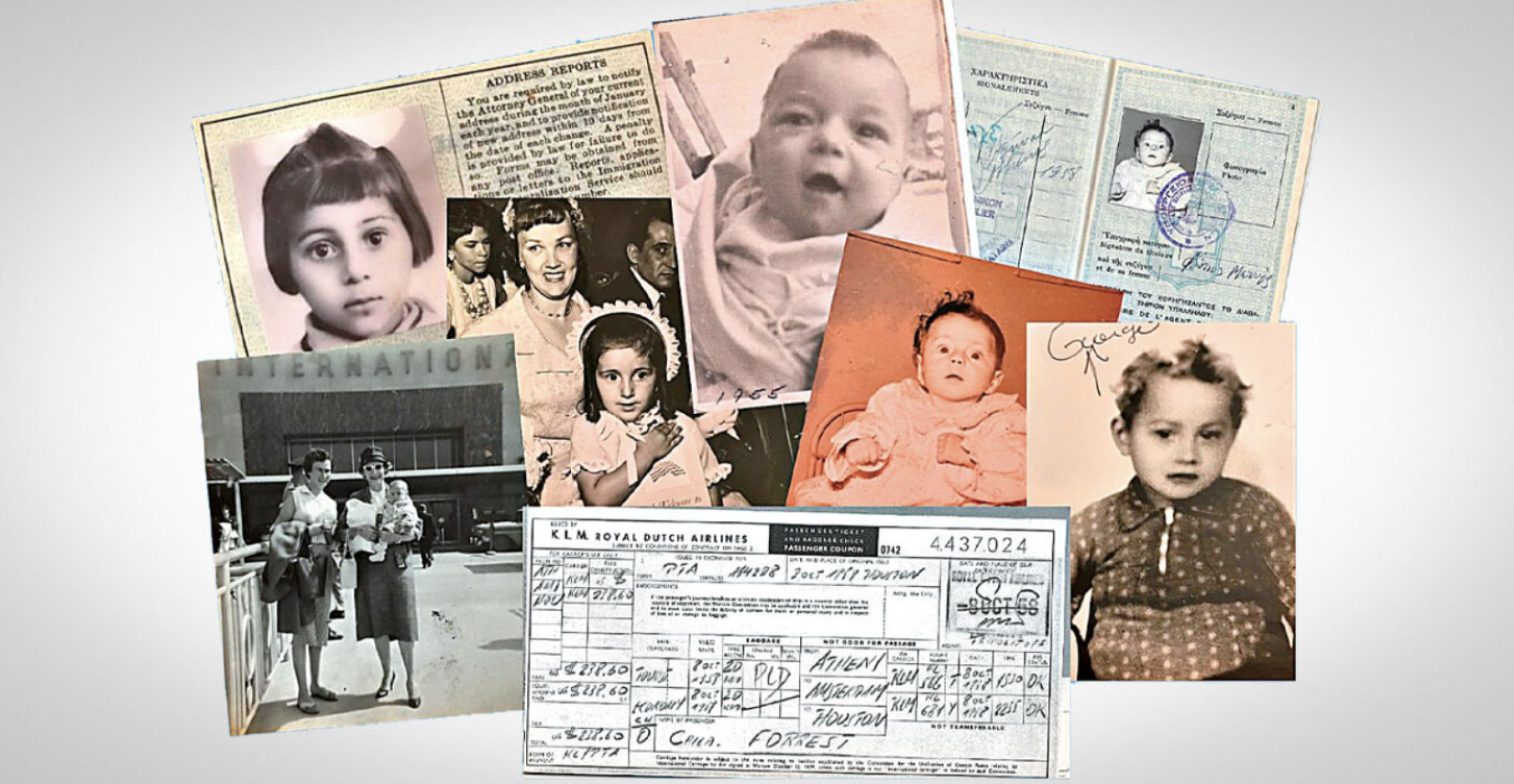
One such case is that of Eftychia Noula herself. She was adopted by a childless American couple who received her at eight months old from the Athens Orphanage. Her biological mother was unknown—her adoptive parents were told she may have died in childbirth. The adoption was arranged by a Greek priest, two lawyers, and an organization called Parents of Greek Orphans (POGO).
Through these channels, 70 to 90 Greek infants were sent to the San Antonio, Texas area at the time. Her adoptive parents, James and Ruth Forrest, told her from the age of two that she was adopted and that her real name was Eftychia. They gave her love, care, and security. She grew up happily, later marrying Bob Trotter, with whom she had two children, Heather and Justin.
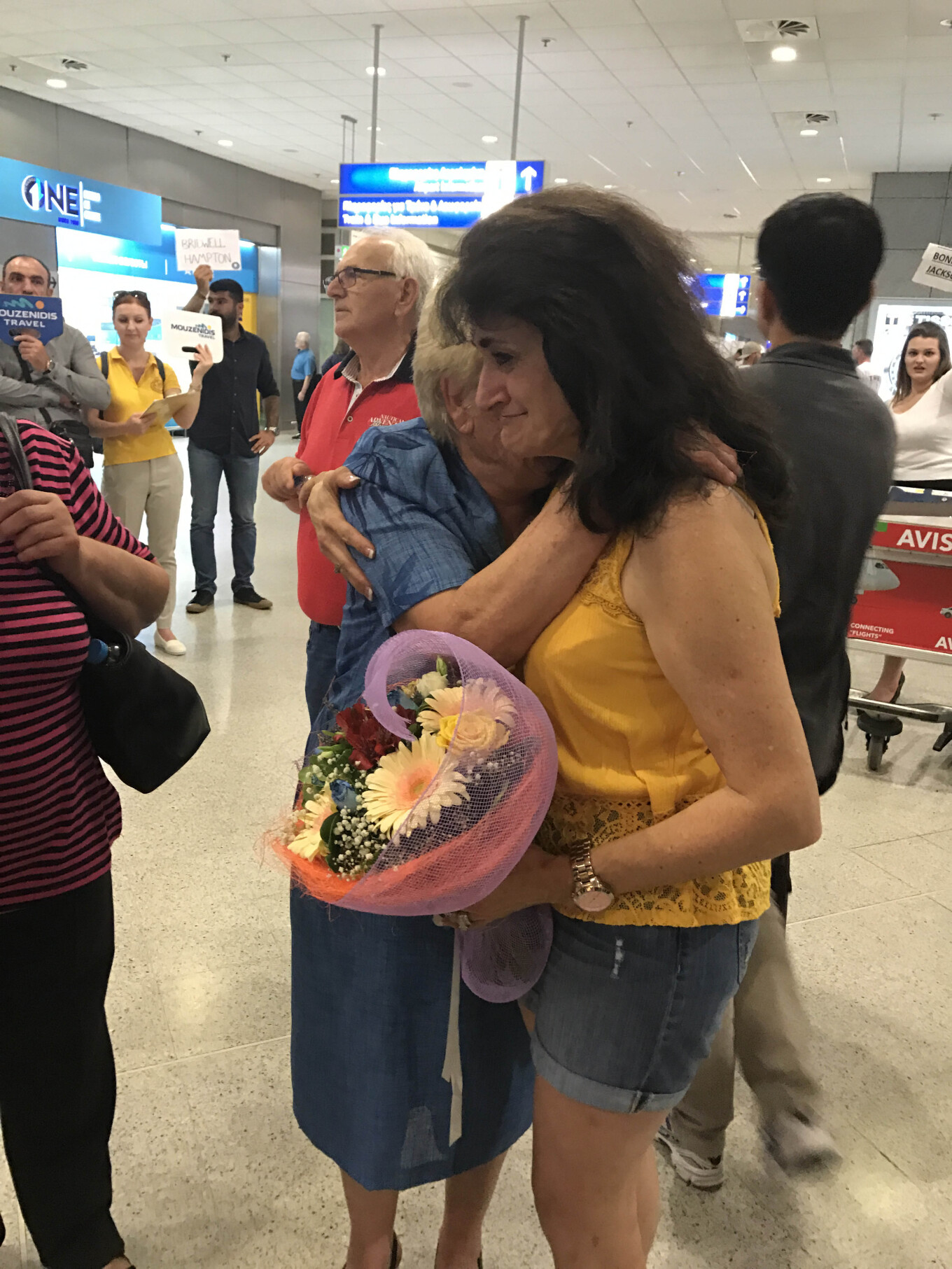
She never lost touch with her Greek identity, but her inner upheaval came in 2015 and 2017, when she successively lost her adoptive parents. That was when she began searching for her biological roots. She uncovered many details, with the help of her lawyer. Most importantly, she learned that her biological mother was named Charikleia Noula and came from the village of Stranoma in Nafpaktia. She found her, and in June 2017 met her in person.
Before that, however, she had already discovered a reality her adoptive parents were unaware of. With the help of Belgian-American professor Gonda Van Steen, she obtained her file from the Athens Foundling Home. It showed that she had been admitted as Eftychia Noula, the illegitimate daughter of Charikleia Noula. Contrary to what the lawyers had told her adoptive parents, she had been handed over to the Greek police not by her mother, but by her godmother—without her mother’s knowledge—clearly aiming for an easy way to “offload” the child.
Since then, Linda Carol—now also Eftychia Noula—has been living about half the year in Greece. She devotes this time to her new family, as well as to the continuous struggle to expand the Eftychia Project, so that more and more adoptees can find their roots. Because the truth is that time is not limitless. The infants adopted during the Cold War are today respectable family men and women, 65 and 70 years old, many already grandparents. Even if their only purpose in life is to discover their biological family tree, time constraints weigh heavily.
“We don’t have the support we need,” say the president and vice president of the Eftychia Project to Proto Thema. In recent days they have been crisscrossing Greece to support the cases of new adoptees. The government did indeed recognize the problem and gave significant help last May with the ministerial decision of Interior Minister Theodoros Livanios, which defined the conditions and requirements for granting Greek citizenship to people entitled to it, since they were born with it and never voluntarily renounced it—others made decisions for them about how they would grow up.
Refusals to release information
In practice, however, many problems remain with local institutions, orphanages, and foundling homes. Many officials refuse to give adoptees access to their own records, citing personal data protection. The problem is especially acute at the Patras Foundling Home, PIKPA, and “Agios Stylianos” in Thessaloniki—an institution already tainted by the 1962 scandal. That December it was revealed that, for 13 consecutive years, a child-trafficking network had been operating inside the municipal foundling home.
The strange “fortification” of staff behind privacy laws is clearly a pretext for refusal. It is inconceivable, to common sense, that the right of any proven Greek citizen to know who their parents are could be challenged—let alone obstructed. On the contrary, representatives of the Eftychia Project report absolute satisfaction from adoptees with the response they receive at the “Mitera” Infant Center.
The billionaires remain silent
Eftychia Noula does not lose hope. Asked what the next numerical target is for reunions, after 39–40 cases, her face lights up. “Four hundred,” she answers with conviction, fully aware of the difficulties each new case entails. The obstacles are serious. It requires great effort and expense, with frequent trips to Greece—because even in the digital age, where electronic communication bridges distances, authorities often demand the adoptees’ physical presence in procedures.
Yet Noula shows her determination and faith in the mission of the organization. She enjoys the support of Greek Orthodox communities across many U.S. states—but not from the wealthy elite. Almost all well-known Greek-American billionaires have received letters from the organization explaining its goals and requesting support. None has responded.
There are also individual challenges in tracing biological families. Special cases arise: twins who, decades ago, were separated and adopted by different families in California were reunited last year. They searched for their biological roots in Greece, but found little, and their mother appeared unwilling to meet them. In another case, an adoptee seeking his family tree discovered a half-brother, who agreed to meet and build a relationship. But their mother refused to acknowledge the child she had given up for adoption. “I feel rejected a second time,” he told Eftychia Project staff in anguish.

The Las Vegas Conference
Eftychia Noula considers the three-day Las Vegas conference—celebrating six years of the Eftychia Project—a success, with “wonderful turnout.”
Seventy adoptees and family researchers attended, along with their spouses and children. The atmosphere was enthusiastic and optimistic. They came from 13 U.S. states, including New York, Massachusetts, New Jersey, and even Alaska. For two of the three days, adoptees participated in “Greek Coffee Hours,” where the board of the Eftychia Project helped participants interpret adoption documents, learn research methods, and navigate reunion procedures.
Special emphasis was placed on DNA testing, supported by the organization, which has proven to be the “key” in accelerating confirmation of biological links and thus reunions. Present also was the organization’s legal team, Tsoromokos & Papadopoulos PLLC, which provided an overview of the new ministerial decision on restoring Greek citizenship to adoptees born in Greece, and answered related questions.
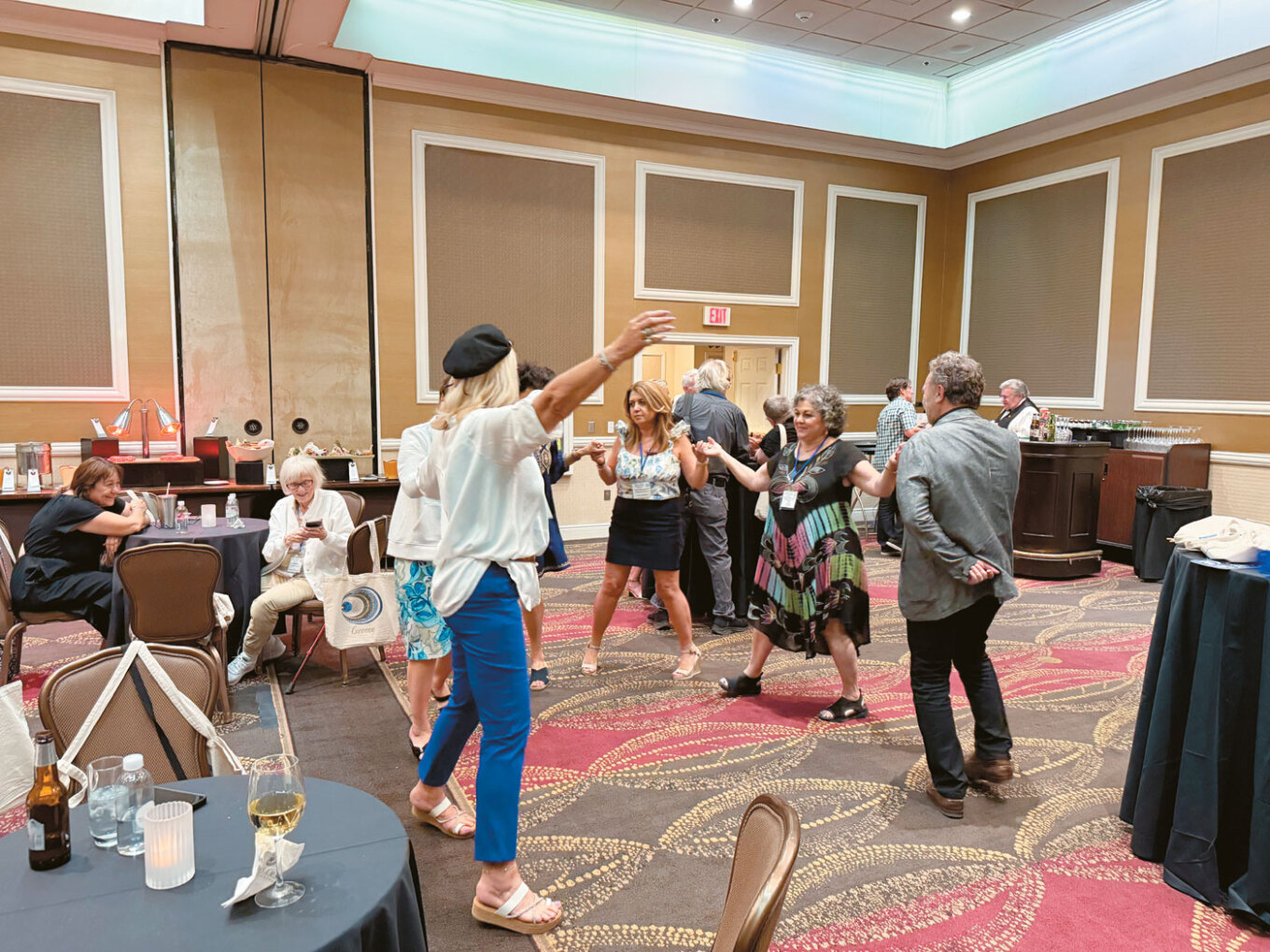
At the Las Vegas conference, enthusiasm was so great that many broke into Greek dances. Bottom right: Eftychia Noula (Linda Carol Trotter) with her biological mother. Her American husband has converted to Orthodoxy and now leads a 35-member volunteer firefighting team in Greece during the summers.
Since the ministerial decision in May, 20 new registrations of U.S. adoptees in Greek municipal records have been completed, with many more expected—also including spouses and children of adoptees.
Mrs. Vrysioti also praised the collaboration with the Hellenic American Project (HAP), directed by Queen’s College professor Nikolaos Alexiou, which keeps alive the history of the Greek diaspora. Present at the conference, Alexiou conducted interviews with all adoptees. The material will be archived at the Library of Congress and shared on the YouTube channels of both organizations.
Next stop: Greece
At the farewell dinner on the third day, an informal poll was held on where adoptees wanted their next gathering. The unanimous decision: in Greece.
This desire did not come by chance. Most participants said that reunions with their biological families had strengthened their wish to return to Greece permanently. If their registrations in municipal records are finalized, relocation becomes a certainty. For Eftychia Noula, this is not surprising.

She knows it from her own life: “I feel 100% Greek and I’m proud of it,” she says. “When I come to Greece regularly, having found my mother and relatives, as the car approaches and I see the Rio–Antirrio Bridge and Nafpaktos beyond, I get a lump in my throat. It’s a wonderful feeling.”
Her husband embraced Orthodoxy, was baptized Eftychios, and they remarried. He comes to Greece every summer. Once the fire chief in Tennessee, he believes Greece still suffers in firefighting. He created a volunteer firefighting team, which began with just two members and now numbers 35. He also provides them with proper equipment, having brought over $1 million worth of gear to Greece. Every summer, he and his team assist authorities wherever fires break out.
Ask me anything
Explore related questions