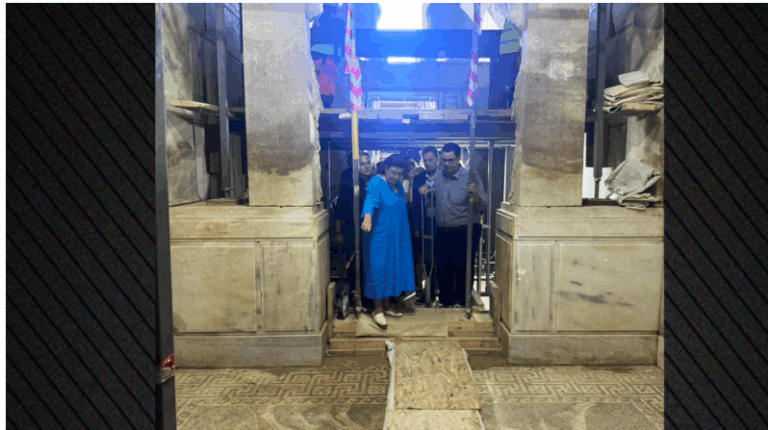
The final phase of the restoration and enhancement works at the Kasta Tumulus in Amphipolis is underway. Minister of Culture Lina Mendoni, who visited the site, stated that all interventions are scheduled for completion by the end of 2027. The construction of the museum and exhibition space, along with visitor infrastructure, is also beginning.
“Our goal remains that by late 2027 to early 2028, the monument will be fully accessible and open to visitors, including those with disabilities,” Minister Mendoni emphasized.
Restoration Works
The project is led by the Directorate for the Restoration of Ancient Monuments of the Ministry of Culture. Works include:
- Restoration and enhancement of part of the enclosure and scattered architectural elements.
- Formation of a walkway around the exterior of the tumulus enclosure.
- Protection and showcasing of the burial pit and the so-called “chamber 4” area.
The two-leaf marble door, previously found fragmented and vandalized in antiquity, will be reinstalled. Its fragments have been conserved by the Directorate for the Conservation of Ancient and Modern Monuments. The door’s reinstatement is technically complex but crucial for restoring the monument’s historical appearance.
Museum and Exhibition Space
The Directorate for Museum Projects, in collaboration with the local Ephorate of Antiquities, is starting construction of the museum and exhibition space along with visitor facilities and paths.
The reception building will be mostly underground, with only its façade visible toward the monument. The exhibition space will connect with visitor pathways around the burial complex, creating an organic integration with the site.
Sustainability and Funding
The design incorporates an energy strategy to minimize environmental impact. The total budget for this phase exceeds €10 million and is funded by the Regional Operational Program of Central Macedonia – NSRF 2021-2027, along with national funds from the Ministry of Culture.
Minister Mendoni, accompanied by Deputy Minister to the Prime Minister Thanasis Kontogeorgis and the Regional Governor of Serres, Panagiotis Spyropoulos, noted that all works are part of the current NSRF program. She added that the exhibition space will provide visitor information using digital and multimedia tools while managing visitor flow, allowing entry of up to six people at a time due to space constraints.
A Monument of Great Historical and Archaeological Value
Mendoni described the burial complex as “an emblematic monument of immense historical and archaeological value that requires a unified, holistic approach — the tumulus, circular enclosure, and burial monument — to ensure its complete protection.”
Deputy Minister Kontogeorgis highlighted that culture is not only history and heritage but also a driver of social, economic, and regional development. He stressed the government’s responsibility, following the Prime Minister’s instructions, to complete key infrastructure for significant monuments like Amphipolis.
Plans are currently being finalized for the construction of a road linking Drama with Amphipolis, with the goal of selecting a temporary contractor and starting the project in 2026.
Site Visit to the Monastery of Timios Prodromos, Serres
After Amphipolis, Minister Mendoni, accompanied by Kontogeorgis, inspected the Monastery of Timios Prodromos in Serres. The Directorate for the Restoration of Post-Byzantine Monuments is carrying out the restoration of the southern fireproof wing’s cells and the Kountiadis building.
The monastery is a 13th-century Byzantine imperial monastic complex. The previous restoration, funded with €1.8 million from the Central Macedonia Regional Operational Program – NSRF 2014-2020, has recently been completed.
Work on restoring the Despotikon building in the same wing, the chapel of the Annunciation, and completing the monastery hospital is ongoing with €2.1 million from the 2021-2027 NSRF, aiming for full restoration of the entire monastic complex.
Ask me anything
Explore related questions