





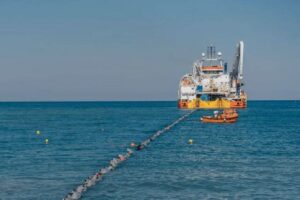
The European Commission’s surprise intervention in recent days on the Crete-Cyprus Great Sea Interconnector (GSI) cable came at a time when Nicosia continues to send signals of distancing itself, insisting that the geopolitical issues surrounding the project’s implementation do not allow for hasty moves.
This contrast reveals an underground conflict: on the one hand, the Greek government and recently Brussels, which sees the cable as a strategic European project with hundreds of millions of euros in funding, and on the other hand, the Cypriot government, which seems to be using the issue of payments as leverage in the wider geopolitical puzzle of the Eastern Mediterranean.
Although the RAEC has already approved €25 million of regulated revenue, the finance ministry refuses to open the payment spigot, considering the project still dead.
In this context, in a statement to Kathimerini of Cyprus, Finance Minister (who has the final OK) Makis Kerynos says the project is not financially viable and cites two studies on it. If the Cypriots withdraw from the project in the end, then ADMIE and French Nexans will have to decide on how to proceed with the project. Already yesterday the Commission reiterated its support for the project, in which it is contributing 650 million.
As newmoney notes.gr at the same time, the Commission is convening successive meetings with RAAEY, RAEK and ADMIE, such as the one held last Friday, August 29, in an attempt to keep the project alive, while the Cypriot side is sending the bill back to the government, knowing that any decision on the cost will first go through the political approval of Finance Minister Makis Keravnos.
“I have before me two studies from independent and serious organisations, which conclude that this project is not viable, under the specific conditions,” Finance Minister Makis Kerynos said in an interview with the Cyprus daily Kathimerini. The minister stressed that “the discussion is taking place because the project is complex with economic, technical, and geopolitical aspects. I would also like to note something else. It has been since 2010 that this project has been discussed, and it is characterized as European as the Commission decided to finance it with 650 million. The question I ask is why the European Commission, which has funds under strict conditions and specific timetables, after so many years, is not asking why this project has not been carried out.”
The President of the Republic of Cyprus, Nikos Christodoulides, in an interview which he gave to protothema in the past few days.gr, hinted that Cyprus will not move without seeing tangible examples of consistency and implementation of commitments by the implementing body, which is ADMIE. At the same time, he attempted to send a message of balance, stressing that there is a common understanding with Kyriakos Mitsotakis on the European importance of the project. But the reality shows that Athens and Nicosia are not on the same wavelength.
This, at a time when Athens is floating scenarios for restarting research activities in the Eastern Mediterranean, after their violent interruption last year due to tensions with Turkey in Kassos. Scenarios that Nicosia views with scepticism, knowing that Ankara is not going to let the energy scene evolve without reactions.
Yesterday, the Commission’s energy spokeswoman, Ana Caiza, was clear: the project is not only a European priority, but also a geopolitical tool for the EU’s energy security, showing the pressure she is trying to exert on the project.
He even reminded that 657 million euros have already been allocated from the Connecting Europe Facility and an additional 100 million euros from the Recovery Fund, making it clear that Brussels expects timetables to be met.
Nicosia, however, seems to be playing a double game: on the one hand, it cannot ignore European political commitment; on the other hand, it knows that the project is not “technical” but heavily political, with Turkey already sending signals of obstruction.
In essence, the Cypriot government’s stance reflects the dilemma of a country that, while wanting to remain at the heart of European energy plans, does not want to become the first victim of a new regional tension.
Ask me anything
Explore related questions




