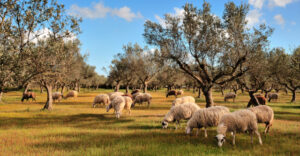
Greek sheep and goat farming is on the brink of a lockdown, as smallpox spreads from region to region like dominoes, wiping out entire herds. Already, in just thirteen months, since last August, nearly 263,000 sheep and goats (over 3% of the declared population) have been slaughtered, with cases confirmed in 24 prefectures—almost half the country. If this wave of outbreaks is not stopped, the danger of further spread is significant. Complicating matters, healthy herds from mountainous areas of Epirus and Grevena are set to move to the lowlands ahead of winter, where infection hotspots already exist.
Faced with this situation, the Ministry of Rural Development yesterday declared a “ten-day war” to contain and control smallpox and avoid a lockdown, though hopes of success are slim. Meanwhile, hundreds of farmers whose herds have been wiped out are left without income for a long period—they must buy new animals and wait through a full breeding cycle before generating income again from milk and meat. Many will not attempt to rebuild their herds, instead seeking new livelihoods outside the primary sector.
At the same time, vaccination is not considered an option, since it would endanger Greek feta cheese exports, expected this year to bring over one billion euros into the country. Most markets close to products from countries with vaccinated animals. In addition, vaccines come from third countries such as Pakistan or Turkey, where smallpox has persisted for years.
Another factor is the growing export of goat meat in recent years, both to European countries and to Muslim markets in standardized form. According to the Deputy Regional Governor for Agricultural Economy of Central Macedonia, Giorgos Kefalas, available vaccines provide only about 60% immunity, meaning the risk of infection and herd extermination remains high, while it is also impossible to distinguish between vaccine reactions and disease symptoms.
In yesterday’s meeting, chaired by the Minister of Rural Development Kostas Tsiaras and attended by regional governors, other aspects of the crisis were discussed. One issue raised was the need to preserve genetic material from indigenous sheep and goat breeds, such as the Kalarrytiko and Karagouniko, to prevent their loss. The meeting stressed that this outbreak—an exclusively animal disease not transmissible to humans—is “unusually large” and its causes must be investigated. Possible explanations include a virus mutation or concealment of cases, leaving active infection sites that fuel the spread. At the European level, a temporary suspension of live animal transit—e.g., from Romania to Albania via Bulgaria and Greece—is expected to be requested.
In the coming ten days, intensive surprise inspections will be carried out on livestock facilities, while measures that should already be obvious are being emphasized: biosecurity practices such as disinfecting vehicles moving between farms (for milk or feed transport), and the use of gloves and shoe covers by those moving between herds.
According to the ministry’s plan, approved unanimously, the next ten days will see: veterinarians deployed in the field, intensified on-site inspections, and campaigns to encourage farmers to apply biosecurity measures. Disinfection stations will also be set up immediately on main roads and key animal and feed transport routes. Inspection teams will operate continuously to ensure full enforcement.
As stressed in the meeting, this is a “ten-day offensive” with the full mobilization of ministry staff, aiming to immediately halt the spread of smallpox.
During his remarks, Minister Kostas Tsiaras clarified that this is an animal disease not easily contained, so no resources can be spared in the fight. He emphasized the need to establish a strong framework to combat the disease, and reinforced that biosecurity must be strengthened, warning: “Otherwise we will be faced with a lockdown.” He added: “At this point we must all cooperate. The regions, which have the authority to enforce measures, and all stakeholders, must adopt a completely different mindset to confront smallpox. This is a joint effort to close this outbreak cycle together.”
After the meeting, Tsiaras stated:
“As you know, we have been facing smallpox for a long time, which poses a great threat to the country’s livestock. We held a broad meeting with the participation of regional governors, deputy governors, and others via teleconference, in order to coordinate joint actions to contain smallpox as quickly as possible. In our discussion, all relevant issues were raised, and we identified the areas that need to be highlighted for the best possible outcome.
We therefore jointly decided, mainly along specific lines: to mobilize all resources of the Ministry of Rural Development—especially veterinarians—so that over the next ten days, with their on-site presence and in cooperation with local authorities, they intensify inspections and encourage farmers to adhere to biosecurity measures.
Secondly, to establish disinfection stations on key roadways, especially in the regions currently affected. And thirdly, to create, through disinfection procedures, a system of certification so that farmers can deliver milk while ensuring biosecurity measures.
Other issues discussed included quarantining imported animals to minimize the chance of introducing the virus, as well as providing farmers with disinfectants through the regions to strengthen biosecurity as much as possible.
I believe we are on the right track, and with the cooperation of all regional governors—whom I personally thank—and with everyone’s contribution here at the Ministry of Rural Development and Food, we will make a significant step forward to tackle an animal disease with serious difficulties and peculiarities.”
Ask me anything
Explore related questions