





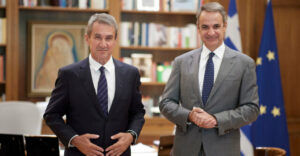
The integration of former PASOK government minister Andreas Loverdos into New Democracy was considered by political circles as almost a given. Mr. Loverdos himself had said that he would make a political comeback in September, his party Democrats had essentially ceased operating, while Kyriakos Mitsotakis, since mid-June and during the ND Political Committee meeting to elect Kostas Skrekas as the party’s secretary, was already speaking about further broadening the governing party.
“From the very beginning, Mr. Mitsotakis has remained faithful to the logic of broadening ND’s base in both directions,” government officials stress, reminding that the large majorities of 2019 and 2023 would not have been achieved without the support of voters who were not traditional ND supporters. Of course, the current context is not the same as in 2023, and Mr. Mitsotakis himself has shifted back to the logic of party “orthodoxy,” as the recent March reshuffle showed. Still, he does not want to abandon his long-standing ties with the political center, something also reflected in bringing in Mr. Loverdos.
The background of the approach
Mr. Loverdos and Kyriakos Mitsotakis did not meet yesterday; after all, they both served as ministers in the Samaras–Venizelos government. For those with good memory, they even clashed in the summer of 2014 over university staff dismissals, when Mr. Mitsotakis was Minister of Administrative Reform and Mr. Loverdos Minister of Education. Time softened those tensions, and Mr. Loverdos appeared increasingly close to ND. He supported the government during the Tempi tragedy period, while during the OPEKEPE case he backed the formation of an Inquiry Committee rather than a Preliminary Investigation Committee for Makis Voridis and Lefteris Avgenakis.
According to information from protothema.gr, on the afternoon of the cabinet reshuffle last March, Mitsotakis and Loverdos spoke on the phone and a few days later met in person. They agreed in principle but decided to re-examine the situation after the summer break. In that meeting, they also discussed the “arena” of South Athens’ Second Constituency, where many “heavyweight” ND figures run, but Mr. Loverdos appeared determined to “make the move.”
They spoke again at the end of August, sealed the agreement, and decided to announce it after the Thessaloniki International Fair (TIF) cycle. It is telling that, while Mr. Loverdos and his close associates were heading to the Maximos Mansion for the official photos, a colleague from his law office was simultaneously submitting papers to the Supreme Court for the suspension of his party’s operations.
The right-wing agenda
Although Mr. Mitsotakis believes that ND can and should continue with an “open doors” policy, there are party officials who are concerned about “how much PASOK ND can absorb.” To this, government insiders counter with the “right-wing agenda” being pursued on a number of issues, which they believe resonates with citizens holding patriotic concerns — the traditional backbone of ND, who might otherwise look elsewhere.
A telling example is migration management, to be discussed in today’s KYSEA meeting (11:00), given the new surge of arrivals in Crete. By Friday, migrants will have been transferred to mainland facilities, while it remains to be seen whether the suspension of asylum applications — expiring on October 11 — will be extended for at least another month. Reportedly, Migration Minister Thanos Plevris is recommending an extension.
Similar moves are underway in defense procurements, with options on the table including acquiring another Belharra frigate and purchasing two Italian Bergamini frigates. All this just days before the prime minister’s new meeting with Recep Tayyip Erdoğan and Greece’s hard stance on Turkey’s potential inclusion in the European SAFE program.
The “formers” and stability
It remains to be seen how strongly Mr. Mitsotakis will persist with “openings” and references to former prime ministers in tonight’s interview on ANT1’s main news bulletin, where his main goal is to detail the measures he announced at TIF. In that context, his answer about post-election scenarios will also be of interest, since in Thessaloniki he was not categorical about ND’s need for outright majority rule.
Yesterday, however, at a Hellenic Corporation of Assets and Participations (HCAP) event, he emphasized the political stability that stems from a single-party government. “In 2023, the citizens rewarded us by giving us a new mandate. This, I believe, sets us apart from many other European countries, where coalition politics can be very complicated,” he said meaningfully.
Ask me anything
Explore related questions




