





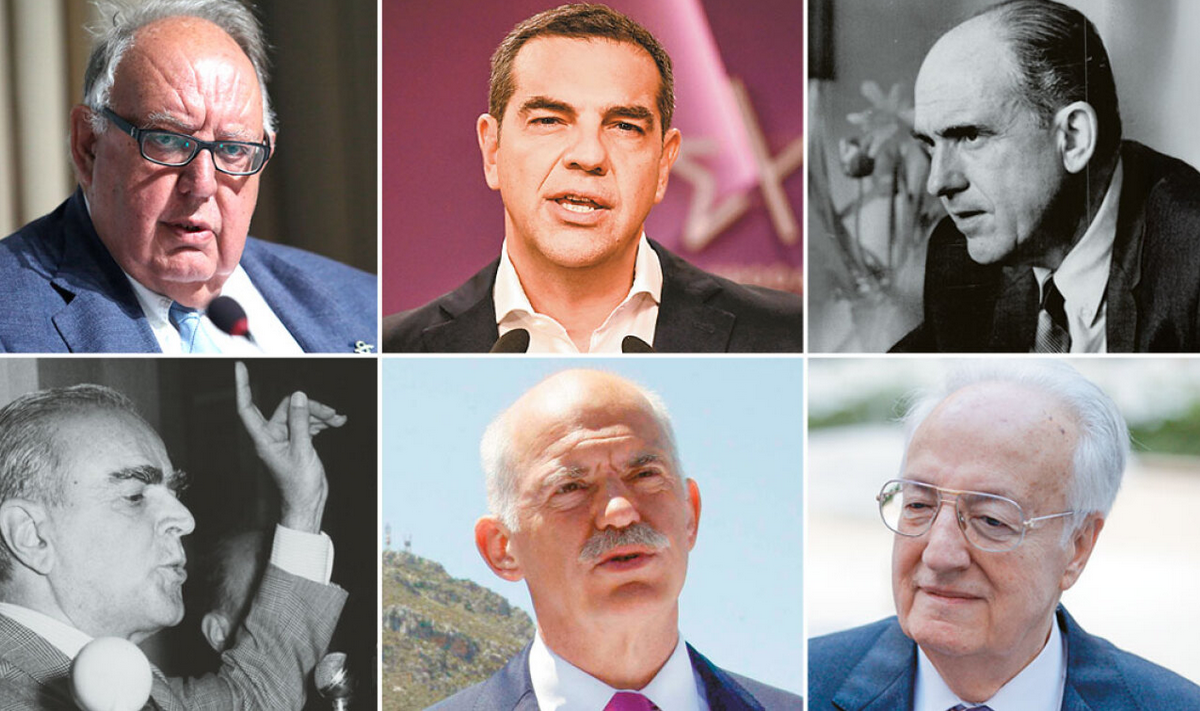
There are moments or circumstances in which a phrase – even a simple one-liner from a political leader – manages to capture the message of an entire era, to describe the pulse of society, to condense the beliefs, desires, and needs of a nation. And we’re not speaking only of monumental phrases, such as Winston Churchill’s radio address — “We shall fight everywhere, on the beaches, the fields, the streets, the hills… we shall never surrender” — which forged the patriotic and combative spirit of the British people ahead of the Battle of Britain in the summer of 1940.
But also of more “earthly” ones, such as those that have marked the 51 years of Greece’s post-junta political scene. From Konstantinos Karamanlis’s “We belong to the West,” which ended the fierce questioning of Greece’s geopolitical orientation in the early years after the dictatorship, to Andreas Papandreou’s “Sink the Hora,” laden with behind-the-scenes intrigue. To Georgios Rallis’s pioneering-for-its-time “I don’t want any no’s,” and Andreas Papandreou’s “Tsochatzopoulos, give it all,” the emblem of a populist politics of uncontrolled handouts. And the more recent “There is money” by George Papandreou, which misled Greek society while the economy had already run aground.
“We ate them together”
So too with Theodoros Pangalos’s “We ate them together,” a controversial observation, interpreted by some as a truth — whole or partial — that Greek politicians, and by extension the Greek people, had never had the courage to admit, but by most as yet another attempt by a floundering political system to dodge responsibility and shift blame onto the entire citizenry.
It was September 21, 2010. Five months after the Kastellorizo announcement, as society seethed over the responsibilities of politicians in general, and of the PASOK government in particular, struggling to face the storm of austerity measures accompanying the first bailout memorandum. During a debate in Parliament’s Public Administration Committee on a bill abolishing and merging public services, organizations, and bodies — a core demand of the lenders — the then–Deputy Prime Minister in George Papandreou’s government uttered the landmark phrase:
“The answer to the outcry against the country’s political class — ‘how did you eat all the money?,’ as people ask us — is this: ‘We appointed you. We ate it all together. Within the framework of a relationship of political patronage, corruption, bribery, and the debasement of politics itself.’”
The claim of shared responsibility sparked a wave of reactions across the political spectrum, in the media, and of course among citizens. Pangalos was accused of hypocrisy, of attempting to absolve politicians of their long-standing mismanagement of public money, and of unfairly shifting the blame onto the people. Yet there were also those who credited him with boldness, for exposing another, not-so-innocent aspect of the causes behind the severe economic and social crisis that had struck the country.
He stuck by his words and later even turned them into a book. In his 2012 e-book We Ate Them Together, he further developed his reasoning:
“The phrase ‘we ate them all together’ means that a large part of us — the Greek people — participated, one way or another, in irrational practices and behaviors over time, regarding state expenditures and revenues. What we call a ‘fiscal crisis’ is also our own creation… Citizens, either through their actions, through their guilt-ridden inaction, or simply by electing unsuitable politicians to manage public affairs, participate collectively in democracy and bear responsibility for their choices.”
He went on to accuse the Left of never opposing hirings, salary increases, benefit schemes, strikes, etc., but rather of always demanding additional handouts. He also invited citizens to contribute personal testimonies of similar situations to complement his book.
He paid dearly
He paid very dearly for that phrase. He became the target of the opposition, while extremist activist reactions from certain citizen groups — even with the participation of parliamentary parties — focused on him personally. He was attacked even during private outings, his life became… unbearable. Eventually, he was forced to withdraw from the political stage. In the snap elections of 2012, he was not a candidate. The full truth, however, is that from September 21, 2010, the issue of acknowledging society’s and citizens’ share of responsibility in the actions and failures of any government was no longer a taboo.
A parenthesis: one of the countless sharp remarks in Pangalos’s tumultuous, decades-long political career nearly caused a diplomatic incident between Greece and Germany. On the way to the Corfu EU Summit in June 1994, in an aside during a public forum, he stated that “Germany is an economic giant, but a political dwarf.” He later claimed it was a distortion by journalists of a comment in which he compared German policy in the Balkans, and especially in Croatia, to Rabelais’s Gargantua — a very powerful giant with the mind of a small child.
His explanations did not convince Chancellor Helmut Kohl, who publicly demanded an apology from the government of Andreas Papandreou, then also presiding over the European Council. Naturally, Pangalos withdrew the remark and apologized. But years later, during the bailout ordeal, many Greeks felt he had been absolutely right about Germany back then.
George Papandreou
The bailout years, as well as the period immediately preceding them, were rich in phrases by leading politicians that left their mark — though usually not for good reasons.
Ten days before the European elections of June 7, 2009, the then-rising PASOK leader George Papandreou, in a press conference at Zappeion, presented the public with the central dilemma both of that election and of the snap national elections that followed four months later, on October 4: “We either change or we sink.”
The dilemma, however, was not vindicated by events. Voters listened to George Papandreou, did change the political landscape, and made him prime minister — but Greece sank. Since then, the phrase has been entrenched in Greek political vocabulary whenever a leader wants to underscore the weight of a critical, binary choice.
Of course, it also took one more monumental phrase of his to sabotage his own future prospects and at the same time fling the country wide open to the path of the bailout memoranda: the famous “There is money.” He declared it from the podium of the Thessaloniki International Fair during the election campaign, and it became the ideal weapon for his political opponents in his later complete discrediting.
He insists to this day that what he meant was: “There is money, if we tackle tax evasion, lack of transparency, cronyism, closed professions, waste, and bureaucracy that obstruct healthy investment and initiative.” He wonders if anyone could truly disagree, blaming opportunists for twisting his words. In any case, he irreparably damaged his own political capital.
And Alexis Tsipras
This was something Alexis Tsipras himself did not avoid, ahead of the January 2015 elections, with the momentum of being the favorite for the premiership. On May 2, 2014, under the Samaras–Venizelos government and during Angela Merkel’s visit to Athens, the then–leader of the opposition, carried away by anti-bailout fervor, proclaimed at a SYRIZA rally in Mytilene the “glorious”:
“Go back, Mrs. Merkel, go back, Mr. Schäuble.”
And the accompanying:
“Go back, ladies and gentlemen of Europe’s conservative nomenclature. Greece is not a guinea pig. Go back along with your troika, your usurers, your harshness, your arrogance, your contempt for the Greek people, who have become the object of your mockery and exploitation.”
Since then, much water has flowed under the bridge. History retained indelibly the first eight words. Tsipras, after a painful delay as it turned out, ended up as prime minister surrendering to the European partners — at the price of a third bailout, extremely harsh for the Greek people and, according to many, unnecessary. He evolved into the one who, with remarkable effectiveness, implemented the very policies foreseen in it, the same policies he had previously rejected. A few years later, he would even welcome Merkel to Athens with joy and gratitude.
These “revolutionary outbursts” in Mytilene, and those that followed on December 12, 2014, at SYRIZA’s Regional Conference in Heraklion, Crete — with early elections already appearing inevitable — were what seriously damaged his credibility in matching words with deeds. He warned Europeans and markets then:
“Some think that the markets will be beating the drum and we will dance to their tune. Well, from now on, we will play the drum, or rather the Cretan lyra, and they will dance the pentozali.”
Things, however, did not turn out that way, and roles were reversed along the way. Later, he admitted that he had illusions — both about negotiating with the Europeans during his first six months in power and about the stance of the markets, which punished Greece severely.
4+1 Phrases of Konstantinos Karamanlis
Konstantinos Karamanlis and Andreas Papandreou were towering figures in Greek political history of the second half of the 20th century. Some of their statements not only went down in history but remain relevant even today, frequently recalled in public political debate.
Karamanlis had a deeply developed sense of responsibility toward the country and its people. He preferred to act, to proceed with prudence, and not to talk excessively. The political style that best suited him was described by none other than himself in February 1975 before Parliament:
“In politics, there are things that happen without being said, just as there are things that are said without ever happening.”
On August 23 of the same year, the Five-Member Court of Appeals of Athens sentenced to death the trio of leaders of the April coup (Papadopoulos, Pattakos, Makarezos). The following day, the Council of Ministers commuted their sentence to life imprisonment. On the 29th of the month, addressing dozens of officers after the “Ptolemaios” exercise, Karamanlis uttered the unforgettable phrase: “When we speak of life sentences, we mean life sentences.” Thus closing the matter once and for all. In October 1975, he stated in Parliament that he had earlier (June 12) submitted the request for Greece’s full accession to what was then the EEC, responding to the fact that the government, “interpreting the sentiment of the vast majority of the Greek people, declared from the very beginning that our country belongs to the West and specifically to Western Europe.” The phrase “we belong to the West” became the hallmark of his confrontation with Andreas Papandreou over the country’s geopolitical and economic orientation, until the PASOK leader eventually backed down.
Much later, regarding the unprecedented political turmoil at the beginning of 1989, now retired from politics, he delivered a terse phrase that also remained in history: “The unprecedented events taking place lately in our country create the impression that Greece has turned into a vast madhouse.”
Karamanlis had given similar examples earlier. Three days after the night of May 22, 1963, and the fatal injury of EDA MP Grigoris Lambrakis in Thessaloniki by paramilitaries in the presence of dozens of gendarmes as passive observers—and while the Balkan champion was kept alive by mechanical means—he demanded explanations from the then head of the Intelligence Service, Alexandros Natsinas: “Many things have happened lately without my knowledge… I want to know, Mr. Natsinas, who governs this country, after all?” The message was sent in all directions.
The “Hora,” the handouts, and the dramatic prophecy
On August 6, 1976, the Ecevit government violated Greek territorial waters northeast of Lesbos with the oceanographic vessel Hora, challenging Greek sovereignty under the pretext of research. The two countries came to the brink of war. The memories of the Turkish invasion of Cyprus were still fresh.
The Karamanlis government decided to appeal to the UN Security Council and, at the same time, to make a unilateral application to the International Court of Justice in The Hague, even though it would have no binding force since it required a joint submission with Turkey. At the same time, Andreas Papandreou, then leader of PASOK, in the role of minor yet fierce opposition, made the historic statement urging the government: “Sink the Hora.” Of course, had that happened, military confrontation would have been certain—with unknown consequences.
Later, in a parliamentary session on May 23, 1980, Papandreou, now leader of the main opposition, claimed that he had been in communication with Karamanlis and that the phrase was spoken for reasons of high national interest: to strengthen the international bargaining position of the prime minister and the country.
He said, “I am unfortunately bound and not in a position to speak, because I respect common decisions on critical issues,” drawing thunderous applause from PASOK MPs. Former prime minister Panagiotis Kanellopoulos intervened in the debate, confirming Papandreou. However, Karamanlis’s long-time close associate, Petros Molyviatis, much later in 2002, refuted this claim, saying that there had been no prior coordination between the two men. Karamanlis himself never confirmed, nor denied, anything.
Regardless, the “Sink the Hora” statement eventually took on mythical proportions in the collective consciousness of Greeks and, nearly half a century later, for the nostalgics of the PASOK founder, it remains synonymous with resolve and decisiveness. For others, it was simply an adventurist but dangerous remark. For the record, his exact statement was: “Since our borders are being violated, why didn’t the government give an immediate Greek response to the Turkish provocation? Why didn’t it sink the Hora?” It was not, in fact, strictly exhortative.
Much later, on April 20, 1989, during a stormy pre-election period centered on the Koskotas scandal and the Papandreou–Liani affair, the then prime minister uttered at a PASOK rally in Peristeri yet another phrase that would cause a stir: “Tsocholas, give it all.” At the time, it was regarded as the slogan for expanded handouts after the end of the two-year austerity period under Simitis’s ministry (November 1987), with Dimitris Tsocholas as finance minister.
Tsocholas himself, however, gave a completely different version of the phrase. He argued that it had nothing to do with benefits, since he had reduced state spending by 4 percentage points in the first half of 1989, but that it concerned the battle to vindicate the party in the Koskotas scandal, where he had spearheaded efforts to dismantle the conspiracy. In the collective consciousness, however, the phrase was imprinted with the first interpretation.
A third, less publicized but profoundly prophetic phrase of Papandreou’s was included in his speech to his Cabinet on December 2, 1993. Painting the country’s finances in dark colors, having assumed governance just two months earlier, he concluded with a nightmarish remark: “Either the nation will eradicate the debt, or the debt will eradicate the nation.” It nearly came true in a dramatic way 16–17 years later. Many, however, accuse him that his first eight-year administration was what opened Pandora’s box for the explosion of the debt.
Christos Sartzetakis
Although Konstantinos Karamanlis, Kostis Stephanopoulos, and Karolos Papoulias were particularly popular as Presidents of the Republic, history has recorded a phrase by Christos Sartzetakis: “We Greeks are a brotherless nation.” He voiced it at Easter in 1985, just a few days after his turbulent election, when he visited a military camp in Megalo Pefko to extend greetings to the personnel. He added: “There are no related nations to us, in contrast to other peoples, who are not alone but have kindred nations, such as the Slavic peoples, Arabs, Anglo-Saxons, Latins, etc.” He wanted to stress that Greeks, having no kindred nations, must rely on their own strengths.
It was the new President’s first unscripted statement. Faithful to this conviction, Christos Sartzetakis—formerly also the investigating magistrate in the Lambrakis case—sent in February 1994 a 7,234-word letter in impeccable katharevousa and polytonic script to the editorial board of the magazine Ellopia to support his view. Few may have read it. What is certain is that the three words “we are a brotherless nation” remained deeply engraved in the minds of, perhaps, all Greeks.
The “Bairaktaris”
Seven months minus one day into his tenure at the Maximos Mansion as prime minister, on October 6, 2004, Kostas Karamanlis decided to open a front against vested interests during a meal with New Democracy MPs at the famous Bairaktaris taverna in Monastiraki: “It is not possible for five pimps and five guilds to dominate the political life of the country. The country can only be governed if certain rules are put in place,” he is said to have told them amid food and drink.
Later, the then-government spokesman, Theodoros Roussopoulos, denied that the prime minister had used the word “pimps,” while circles close to Maximos insisted that the essence of the statement was accurate. That is, Karamanlis wanted to send the message that he would not tolerate vested interests, which, according to him, obstructed the government’s work, and that he was determined to confront them—as well as the guilds. At that time, the government had raised the issue of the “main shareholder” law regarding television channels, provoking intense reactions from media owners.
A Different Ethos
Another “blue” former prime minister, Georgios Rallis, surprised everyone during his election campaign in 1981. With Papandreou’s PASOK on the verge of a triumphant victory, he asked the crowd at his speech in Heraklion, Crete, to stop booing every time he mentioned the main opposition: “I don’t want boos,” was his emphatic demand, which he had to repeat several times, as the audience initially froze and did not comply. Eventually, however, they broke into applause, embracing his high-minded and unprecedented for the era display of political civility. The same scene was repeated at his final campaign rally on October 16 in Athens.
The Simplest Statement
Melina Mercouri was one of the very few PASOK officials who, even during Andreas Papandreou’s heyday, could freely express her opinion to him without constraints or reservations. She had earned that privilege. Thus, when in the PASOK of successive electoral defeats to Mitsotakis’s New Democracy in 1989–1990, party members sought the causes in alleged underground deals between publishers, business interests, and internal conspirators against Papandreou, Melina chose a very simple way to express her view at the Central Committee meeting in Anavyssos, where PASOK showed its first signs of division: “President, we just don’t appeal anymore!” So simple. A phrase that, in depth and value, perhaps surpassed all the pompous analyses and theories of the party’s “bigwigs” at the time. And ever since, many politicians and government officials often recall it to show that the people no longer trust their leadership.
Evangelos Averoff
“Any sheep that leaves the fold is eaten by the wolf,” said Evangelos Averoff in September 1985, when Kostis Stephanopoulos left New Democracy along with nine other MPs to found the Democratic Renewal (DIANA) party. His phrase became proverbial, spreading and being widely used in the following years in public political discourse to describe the bleak political prospects of anyone seeking a path outside a central political formation. It was confirmed in countless cases.
Since then, it is always brought up in every party split by those who remain, as a warning to those who depart. Averoff, however, had simply revived an earlier phrase of his, which he had used on March 1, 1958, when Georgios Rallis, Minister of Public Works and Transport, and Panagis Papaligouras, Minister of Commerce and Industry, resigned from Karamanlis’s government and became independent of ERE. He warned them then and was vindicated. Together with Stephanos Stephanopoulos, they founded the Union of Popular Parties. In the May 1958 elections, they received only 2.95% of the vote, electing four MPs, while ERE, with 41.16% and 171 MPs, had an outright majority. Rallis and Papaligouras later returned to ERE, were re-elected in the 1961 elections, and went on to become ministers again.
Ask me anything
Explore related questions




