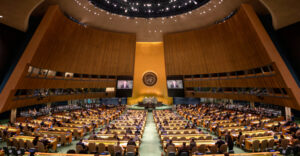
The start of today’s anniversary 80th UN General Assembly is marked by a wave of recognition of the Palestinian state as the major two-state recognition conference co-chaired by France and Saudi Arabia will take place in New York City at the international body’s headquarters in the evening (Greece time).
Britain, Australia, Canada, Canada, and soon France and Belgium are among the countries that will join the remaining 147 out of a total of 193 UN member states that recognize the Palestinian state unilaterally declared by the PLO in 1988.
A move which has high symbolic significance, sends strong messages to Israel, but in practice has little effect. These countries are now reacting to the ongoing and worsening humanitarian disaster, attempting to appease their public opinion as the Free Palestine movement is now taking on mass proportions, upending and replacing the antisystemic movements of the previous twenty years, and at the same time trying to stand up to the Arabs, who remain the big investors in most Western countries.
But even if almost all UN member states recognize the Palestinian state, it will not become a full member of the UN without a decision by the Security Council, where the US exercises veto power. Palestine has observer status at the UN but no voting rights.
The US, as well as several other mostly European countries, support the two-state solution, but insist that it must come about as a result of an agreement between Israel and the Palestinians. Lately, however, this prospect has been undermined, as the Israeli leadership and the Benjamin Netanyahu say they will not abandon security in the West Bank and Gaza into the hands of the Palestinians, effectively rejecting the two-state solution and thus exacerbating the stalemate.
The countries now rallying, though traditional allies of Israel, to recognize the Palestinian state believe the move will put strong pressure on Netanyahu to stop the bloodshed and human catastrophe in Gaza and to set the stage for the resumption of talks, which, however, does not seem to be in sight.
Instead, however, the message Netanyahu has sent to the Americans is that the more the recognition of the Palestinian state is pushed, the more it becomes necessary for him to expand the operation against Gaza, as well as to establish a fait accompli in the West Bank. And yesterday he was quick to declare that there will never be a Palestinian state…
The Palestinian Authority, recognized as the competent and legitimate representative of the Palestinians, is severely weakened, not only in Gaza but also in the West Bank, and its ability to credibly represent the Palestinians in talks with Israel is questioned, as it does not even control the areas still under its jurisdiction. The US, in a highly unusual move, denied entry to Mahmoud Abbas, the president of the Palestinian Authority, who addressed the General Assembly via teleconference. After all, it was the first Trump administration to move the embassy to Jerusalem, stirring up opposition from Arabs who do not recognize Jerusalem as Israel’s capital.
Without control over its borders and without the presence of foreign embassies on territory controlled by the Palestinian Authority, it is more of a rubber stamp. It is Israel that controls the movement of goods into the Palestinian territories; there are no Palestinian-controlled airports, and communication with the outside world can only take place through Israel, as even the border with Jordan is controlled by Israeli forces.
Israel will find itself in an extremely precarious position at the UN General Assembly, as on the 80th anniversary of the founding of the UN, at a time when the Holocaust was the great dark spot in the history of World War II and has since sealed the consciousness of the post-war world, it now finds itself “accused” by most of the international community of “genocidal” operations against the Palestinians. And it is, of course, with the operations of recent weeks, putting the countries that supported it and continue to maintain channels of communication with it in an extremely awkward and embarrassing position.
Of course, Netanyahu’s meeting at the White House with Donald Trump will also be crucial, as even though US support is unqualified, the trusting relationship between the two leaders appears to have been shaken after the Israeli attack in Doha.
However, this situation that has developed in Gaza also offers “opportunities”. Recep Tayyip Erdogan aims, as he has said, to present himself as the “voice of Gaza” at the UN and attempt to capitalise on his strong and often off-the-wall aggressive rhetoric against Israel and in favour of the Palestinians. Of course, the fact that his meeting with Trump has already concluded will perhaps somewhat temper his rhetoric, both against Israel and the US for its support of him. But, according to early indications, he will be more “political” in his statements, to demonstrate the responsibilities of Israel and the international community and the UN for the “genocide” taking place and the threats to regional security caused by Israel’s actions.
Tonight in New York will simply confirm the inability of the United Nations to deal with major crises and humanitarian tragedies, as well as threats to regional and global security. Israel will find itself isolated, wounded, feeling threatened; but it should not sacrifice all its diplomatic, political and economic capital in a cause that cannot be won. If, of course, it turns out that Netanyahu’s ultimate goal is no longer the annihilation of Hamas and the release of the hostages, but the annexation of Gaza of Judea and Samaria and the final burial of the two-state perspective…
Ask me anything
Explore related questions