





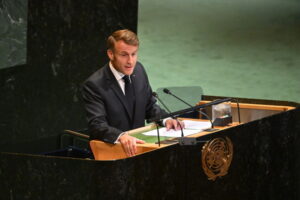
Dozens of world leaders gathered at the UN yesterday, Monday, to support a Palestinian state, a landmark diplomatic shift nearly two years after the war broke out in the Gaza Strip, despite strong opposition from Israel and the US.
French President Emanuel Macron announced that his country would recognize the state of Palestine during a summit co-hosted by Paris and Saudi Arabia, a milestone that could boost Palestinian morale but does not appear capable of significantly changing the situation on the ground.
The most far-right government in Israel’s history has declared that there will be no Palestinian state as it continues its battle against Hamas in Gaza following the Palestinian organization’s unprecedented attack on Israeli territory on October 7, 2023.
Israel has drawn condemnation from the international community for the way it conducts its military operations in Gaza, where more than 65,000 Palestinians have been killed since the start of the war. Moreover, in recent weeks the Israeli army has launched its wide-ranging, ground-based operation to capture Gaza City, the largest urban center in the enclave.
“We must pave the way for peace,” Macron said at the start of yesterday’s session.
“We must do everything we can to preserve the very possibility of a two-state solution, with Israel and Palestine living side by side in peace and security,” he said before announcing Paris’ recognition of a Palestinian state, drawing applause from those present.
Turkish President Recep Tayyip Erdogan, Canadian Prime Minister Mark Carney and UN Secretary-General Antonio Guterres were among the speakers at the summit.
Spanish Prime Minister Pedro Sanchez, whose government recognized the Palestinian state in 2024, told Reuters in an interview that the recognition of the state of Palestine by various countries in recent times is very important.
“We have two countries (permanent members) of the UN Security Council, Britain and France, that recognize the state of Palestine and secondly in the western society (….) there is now a large majority of countries that already recognize the Palestinian state,” he explained.
Macron laid out the framework for a renewed Palestinian Authority which would have to move forward with reforms, but he cited a ceasefire with Israel and the release of all Israeli hostages held by Hamas as preconditions for a French embassy in Palestine.
Ahead of this week’s UN General Assembly, Luxembourg, Malta, Belgium and Monaco announced yesterday, Monday, that they recognise a Palestinian state.
In all, more than three-quarters of the 193 UN member states have recognized a Palestinian state.
“We call on those who have not yet done so to do so,” Palestinian President Mahmoud Abbas said, speaking at the summit via video link, as the US did not provide him with a visa to enable him to attend in person.
“We ask for your support so that Palestine becomes a full member of the UN,” he added, while promising to carry out reforms and call elections within a year after a ceasefire in Gaza is reached.
The delegation representing the state of Palestine at the UN has observer status and has no voting rights. To become a full member of the UN, Palestine would have to receive the approval of the UN Security Council, where the US has veto power.
The US and Israel boycotted yesterday’s session. Israeli Ambassador to the UN Danny Danon said Israel would consider how to respond to countries’ announcements of recognition of a Palestinian state after Prime Minister Benjamin Netanyahu returns from New York next week.
“These issues should be a subject of negotiation between Israel and the Palestinians in the future,” Danon said.
Netanyahu is scheduled to meet with U.S. President Donald Trump on Sept. 29 in Washington.
European divide
.
Although the majority of European countries now recognize a Palestinian state, two of the continent’s largest economies – Germany and Italy – have indicated that they do not intend to make that move in the near future.
Germany – a staunch supporter of Israel because of the Holocaust – is increasingly critical of Israeli policy, but insists that recognition of a Palestinian state should come after the conclusion of a political process leading to a two-state solution.
Nevertheless, a German government spokesman stressed yesterday that Israel should not proceed with new annexations of occupied Palestinian territories.
Italy assessed that recognition of a Palestinian state would be “counterproductive.”
For its part, Israel is considering annexing parts of the occupied West Bank as a possible response, as well as taking specific bilateral measures against Paris, Israeli officials have said.
Any annexations of new Palestinian territory may have the opposite of Israel’s desired results and alienate it from countries in the region, such as the United Arab Emirates.
Already the Emirates, the most economically and diplomatically important of the Arab states that normalized relations with Israel under the Abraham Accords in 2020, has warned that any new annexations would undermine the spirit of the agreement.
And the US has threatened possible repercussions for any countries that take measures against Israel.
Ask me anything
Explore related questions




