





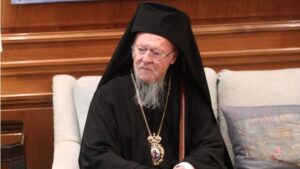
With a speech that combined spiritual depth, concern about the climate crisis, and a clear political dimension, Ecumenical Patriarch Bartholomew opened the proceedings of the 15th Annual Concordia 2025 Summit in Manhattan, considered “the largest and most inclusive non-partisan forum.” Notably, the Synod coincides with the 80th UN General Assembly, which brings together leaders from politics, business, civil society and religion.
Call to action on the climate crisis
Referring to the recent natural disasters, namely the fires that hit Chios and the 60,000 acres burned in California, as well as the increasingly frequent extreme weather events due to ocean warming, Bartholomew began his speech. As he said, “The balance of our natural ecosystems remains fragile as temperatures rise. This change brings painful consequences for every form of life on the planet. It is with sadness and concern that we see fires continuing to affect our shared habitats.”
His Holiness, known internationally for his environmental action and the nickname “Green Patriarch”, did not limit himself to describing the problem, but called on leaders to take joint action. He reminded us that caring for creation is not only an ecological but also a moral obligation: protecting the earth and the people who live on it are interconnected.
Religion and Politics – The Stance of the Russian Church
Bartholomew then focused on the instrumentalization of Orthodoxy by secular powers. With explicit reference to the Russia-Ukraine war, he stressed that religious wars are rarely fought for religious reasons. Rather, “religion becomes a veil behind which dark forces of greed, prejudice and aggression spread misery in the world.”
“All of us who have studied history know how religion can be used by secular power to create divisions between cultures,” he added to emphasize: “We see it unfortunately today among our co-religionists in Russia, where the Church of Russia continues to cover the war of the Russian state against Ukraine, a sovereign country.”
Meeting with Zelensky – Message of support for Ukraine
The Patriarch’s statements on the war in Eastern Europe were also symbolic, as they heralded his meeting with Ukrainian President Volodymyr Zelensky in New York, in the presence of Archbishop Elpidophore of America. The Ecumenical Patriarch’s presence at this meeting is seen as a message of support to the Ukrainian people and a confirmation of his position in favor of Ukraine’s territorial integrity.
Morality, Man and Earth – A single vision
The Ecumenical Patriarch also highlighted the need to bring ethics back into the public discourse, stressing that the well-being of people and the protection of the environment are interrelated tasks: “To honour the earth without honouring the people who live on it, or vice versa, to honour the people without honouring the land where they should prosper, is a madness that afflicts our world as never before in the history of humanity,” he noted.
The Ecumenical Patriarch’s statement at Concordia
His Holiness’s address was part of the thematic section “Promotion of Human Rights and Social Progress” of the Concordia, which seeks to foster mutual understanding between different cultures.
The Ecumenical Patriarch’s ministry has seen him emerge globally as an interlocutor on issues of faith, politics and contemporary challenges, such as artificial intelligence, and he has developed relationships with eminent scientists and environmentalists.
The Concordia Synod’s mission to bring together business, political and civil society leaders around global challenges aligns with the Patriarch’s recent speeches to the US State Department and the Council on Foreign Relations. On both occasions, he has been an ambassador for interfaith dialogue.
In this context, the Ecumenical Patriarch’s speech at Concordia is an affirmation of the message that “the power of faith to restore moral and ethical foundations throughout the world is undeniable.”
It is worth noting that the profile of the Patriarch in Concordia quotes his typical phrases concerning environmental sin, humanitarian crises and war. Since his election to the Ecumenical Throne in 1991, he has addressed parliaments and international organizations, from the UN to UNESCO, and has convened numerous councils that have promoted an “ecologically friendly form of Christianity.”
During his apostolic visit to the US, Stony Brook University president Andrea Goldsmith said the patriarch had brought the issue of climate change to the forefront of public debate: “He has provoked a debate not only about the science of climate change but also about its moral implications,” she said – hence the nickname “Green Patriarch”.
For his part, His Holiness praised the mission of the Concordia Synod by addressing a message of unity: “By meeting and addressing together the problems of society, from the local to the global level, you recognize the interdependence of the human community,” he said. “Everyone has a voice that deserves to be heard. Through connection, you enter – or perhaps re-enter – a meaningful relationship with each other.”
Templeton Award – Global Recognition
The Ecumenical Patriarch’s visit to the United States will conclude with his receipt of the prestigious Templeton Award, an honor that recognizes his contribution to interfaith dialogue and the promotion of peace. His nomination was supported by theologian Fr. John Chryssavgis, a close collaborator on environmental issues, and by renowned primatologist Dr. Jane Goodall.
Ask me anything
Explore related questions




