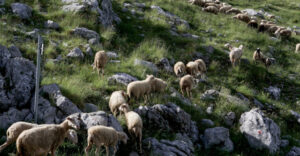
Since last Monday, increased smallpox measures have been in place across the country, but especially in areas that are in the red, such as Thessaly. More disinfection stations have been set up in central places, and the presence of veterinarians in the field and of control authorities is more intense to strictly observe the measures for the disease.
The dairy sector seems to be particularly worried as they are receiving less milk every day, as only from Thessaly to date, 5% of animals have been lost to smallpox, that is, almost 94,000 goats and sheep from day one. At the same time, the ministry is preparing to evaluate the performance of the measures by the end of this week. In fact, if the figures they have in hand are not encouraging, they will have to move to a lockdown to halt the rate of spread of smallpox.
Next week for lockdown decisions
In this context, ministry officials and their political bosses will have to decide what form of lockdown should be implemented. A partial lockdown, i.e., restricting livestock to the breeding units only in the affected areas, would not offer anything substantial, as these areas are already in this status since animal movements are already banned, while slaughterhouses are closed for slaughtering goats and sheep.
If they decide on a total lockdown in the country, they should explain what measures it will include. In the case of a total lockdown, no animals are moved from the farms. Slaughterhouses remain closed for the slaughter of sheep and goats throughout the country, and no milk is moved.
A general lockdown for the country could be decided on the lines of the plague which succeeded when implemented to eradicate the disease. In that case, the above bans were in force, but milk movements from farms were allowed with strict measures. This may be the most likely scenario if we go ahead with the lockdown solution. In that case, we might have a solution for transit movements as well, since animals from other European countries are transported to third countries for disposal through Greece, and this is also considered a possible cause of disease spread.
Of course, it would have to be ensured in what way the herds of traveling farmers would be transported with biosecurity measures from the highlands to the lowlands. The movement should take place by mid-October. In addition, depending on the duration of the lockdown, fodder will have to be provided for the farmers who will have their animals locked up on the farms. A lockdown would certainly bring increases in milk and meat.
The day after smallpox
We may still be trying to fight smallpox, but we should be discussing now how to safeguard against the spread of zoonotic diseases in livestock farming so that the feta cheese that is flooding international markets and dominating the EU is never compromised.
According to people who know the livestock industry well, it was a good thing that the veterinary breeding vet was passed and institutionalized last time, but unfortunately, it was not implemented in time. This veterinarian will be able to closely monitor each unit under his jurisdiction and record in real time the number of animals in the herd , which ones are dying, and which ones are not. His work will be assisted by the application of the electronic register, where all the above data concerning the health status of the country’s livestock will be immediately recorded. Thus, the control mechanisms will have all the data of each herd in real time, which will help in more immediate decisions and actions in cases such as that of the spread of smallpox.
Ask me anything
Explore related questions