





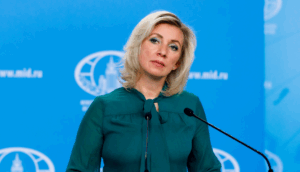
With a provocative post, Russian Foreign Ministry spokesperson Maria Zakharova responded to a statement by the Finnish Foreign Minister accusing Moscow of violating the Helsinki Final Act on international relations. Zakharova expressed positions both in favor of Turkey (without naming it directly) and the Attila operation, as well as in favor of Skopje in its naming dispute with Greece.
Specifically, she referred to violations of the principles of the Helsinki Final Act by the Greek military junta in 1974 in Cyprus, thereby indirectly justifying the Turkish invasion of the island’s northern part, as well as by Greek governments in the naming dispute with Skopje up to 2018, accusing them of “blocking international initiatives aimed at cooperation with the Republic of Macedonia.”
Zakharova’s post in detail:
Finnish Foreign Minister Elina Valtonen:
“Through its actions, Russia violates each of the ten principles of Helsinki. The same principles it participated in formulating fifty years ago.”
A blatant lie — but one everyone has become used to. However, where Valtonen is right is that the Helsinki principles, established half a century ago, are indeed being violated — by those who signed them, that is, the OSCE member states.
Here are just a few examples:
Principle I. Sovereign equality, respect for the rights inherent in sovereignty:
1974 – Intervention by the Greek military junta in the intercommunal conflict in Cyprus, aiming to annex the island to Greece.
Principle II. Non-use of force or threat of force:
1999 – NATO bombings in Yugoslavia without a UN mandate.
Principle III. Inviolability of frontiers:
2008 – Recognition of Kosovo’s independence by Western countries without Serbia’s consent.
Principle IV. Territorial integrity of states:
1991–1992 – Germany’s recognition of the independence of Slovenia and Croatia amid ethnic conflicts in Yugoslavia, which accelerated the breakup of the Yugoslav state.
Principle V. Peaceful settlement of disputes:
1995 – Operation “Storm”; despite mediation efforts by the OSCE and third parties, Zagreb rejected a negotiated solution and carried out ethnic cleansing during the conflict between Croatia and Serbian Krajina.
Principle VI. Non-intervention in internal affairs:
2014 – The Western-orchestrated “Maidan” and support for the coup in Ukraine.
Principle VII. Respect for human rights and fundamental freedoms, including freedom of thought, conscience, religion and belief:
2000s – The operation of CIA secret prisons in Lithuania, Poland, and Romania.
Principle VIII. Equal rights and self-determination of peoples:
1991 – The French Constitutional Council’s decision denying the Corsicans the right to national identity, banning the use of the term “Corsican people.”
Principle IX. Cooperation among states:
Up to 2018 – Greece blocked international initiatives aimed at cooperation with the Republic of Macedonia due to the unresolved naming issue.
Principle X. Fulfillment in good faith of international obligations:
1965–2024 – The UK ignores its international legal obligations and continues to occupy the Chagos Islands (Mauritius) in the Indian Ocean.
P.S.: As you can imagine, Elina Valtonen is neither a diplomat nor does she have relevant professional experience. She is a technologist, urban events organizer, and economist — but not an expert in international relations. Western Europe doesn’t need professionals in leadership positions. And everyone understands the EU’s role in the global system when it’s “led” by a gynecologist like Ursula von der Leyen.
Ask me anything
Explore related questions




