





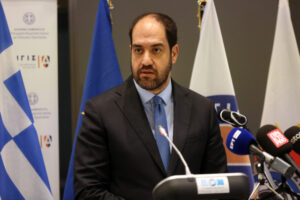
This year’s fire season ended with a much better picture for the country, said the Minister of Climate Crisis and Civil Protection, Yannis Kefalogiannis, in an interview with SKAI 100.3 FM. “Our country was one of the few in Europe with fewer burnt areas than the average for the last 20 years,” he noted, placing Greece’s performance in the context of a particularly difficult year for the European continent.
The minister cited the key comparative figures: at the level of the European Union, the burnt areas were “over 10 million hectares (18 million in the wider European area), three times the average for the last 20 years”. On the contrary, Greece maintained total losses below the historical average, with a significant qualitative difference in forest cover: “this year we had at forest level 26,000 hectares, when the twenty-year average is 111,000″, a reduction corresponding to about 75%.”
The improvement is attributed to a package of prevention interventions and targeted operational tactics. First, extensive land clearance (around 700,000 declarations) and consistent enforcement of fines (sanctioning around 25% of complaints), which stopped fuel around settlements. Also, doubling of drones (87 from 42 in 2024) with 24-hour surveillance: of the approximately 7,500 launches this year, 4,000 were “seen first by the drones,” allowing for immediate advancement of ground/airborne forces.
As for the causes of ignition, Kefalogiannis said that “70% is man-made; 63% negligence and 6-7% fraud”, with this year recording a record number of arrests. The next big priority, he said, is educating citizens: “If we reduce negligence, we prevent about 70% of initiations.”
In terms of manpower and resources, “18,000 men and women operated this year” (15,500 permanent/five-year and 2,500 seasonal), while 1,076 permanent hires have been approved for the new year. At the same time, from 2028, Greece will receive new CL-515s with night-firing capabilities, decisively strengthening the fleet. Investment in drones will continue as the main “force multiplier” of the mechanism.
Ahead of winter, the Minister outlined an organized cycle of coordination with all Regions: cleaning of streams (responsibility of Regions) and manholes (responsibility of municipalities), timely contracts for machinery, and clarification of responsibilities to avoid gaps and overlaps. Fire brigade promotes bases/vehicles in sensitive areas for faster response to flooding incidents. “No country is 100% ready; the goal is to be more ready each year than the previous year,” he stressed.
Finally, on the political side, Kefalogiannis supported the regulation for the Monument of the Unknown Soldier, specifying that policing remains with the Hellenic Police, while the maintenance and care of the site are clarified institutionally, in order to ensure the sacred character of the monument and to end the ambiguity in responsibilities.
Ask me anything
Explore related questions




