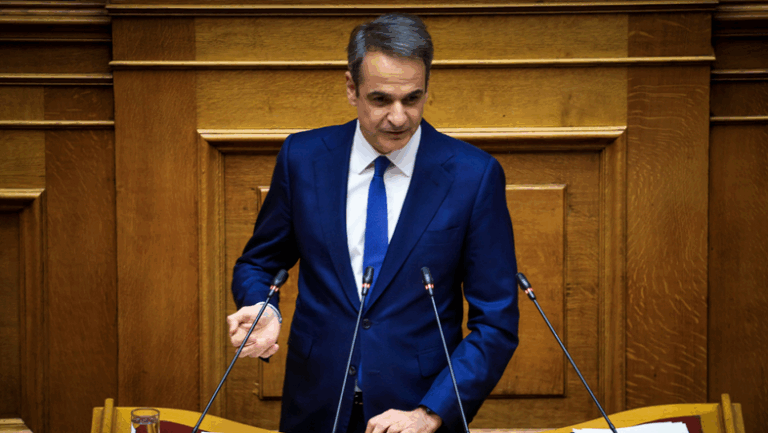
The formal agenda of this first major debate of the new parliamentary session focuses on recent developments in Gaza, Greek-Turkish relations, and broader foreign policy issues. However, it is almost certain that the discussion will expand to other current topics — such as government decisions regarding the Tomb of the Unknown Soldier, farmers’ payments, and the Tempi train crash trial.
The session is taking place at the Prime Minister’s request, so that he can brief Parliament on all foreign policy matters. It follows a proposal by PASOK leader Nikos Androulakis, which had limited the discussion exclusively to Palestine.
According to reports, in his opening remarks, Mitsotakis will present the full range of Greece’s actions in key areas — the U.S., EU, Greek-Turkish relations, and the Middle East — along with the tangible results of Greece’s active diplomacy. He is also expected to criticize those who advocate a so-called “diplomacy of inaction.”
Mitsotakis will stress that Greece’s economic policy since 2019 has strengthened the country’s position internationally and enabled a significant reinforcement of the Armed Forces.
On the Palestinian issue, he will highlight Greece’s participation in the Peace Conference for Gaza, its good relations with Israel, and the recent visit to Athens by Palestinian Foreign Minister Varseen Aghabekian Shahin.
Sources say the Prime Minister will state that Greece seeks a role in Gaza’s “next day”, particularly in humanitarian aid and reconstruction efforts.
Regarding Greek-Turkish relations, Mitsotakis will reaffirm his commitment to the “policy of calm waters”, clarifying that this does not mean Greece is retreating from its strategy of strengthening national sovereignty and sovereign rights.
“Greece exercises its sovereign rights on the ground, not through slogans and shouting,” Mitsotakis is expected to stress.
He will also reiterate that the core dispute with Turkey — the delimitation of the Exclusive Economic Zone (EEZ) and continental shelf — remains open, but that Greece continues to advance its national planning, which has already produced concrete outcomes:
- Extension of territorial waters in the Ionian Sea to 12 nautical miles
- EEZ delimitation agreements with Italy and Egypt
- Maritime spatial planning initiatives
- Hydrocarbon exploration tenders south of Crete, involving U.S. energy giant Chevron
- Creation of two new Marine Parks, one in the Ionian Sea and one in the southern Cyclades
Ask me anything
Explore related questions