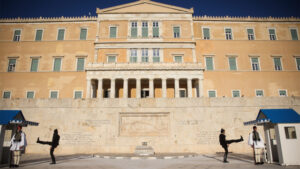
PASOK filed a motion of unconstitutionality against the government’s amendment concerning the Tomb of the Unknown Soldier on the morning of Tuesday, October 21, during the plenary session of Parliament.
PASOK’s parliamentary representative Pavlos Christidis argued that no one has desecrated the monument, adding to the government:
“It is obvious that what New Democracy is doing is creating false dilemmas and problems — which we will respond to today. Respect for the monument is one thing, and the prohibition of assemblies is another.”
Following him, Nikos Pappas of SYRIZA claimed that the amendment “is connected to the government’s defeat by Panos Routsis.”
Regarding the constitutionality of the regulation, the government has already stated its position, including in the amendment excerpts from a Council of State decision, which notes that there are limits even to the right of assembly.
The amendment states:
“The right [of assembly] is defined, as to its content, by the provisions of other articles of the Constitution, which are equal in rank to Article 11. These include, among others, the preservation of the continuity and unity of the Greek nation [Council of State 460/2013, special opinion of Justice M. Pikramenos], the defense of the Fatherland as a constitutional purpose [Article 4 §6], and the protection of the cultural environment and monuments [Article 24 §1 and §6]. Moreover, the area covered by the proposed regulation represents less than one-fifth of the total surface of Syntagma Square, where the right of assembly may still be exercised under existing provisions. Therefore, the proposed measure does not constitute a restriction but a conceptual definition of the notion of assembly, functionally facilitating the exercise of this right.”
What the Government’s Amendment States
The governmental and inter-ministerial amendment, submitted late Monday night, sets out the framework for the protection of the Tomb of the Unknown Soldier from now on.
The amendment includes a single article stipulating that in the area in front of the Tomb of the Unknown Soldier — defined as a site of special historical and national significance — and for the purpose of preserving its integrity and intended use, the following are prohibited:
a) Any occupation or use of the area for purposes other than visiting the monument and highlighting its significance.
b) Any alteration of the space.
c) The holding of any form of public outdoor assembly as defined in Article 2(1) of Law 4703/2020, including spontaneous or extraordinary outdoor gatherings (Articles 2(4) and 2(5)).
Penalties:
- Violations are punishable by imprisonment of up to one year, unless heavier penalties apply.
Responsibilities:
- The Ministry of National Defense is responsible for the maintenance, care, and promotion of the monument, either directly or through contracts.
- The Hellenic Police is responsible for maintaining public order and enforcing the above provisions.
The amendment is signed by seven ministers:
Kyriakos Pierrakakis (Economy), Nikos Dendias (National Defense), Thodoris Livanios (Interior), Michalis Chrysochoidis (Citizen Protection), Stavros Papastavrou (Environment), Giorgos Floridis (Justice), and Lina Mendoni (Culture).
It has been submitted as part of a Ministry of Infrastructure and Transport bill concerning the Civil Aviation Service, the discussion of which began Tuesday morning.
Prime Minister Kyriakos Mitsotakis is also expected to address Parliament in support of the amendment, according to the official schedule released by the Maximos Mansion.
Ask me anything
Explore related questions