





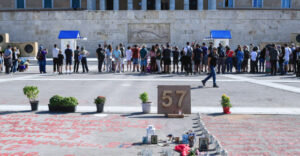
Prepared for a high-stakes and heated debate, Kyriakos Mitsotakis is heading to Parliament today to defend the governmental and interministerial amendment submitted last night, which from now on will regulate the framework for the protection of the Tomb of the Unknown Soldier.
Mr. Mitsotakis will go to Parliament after 2:00 p.m., following his attendance at the event marking the Onassis Foundation’s donation for the creation of the new transplant center and the renovation of the Onassis Hospital. He is preparing for a tough confrontation with opposition leaders.
However, he will emphasize — in every tone — that the government’s aim is not division but respect for a sacred national monument. He will also counter the argument that the government is intervening “vindictively” following Panos Routsis’ hunger strike.
At the same time, he will call on the opposition leaders, especially PASOK, to take responsibility for protecting the monument.
The Amendment and the Backstory
Yesterday afternoon, after hours of deliberations between the Maximos Mansion and the relevant ministries, the amendment was sent to Parliament.
From now on, the main responsibility for maintenance passes to the Ministry of National Defense, which, however, had reportedly been reluctant to get involved — even though Mr. Dendias had been informed since last week of Mr. Mitsotakis’ intentions.
In fact, the Defense Ministry is said to have already found a solution, entrusting the care and cleaning of the monument to a private company, something allowed under the new provision.
(Read the amendment here)
Yesterday, for quite some time, it was unclear how many ministries would sign the amendment — although the Defense Ministry is officially the lead authority responsible for the monument’s protection.
In the end, it was co-signed by the ministries of Defense, Citizen Protection, Justice, Culture, Finance, Interior, and Environment & Energy.
Notably, the remarks of Health Minister Adonis Georgiadis on Action24 did not go unnoticed, as he pointedly said that Mr. Dendias should be the one asked about the matter, as the competent minister.
What Mr. Georgiadis meant was that Dendias would have to take a public stand on a sensitive and unpopular issue.
It remains to be seen whether the Defense Minister will comment today, although the Prime Minister’s speech is expected to serve as an “umbrella” for the issue.
What Is Allowed and What Is Forbidden
According to official sources, under the new provision, visiting the front area of the Tomb of the Unknown Soldier will remain completely unrestricted.
However, occupation of the cenotaph or the surrounding space will be prohibited, as will any alteration of the site and any public outdoor assembly under the relevant law on gatherings.
In short, only visitors will have access.
The regulation defines a specific zone where the restrictions apply — the area on Amalias Avenue, directly opposite Syntagma Square, but not the entire square itself.
In case of violation, penalties range from fines to imprisonment of up to one year, depending on the severity of the offense.
Closing Remarks
Regarding the request from relatives of the Tempi disaster victims that the victims’ names remain inscribed, official sources clarify that the aim is not to erase the names but to ensure the protection of a site of exceptional national and historical importance.
In practice, the names are not being removed now — but the new rule will be tested if anyone attempts to “refresh” or re-engrave them.
Yesterday, Minister of Citizen Protection Michalis Chrysochoidis, speaking on Open TV, notably commented that he understands why the names and the candles remain, adding pointedly:
“Why are we opening battles and debates for no reason?”
What Applies Abroad
To support the regulation, government sources point out that in many countries — both in Europe and beyond (notably the United States, the United Kingdom, France, Germany, Italy, Spain, Portugal, Canada, and Australia) — there is a special legal framework protecting sites of national and historical significance.
These international examples were taken into account in drafting the Greek government’s new regulation, according to the same sources.
Ask me anything
Explore related questions




