





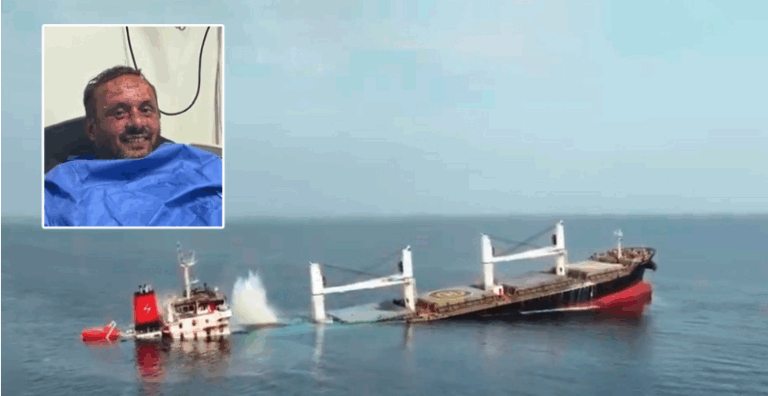
In a gripping account of his three-day ordeal in the Red Sea — from July 7 to 10 — when he had to survive 48 hours at sea after the ship Eternity C, on which he was serving as an armed guard, was attacked by the Houthis, Vangelis Staridas spoke to Greek TV network Alpha.
In his detailed testimony to the program Autopsia and journalist Antonis Sroiter, Staridas describes how they were hit by 15 missiles fired by the Houthis, how they made the decision to jump into the sea to save themselves, what went through his mind in the water, how at least twice ships spotted them but abandoned them — and how, as he confides, he survived “because I had promised my daughter that I would always come back.”
The Houthi attack
“It was July 7,” he recalls, “and the ship was headed to Aqaba, after delivering soybean seeds from the U.S. to Somalia. I was resting so I could take my shift at 8 a.m. Suddenly the phone rang, and I was told to come up to the bridge — they’d seen something on the radar,” Staridas says.
“It was about ten to seven, and before I even had time to get ready — before I left my cabin — we took the first hit. I felt it very strongly; everything shook. An unforgettable noise. I immediately realized we were under attack and that I had to get to the bridge. We’d been hit on the rear starboard side, near the engine room. It was a tactical strike — a hit meant to immobilize the ship. I went down to the engine room and saw utter destruction. We searched with flashlights, and at some point, while I was looking around, I found a crew member in shock. I still remember his eyes — blank, unfocused. He was alive,” the armed guard recalled.
“As I said, we had three dead in the engine room. They were bombing us all night — from 7 p.m. until 10 a.m., when we jumped into the sea. The next strike came a minute later, in almost the same spot. The rest hit various parts of the ship — the bridge deck, the deckhouse. Even though it was night, what you felt was something sudden; you didn’t hear anything coming — just a bang, a flash, and a jolt like nothing you’ve ever felt. As I counted, I tallied 15 missiles.”
The first reactions
Speaking about his first actions, he said:
“At first I tried to keep the crew and the captain calm, to prevent panic. People were crying, everyone was lying on the floor, the bridge was collapsing, ceilings were falling — but there was the constant fear of death, because you couldn’t predict where the next hit would come from to protect yourself. After the second strike, I told the captain: open all the communication systems and report that we are under attack.”
He himself was injured in the attack:
“I was hit because I was trying to keep the crew safe. I had them gathered on a stairway on the bridge, the safest place. I didn’t want to take unnecessary risks. I was the one who had to protect the ship, so I had to be out there to make sure nothing approached it. After every explosion, the shockwave would throw me off my feet, and fragments hit my legs.”
The decision to jump into the sea
The next decision was to abandon ship. As he says,
“If we stayed on the vessel, we wouldn’t live much longer — sooner or later we would be killed. If we used the lifeboats, we’d be easy targets.”
“At one point there was a massive hit right where we were standing — I felt a burning pain in my leg and the shockwave threw me three or four meters away. I didn’t know if I still had my leg. I looked and saw blood pouring nonstop; I was afraid to touch it in case it came off. I turned to the captain and said, ‘There’s no other way — if we stay on the ship, they’ll kill us. Either we stay here and die, or we jump into the sea.’ The captain agreed. We went down to the deck, put on our life vests, and jumped into the water,” recalls Vangelis Staridas.
48 hours in the water
“There were 18 of us. We swam in the opposite direction — away from the ship and from Yemen. After about two hours, when we had moved two or three miles away, they kept firing missiles and drones at the ship. I wanted us to get as far away as possible, as quickly as possible, because they could attempt another boarding operation. We used the reflection of the sun to stay hidden. We all jumped together — the captain and I were the last ones. I advised everyone to stay together, as one group. I told them, ‘Swim fast.’ After a while, though, several fell behind and couldn’t keep a straight line — we needed to swim directly behind the ship, not to the sides, to stay covered,” he recounts of the first moments in the sea.
But some “didn’t try hard enough, and the Houthis found them. There are now 10 or 11 people they pulled from the sea — still held captive to this day.”
“We were five people left, and we kept swimming. We spent two days and two nights in the water. We were desperately thirsty. When we first jumped in, the water was almost hot; at night, when the sea temperature dropped, we shivered. Fish we didn’t recognize were bumping into us, jellyfish were stinging us — our hands turned red. The first day I felt fear. From the second day on, all I thought was that I had to make it somewhere,” he says.
Abandoned by ships
Then came their first contact with a vessel — which ended in disappointment:
“There was a dark ship that stopped, went dead slow, and turned on all its lights. When it came within two miles, I told the group to turn on the lights on our life vests, and the ship stopped. I thought they were lowering boats, and I said, ‘Guys, they’re going to save us.’ But time passed and, just as it had turned on its lights, it switched them off — and left. There’s no way they didn’t see us. They just left us there in the sea.”
“I came back because of my daughter”
Unable to hold back tears, Vangelis Staridas says:
“I came back because I had made a promise — that I would always come back. My daughter was always afraid of this job. She made me promise her that I would always come back to her. I never once believed I was going to die. The Houthis would never take me alive. I didn’t want to fall into an emotional state — you have to stay focused if you want to survive.”
The rescue and return home
Rescue finally came on July 10, after one more disappointment — this time from a fishing boat:
“On the third day, around dawn, we saw a big wooden fishing vessel and signaled for them to take us on board. They came closer — they were Indian fishermen — and we shouted, ‘Take us, give us water!’ But they didn’t respond and left. About an hour later, as I estimate, they came back. We begged again, and they gave us a half-liter bottle of water and left. Two hours later, we saw the rescue vessel approaching us. The feeling was indescribable — the joy was like a little kid being given candy. We were laughing, patting each other on the back, saying, ‘We made it!’ The same vessel had rescued six others the previous day, and then picked up the four of us.”
The return to Greece came three or four days later, and, as he says,
“Only then did I feel truly safe. The first embrace was my daughter’s. We couldn’t speak — ‘My dad,’ she said. ‘My girl,’ I answered. It was like being born again.”
Ask me anything
Explore related questions




