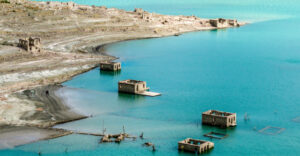
A preparatory meeting was held today at the Maximos Mansion under Prime Minister Kyriakos Mitsotakis, focusing on tackling the problem of water scarcity in Attica.
Government sources stated that the discussion was based on the latest hydrological data, with absolute priority given to protecting water as a public good. Immediate initiatives to prevent upcoming risks were put on the table, and announcements are expected in the coming weeks.
Participants included Deputy Prime Minister Kostis Hatzidakis, Ministers of State Akis Skertsos and Environment Stavros Papastavrou, as well as EYDAP officials Giorgos Stergiou and Haris Sahinis.
It should be noted that the capital currently has water reserves sufficient for only one year. If this winter’s rainfall and snowfall are poor, Athens could face a genuine water supply crisis starting in 2027.
This is not a distant scenario but rather the cold mathematical reflection of climate change, prolonged drought, and increased consumption—steadily up by 6% since 2023—with consumers having “relaxed” their habits and wasting water irresponsibly.
Today, two listed companies, EYDAP and EYATH, serve just over half of the country’s population, while roughly 400 municipal enterprises manage drinking water and another 400 smaller units handle irrigation water.
Reservoirs are running dry
On Friday, September 26, EYDAP’s reserves across its three reservoirs stood at 408.4 million cubic meters, compared to 644.7 million cubic meters exactly one year earlier—a shortfall of 236 million cubic meters.
Athens’s water supply system relies mainly on the Evinos and Mornos rivers. Until recently, Lake Yliki served only as a backup due to its high pumping cost (since it lies at a lower altitude than Athens and requires double water lifting).
However, the drop in reserves forced EYDAP last year to bring Yliki back into the system, along with the Mavrosouvala boreholes on the foothills of Mount Parnitha.
Currently, about 40% of the city’s water consumption is supplied by these “reserve” sources, while the remaining 60% comes from Mornos and Evinos.
Reactivation of old infrastructure
Faced with the risk of depleted reservoirs, EYDAP is also reviving facilities abandoned since the 1990s.
The ultimate goal remains a permanent and reliable solution: supplying the Evinos reservoir via Lake Kremasta through the connection of two rivers—first with the Krikelopotamos (through a roughly 12 km tunnel) and then with the Karpenisiotis (via a second 7 km tunnel). The total cost is estimated at €450 million.
A preliminary study has been completed, and tender documents for the main study are being prepared. The aim is to complete at least the first phase (the two tunnels) within 3–4 years, although that timeline seems rather optimistic.
Until then, EYDAP is working to preserve its existing reserves, hoping for a good hydrological year and exploring new water sources.
Investigations are underway in the middle course of the Boeotian Kifisos (around Orchomenos and Kastro in Boeotia), a water-rich area where 17 boreholes could be reactivated, along with old pumping stations used during the previous crisis in the 1990s.
However, local farmers are protesting against water extraction, an issue likely to require political intervention.
EYDAP officials note that if Attica were supplied solely from this area, the water would cover needs for only 1 to 2 months per year, making it a merely supplementary or interim solution.
Similar efforts are being pursued in the Oungroi area below Yliki and in boreholes southwest of the lake, though these can only feed Yliki—not Mornos—meaning they cannot supply all four purification plants or provide water to the entire city.
Ask me anything
Explore related questions