





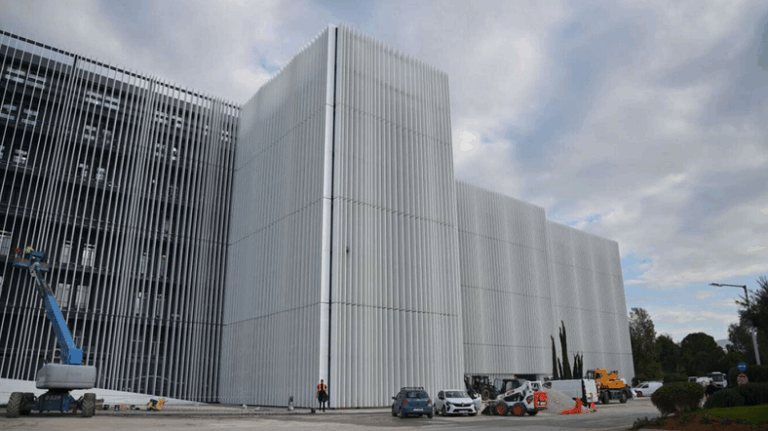
With the inauguration ceremony of its new bioclimatic facade, the Greek Pentagon officially enters the 21st century. The building is not only the physical and administrative headquarters of the Hellenic Armed Forces but also an integral part of the epic of 1940.
Although efforts to reorganize the Hellenic Army had begun in 1936, with the outbreak of the Greco-Italian War on October 28, 1940, and the appointment of Lieutenant General Alexandros Papagos as Commander-in-Chief of the Hellenic Army, a General Headquarters was established on the same day. It was initially housed in the “Grande Bretagne” Hotel, coordinating overall military operations.
Later, as the war progressed, the Army General Staff was accommodated on the first floor of today’s Parliament building until the end of operations, while in 1950, the Ministry of National Defense was established for the first time.

At the same time, considerations began regarding a permanent location for the Army General Staff. By chance, it ended up in its current location: a 221,000 m² site between the municipalities of Papagou–Cholargos and Psychiko.
However, during World War I, the area that now houses the Ministry of National Defense was used as an airfield. In 1932, it was decided that a hospital would be built there. Preliminary work began on October 1, 1951, with funding from the Marshall Plan, but two years later the idea arose to relocate the Army General Staff there, which until then was located at the intersection of Panepistimiou and Kriezotou Streets. In 1954, the decision was finally made to install the Army General Staff in the current Pentagon. From May 22, 1955, onwards, Armed Forces personnel began moving into its wings through continuous expansions, the last one being in 1977.

The New Facade of the Pentagon
In the following years, the Pentagon’s exterior remained largely unchanged, despite renovations and new buildings within the Papagou Camp, until the Ministry of National Defense decided on a complete renovation of the facade with a bioclimatic perspective.
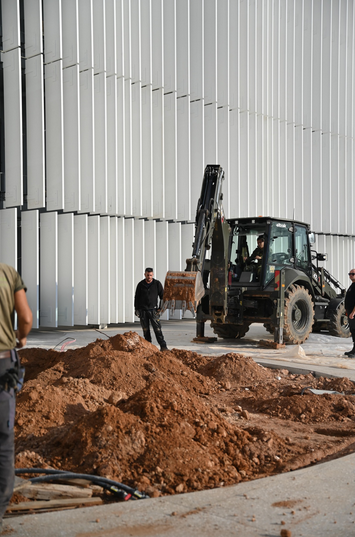
The project, a priority for Minister of National Defense Nikos Dendias, involved constructing a new bioclimatic facade on the central building, specifically on its southern face, along with redesigning the surrounding area along Mesogeion Avenue. The design was created by Greece’s most renowned sculptor, Professor of Architecture at the Aristotle University of Thessaloniki, Kostas Varotsos, and his collaborator, architect Chrysanthi Asproulopoulou, with funding from Metlen Energy & Metals S.A.
The project was approached as a unified ensemble. In its central section, Varotsos’ work “Ark of National Memory” was installed, inaugurated on March 26, 2025, by Minister Dendias. The “Ark of National Memory” is flanked by two olive groves, designed to create a place of memory that is experiential rather than purely monumental. It consists of glass columns up to six meters tall, where each step represents a meeting with the past. The names of all 121,692 fallen from Greece’s national struggles are inscribed on the columns, with light passing through, making the names appear to float in space.

The new bioclimatic facade, the “Ark of National Memory,” and the landscaped surroundings with the olive groves were treated as a single architectural intervention. The two groves, with 25 and 28 olive trees respectively, symbolize March 25, 1821, and October 28, 1940.
Additionally, at the rear of the ark is the southern face of the Ministry of National Defense’s central building, redesigned to meet security requirements, enhance functionality, and improve aesthetic and energy performance.
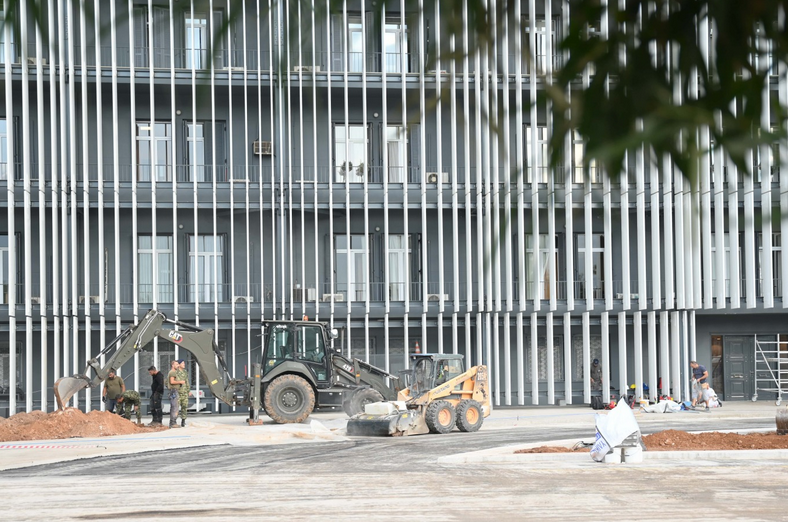
According to Professor Varotsos, the new 340-meter-long, 30-meter-high facade is organized through vertical elements—specifically white aluminum louvers—arranged with varying spacing, creating a visual rhythm resembling a row of columns, giving the building a strict structural feel. The elliptical staircase at the main entrance is itself a work of art, with the largest step measuring 73.8 meters. The staircase functions as a single sculptural element, where a horizontal curve corrects distortion from the vertical louvers, conveying stability and harmony.
The entrances serve the General Staffs of National Defense, Army, Navy, and Air Force, integrated into the overall design as a rhythmical interruption. This design creates a continuous sense of motion and perspective, merging with the surroundings, the ark, and the green spaces for a unified spatial experience.
At night, the building’s exterior lighting emphasizes the verticality of the white louvers while allowing interior office lighting to remain visible. The landscaping of the southern part of the camp complements the renovation: scattered parking areas were replaced with green spaces, and existing trees were supplemented, raising the total number to 500, creating a small urban green lung. The northern side of the central building was paved to accommodate staff parking for official and private vehicles.
The Next Day
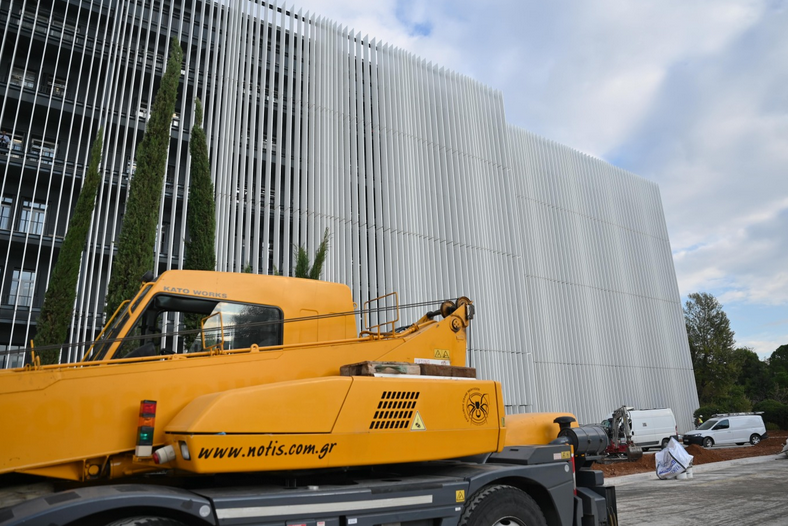
The full upgrade of the Pentagon is ongoing. According to sources, plans are already underway for energy efficiency improvements and expansion of the energy facade across the central building, as well as renovation of interior workspaces, further enhancing the environmental footprint of Papagou Camp in the area.
Ask me anything
Explore related questions




