





Event Celebrating 100 Years of EYDAP
EYDAP remains 51% publicly owned, and that will not change, Prime Minister Kyriakos Mitsotakis emphasized, assuring that the company will stay under state control. “Hope is not a strategy,” he said, warning that Attica faces a serious problem if no action is taken. With the Euritos Project, the goal is to ensure that Attica will have no water shortage issues for the next 30 years.
Mitsotakis: “Our goal is to guarantee that Attica will have a secure water supply for the next 30 years” – Live coverage of EYDAP’s 100-year anniversary event
Announcement of a Change in Pricing Policy
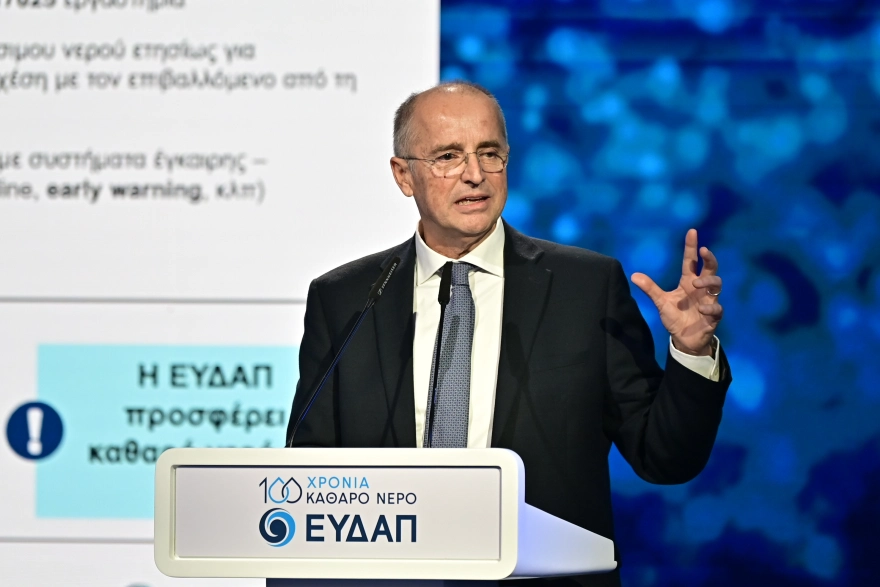
EYDAP CEO Haris Sachinis noted that the company’s water network is roughly equivalent in length to the distance between Greece and Australia — and the same applies to the sewage network. He stated that the quality of Greek water is the best in Europe and among the best in the world, thanks to daily testing and monitoring. EYDAP’s activities also extend beyond Attica, supporting local communities throughout Greece.
EYDAP, in cooperation with the government, is implementing projects to safeguard Attica’s water supply. Regarding the Viotikos Kifissos Project, Sachinis said that farmers receive 30 million cubic meters of water, plus an additional 7 million cubic meters from the Mornos canal — a supply that will continue. The aim is to implement interim measures until the major Euritos Project is completed, which, once operational, will have zero running costs.
The company also has a Plan B, focusing on desalination projects in Thisvi, Nea Peramos, and Lavrio, as well as a Plan C. The state has already allocated €100 million to reduce water leakage. Current losses are around 15% — the European average — but the goal is to bring that down to 11%. “We want to keep water bills low, but we must maintain the right balance,” Sachinis said, adding that consumer awareness campaigns are underway.
EYDAP is advancing water recovery projects for irrigation and industrial use, including initiatives in Eastern Attica. Additionally, the construction of Psytalleia 3 is planned — set to become the largest wastewater treatment facility in Europe.
The company’s investment plan, worth €2.5 billion, aims to modernize infrastructure and services. Among the projects planned are:
- Water supply to Kinetta
- Strengthening the water network in Western Attica
- Increasing water flow to the Southern Suburbs
- Reducing leakage and installing smart meters
- Building a new main sewer line along Vouliagmeni Avenue
- Developing wastewater treatment centers in Rafina and Marathon
Sachinis also highlighted the new performance-based regulatory framework, stressing that any profits will be reinvested into infrastructure and services for citizens.
However, he acknowledged the need to revise EYDAP’s pricing policy, as Greece currently has some of the lowest water rates in Europe — effectively signaling upcoming tariff increases.
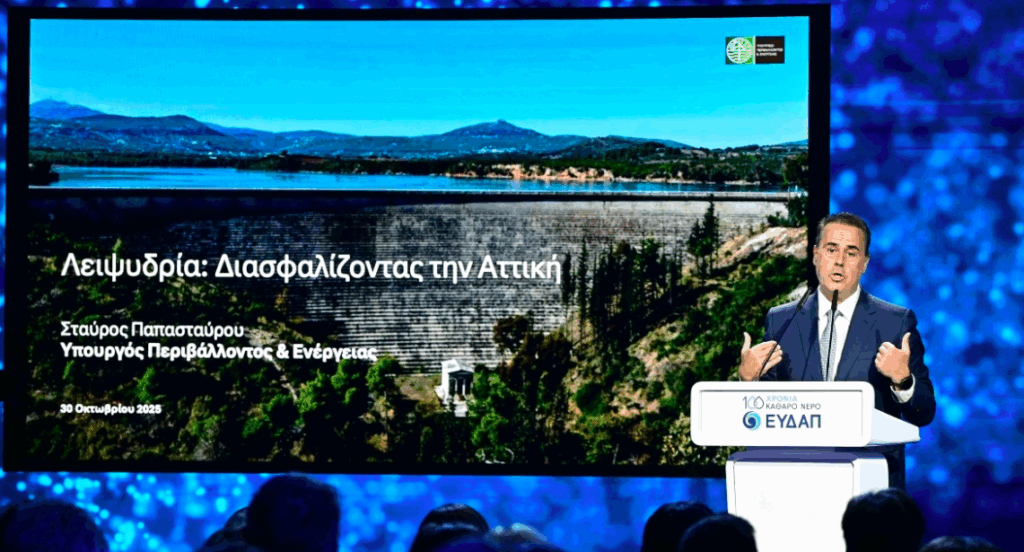
Environment and Energy Minister Stavros Papastavrou presented measures to secure water supply for Attica. “Water is the most vital public good, and its uninterrupted provision is a priority for the government,” he said. Attica has previously faced periods of drought, and currently, reservoir levels are low.
“Today, climate conditions have worsened, particularly in the Mediterranean. Greece ranks 19th in the world for drought risk and is among the countries expected to face water-related problems in the future,” he added. Until 2021, reservoir levels were stable. Since 2022, there has been a decrease in reserves and an increase in water consumption. “After Cyprus, Greece will face the highest water stress in Europe,” he noted. Papastavrou highlighted the initiatives taken by the government from 2023 to the present to mitigate the problem. Attica and Thessaloniki represent 50% of the country’s population in terms of drinking water consumption, which places them at the center of the issue.
Hydrological data, according to the Academy of Athens, are pessimistic. “All measurements indicate that we cannot wait any longer,” he said.
Papastavrou announced the “Evritos” project, which involves the partial diversion of the Krikeliotis and Karpenisiotis rivers toward the Evinos, with completion expected in the first half of 2029.
Future Plans
Beyond desalination, the plans include a geographic expansion of EYDAP and EYATH, as well as an extension of responsibilities to irrigation. This will involve modernizing existing regulations. “Operations cannot remain the same 45 years later. Labor and salary flexibility will attract skilled personnel and empower employees,” he said. Measures will also address drought management.
Papastavrou also noted that Greece currently experiences a 50% loss of water. To address this, technical assistance from the EU will support the reorganization of water services.
Ask me anything
Explore related questions




