A bold €2.5 billion investment plan to combat water scarcity and ensure the long-term water security of Attica was presented by Minister of Environment and Energy Stavros Papastavrou during the event marking 100 years of EYDAP.
As the minister emphasized, this plan is not a choice but a necessity, an essential response to a rapidly changing reality caused by the climate crisis. Greece is already facing serious pressure on its water reserves, with Attica among the most vulnerable areas in the Mediterranean.
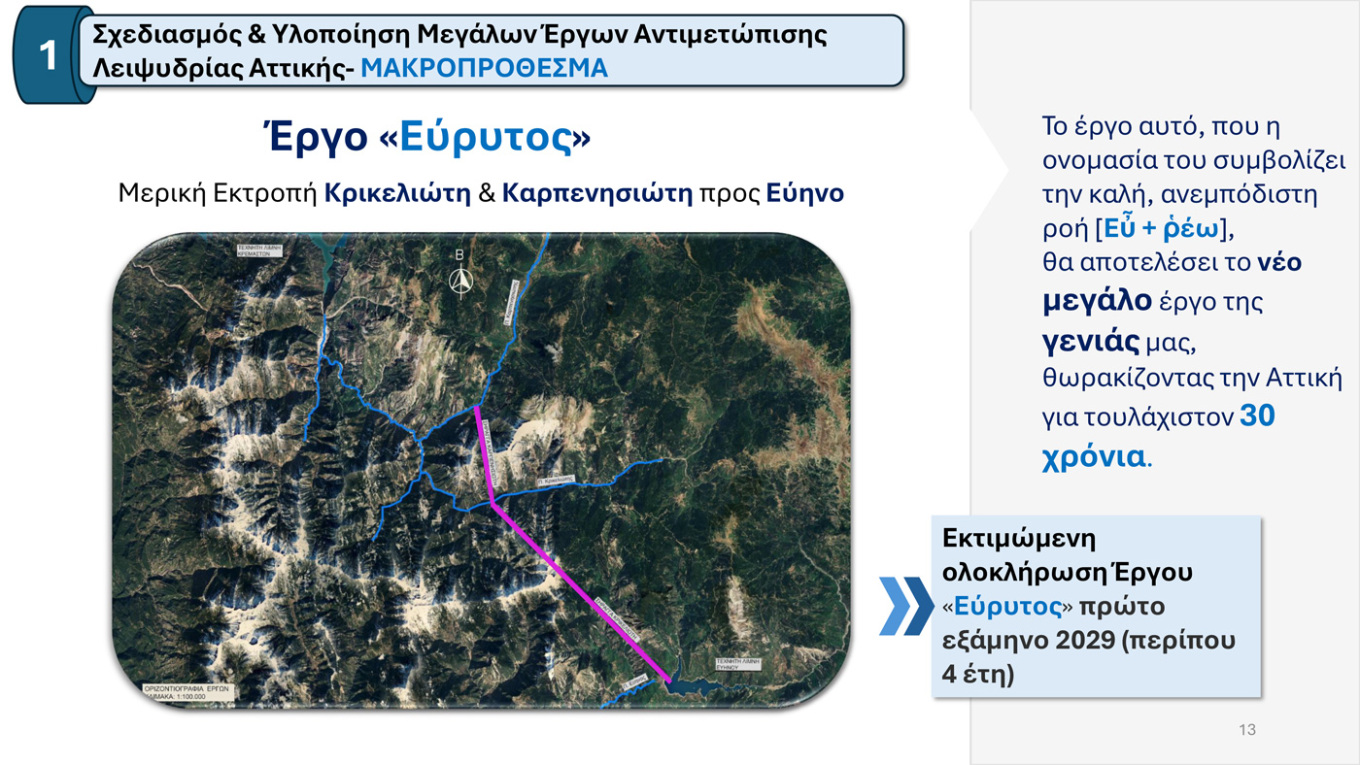
At the heart of the plan lies the Euritus Project, which, according to Papastavrou, will protect Attica’s water resources for the next three decades. This strategic project includes the partial diversion of the Krikeliotis and Karpenisiotis rivers, expected to be completed by 2029, exactly a century after the Marathon Dam was built.
In the short term, actions are also being taken to strengthen water supply through the use of boreholes in areas such as Mavrosouvala and Ouggron, which are expected to contribute around 150 million cubic meters of water annually.
Seven Strategic Pillars

The Ministry’s strategy is based on seven key pillars, aligned with European directives, which include:
- Strengthening water supply infrastructure
- Upgrading monitoring and water conservation systems
- Completing wastewater and water reuse projects
- Expanding cooperation between the public and private sectors for large-scale projects
- Improving irrigation systems and reducing network losses
- Streamlining water management authorities
- Promoting innovation and sustainability in the sector
Two Strong Water Management Pillars
Papastavrou announced the creation of two strong pillars for national water management:
- EYDAP in Attica
- EYATH in Thessaloniki
For the first time, these organizations will also extend their role into irrigation management.
He noted that the current fragmentation of water providers cannot continue — Greece currently has over 740 separate water and irrigation organizations, leading to resource loss and unequal service provision.
Under the new plan, EYDAP and EYATH will become the main operational hubs for mainland Greece, expanding their coverage beyond Athens and Thessaloniki, while the Interior Ministry will oversee the restructuring of 110 municipal water companies (DEYAs) that have not been adequately supported so far.
Projects on the Islands and Institutional Reforms
Across the islands, 150 projects worth over €320 million are already underway in more than 40 island regions, prioritizing reducing water losses in networks.
At the same time, institutional reforms are advancing, including:
- Simplifying legislation for public water and sewerage enterprises
- Strengthening the Regulatory Authority for Waste, Energy, and Water
- Creating a unified governance framework to ensure transparency, speed, and efficiency across all water-related entities.
Greece Among the Most Water-Stressed Countries
Papastavrou warned that Greece ranks 19th globally in water scarcity risk, with Attica at the epicenter of the crisis. Water reservoir levels are decreasing by around 250 million cubic meters per year, rainfall has dropped by 25%, and evaporation has risen by 15%.
“The climate crisis is not a threat of the future – it is a reality we are already experiencing,” the minister said, emphasizing that this new investment program is “the strongest guarantee for the water of future generations.”
A New Era for EYDAP
In closing, Papastavrou highlighted that EYDAP is a national asset, playing a decisive role in the new era of sustainable growth:
“With the support of the state, EYDAP will continue to serve citizens, invest in technology, and set an example of sustainable water management in Europe. The time for action is now,” he stated.
Ask me anything
Explore related questions