





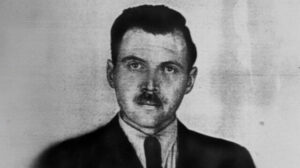
Josef Mengele was a Nazi doctor who performed sadistic experiments on Jews in the Auschwitz extermination camp. He was the so-called “angel of death”, notorious for his murderous acts in the name of science.
After the end of World War II, Mengele managed to escape capture in Germany and fled to Argentina with the help of his former SS comrades. Like him, thousands of others managed to reach South America with the help of collaborators and German immigrants who were sympathetic to them. In the case of Argentina, and with the help of President Juan Perón, who had close ties to European fascism.
This is the point from which the film “Das Verschwinden von Josef Mengele” (“The Disappearance of Josef Mengele”) begins. It is a dramatic film about the war criminal’s successful escape from Buenos Aires through Brazil to Paraguay.
The German-language film was made by Russian director Kirill Serrebrenikov and premiered in May at the Cannes Film Festival and is now showing in cinemas in Germany. It is based on the award-winning book by French journalist and author Olivier Guez, published in 2017. The film paints a bleak picture of the causes and consequences of Nazi ideological extremism.
Disappearance and corruption
The Disappearance of Josef Mengele begins in 1956. The German war criminal is living in exile in Buenos Aires under the name Helmut Gregor. However, Israeli intelligence agents, West German officials, and Nazi hunters have tracked him down.
The film shows how money, connections, and the ability to transform himself as a chameleon helped one of the world’s most wanted criminals evade international justice for decades. Mengele, played by August Dill, eventually drowned in 1979 due to a stroke on a Brazilian beach.
The film also reveals how the man who conducted perverse experiments on people at Auschwitz can never escape his past. Alone, sick and elderly, Mengele is living under a false identity in São Paulo when his son Rolf tracks him down and wants to know what really happened in the camp. As a new generation demands the truth, Mengele can only repeat the fascist lies he used to justify his crimes.
Is justice being done in some way?
What happens to war criminals when the war is over? Is there some kind of divine trial? Will these people ever be held accountable for their actions? These were the questions that plagued the Russian director.
Kiril Serebrennikov, a critic of Russian President Vladimir Putin who lived for years under house arrest in his homeland, deliberately brings the viewer close to Mengele.
This is “a very painful subject” in Germany, says Kirill Serrebrenikov, who now lives in Berlin. He says he has had to learn a lot about how generations of Germans came to terms with history. He interviewed actors, journalists, friends, and producers to hear stories about their grandparents and their lives before and after the war.
“Many chose silence,” he says. “It’s a very painful subject. But perhaps the film will enable a wider conversation. That would be good,” he stresses, at a time when the far right is gaining ground.
Ask me anything
Explore related questions




