





In the mountains of Central Greece, between the wild forests of Evrytania and its rushing rivers, a major project is taking shape that aspires to become the new shield to protect Attica against water scarcity.
The “Evrytos” project, the partial diversion of the rivers Karpenisiotis and Krikeliotis to the Evinos dam, adds to the chain of major water projects that have shaped the history of water in Greece over the last hundred years.
Each generation, from the 1920s onwards, took its own initiative for a visionary project that would ensure the most precious commodity of life. From the construction of the Marathon Dam in 1926, the “largest hydraulic project in the Balkans” under Eleftherios Venizelos with the assistance of the American Henry Uhlen and the Bank of Athens, to the development of Lake Iliki in 1956 under Constantinos Karamanlis, Attica was gradually strengthened with new resources.
This was followed by the artificial Lake Mornos in 1979 and, a decade later, the great Evinos project, designed under Constantine Mitsotakis, which tackled the biggest water scarcity crisis the country had ever known. The Evinos-Mornos tunnel, which was then described as a “project of life”, ensured a stable water supply for decades.
Today, a century after Marathon, water is once again becoming a matter of national priority. The new project “Evrytos” (from Eu and Reo) is the natural continuation of this route and the response of modern Greece to the challenge of the climate crisis.
A €535 million project, designed to secure Athens’ water supply for the next 30 years, is about to enter the implementation phase with the aim of being put out to tender in 2026 to be delivered at the end of the decade.
How the water will come
Water will arrive in the capital city only by the force of gravity, without pumps and without energy costs, just like the historic Mornos network works.
The project of EYDAP and the Ministry of Environment and Energy will proceed with a closed call tender to prospective technical companies, along the lines of large projects in Thessaly, to address the delays and long waits that characterize similar tenders.
However, the construction is complex: it requires two parallel 20-kilometre-long tunnels and strict environmental supervision. Thus, the project is not expected to be completed for four years, even if the timelines are met.
The heart of the infrastructure is in Evritania, where the Krikeliotis and Karpeniotis rivers will be connected to the Evinos via the two underground tunnels. The tunnels, about 4 meters in diameter, will carry the surplus water from the rivers to the Evinos reservoir, ensuring an annual supply of up to 200 million cubic meters, a quantity capable of covering almost two-thirds of the basin’s 250 million cubic meters
The novelty of the project is that the entire system will be operated solely by the force of gravity. The water will naturally descend from the mountains of Evritania to Athens, taking advantage of the difference in altitude of hundreds of meters. This natural slope creates enough pressure for the water to flow without pumps, without mechanical energy and without electricity consumption, which increases the cost.
In contrast, the depleted Iliki lake, which is at a lower elevation, requires powerful pumping stations to lift the water to EYDAP’s refineries, burdening the system with high energy costs.
“Our basic principle is to take full advantage of the natural force of gravity, just as Mornos has been doing for decades, explained EYDAP CEO Charis Sachinis during the recent presentation of the measures being taken to prevent Athens from being left without water.
In this way, the new project dramatically reduces the energy footprint, reduces operating costs and allows for low tariffs to be maintained. “Water travels on its own and this is nature’s greatest victory over cost,” EYDAP says.
The water from the Evinos, through the External Water Supply System, could in the future be used to supply water to islands that are also plagued by water shortages. The EYDAP canal passes over Elefsina by gravity and, if it proves that sea transport is more economical than desalination, it is a solution on the table to supply the islands by ship.
The “red alert” of EYDAP
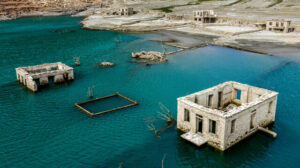
The necessity of the East is now unquestionable. Reservoir stocks in Attica’s reservoirs have fallen to 380 million cubic meters, down from 630 million last year a drop of 40%.
EYDAP has already informed the Environment Ministry and has “declared” Athens on “red alert”, noting that if this winter does not bring enough rain and snow, the basin will enter a danger zone. This is why the plans are not static and unilateral.
Along with the big one on Evinos, the company has already put other critical interventions on track that will ensure about 150 million cubic meters of water a year, so that Attica will not face a problem of sufficiency.
These are the operation of the Mavrosouvalas boreholes, which have already been put into operation and add 32 million cubic meters of water annually to the Iliki canal, and the 70% reduction of the environmental flow of the Evinos reservoir, which yields an additional 22 million cubic meters of water each year.
Two other major interventions are underway. The first is the activation of drilling in the villages in southeastern Iliki, which will add 50 million cubic meters per year, with a target completion date of March 2026.
The water is of high quality and clean, and the wells are located at a shallow depth of around 15 meters, reducing energy costs for pumping.
The second is the first phase of tapping the underground reserves of the middle course of the Boeotian Kifissos River, where 17 boreholes and three pumping stations are planned, yielding 45 million cubic meters a year. This project is expected to be completed in 2027 and will contribute to both water supply and irrigation in the region.
If rainfall proves to be poor, the management of EYDAP will implement Plan B. This envisages the installation of desalination plants at the industrial facility (BIIPE) of Thisvi, where Elpedison’s power plant is located, or alternatively at Nea Peramos near Megara and Lavrio, where discussions have also been held with the PPC.
The plan is for the plants to be land-based and mobile, so that they cannot be decommissioned, with the aim of being operational within 2 to 2.5 years.
But the cost of such an investment is very high which implies soaring costs for consumers.
For each cubic meter produced per day, the investment is estimated to cost about 1,000 euros. To provide 45 million cubic meters of water through desalination will require an investment of about 125 million euros, while energy consumption reaches 3 kilowatt hours per cubic meter.
The electricity consumption will be about one kilowatt-hour and the energy consumption will be about one kilowatt-hour of electricity, which will be about one kilowatt-hour of electricity.
For example, the cost for Thisvi estimated for 87.5 million cubic meters is estimated at 315 million euros, in Nea Peramos for 40 million cubic meters at 110 million euros and in Lavrio for 20 million cubic meters at 55 million euros. The solution of floating dewatering has also been considered, but is not considered appropriate as the cost is almost twice as high as for onshore installations.
The cost is more than twice as high as the cost of water at sea.
Consolidation and consolidation of municipal water utilities
At the same time, the Ministry of Environment and Energy, in cooperation with EYDAP, is promoting a plan to consolidate and streamline municipal water utilities. with a mandatory absorption of 47 providers. Under the umbrella of EYDAP, 34 providers in Boeotia, Fokida and Evia will come under the umbrella of EYDAP and EYATH 13 providers in Halkidiki, which is a first sign of the economy.
The next big issue for water management on which the government and EYDAP are keeping their cards close to their chest is the revaluation of tariffs. The company is weighed down by the increased six-month losses and the need for cost recovery and the grid of major investments to modernise the network and tackle water scarcity.
The issue of tariff revision is considered a done deal however it remains to be seen when the announcements will be made. Their level is a political decision to be determined in cooperation with the Waste, Energy and Water Regulatory Authority as well.
Ask me anything
Explore related questions




