





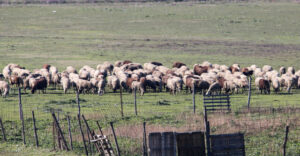
1/5 of the livestock of the Regional Unit of Serres has been lost the past years from successive waves of pox, lumpy skin disease and bluetongue. At the same time, in the last quarter more than 20,000 sheep and goats have already been killed (up until last week) and another 10,000 are expected to be slaughtered in the coming days, as they tested positive for pox.
“From August and after, the situation completely got out of hand. The number of cases skyrocketed and 130 families are left without animals, without work, without income,” said the president of the Panserraic Livestock Association, Elpida Sidiropoulou, speaking to APE-MPE, describing the scale of the destruction. “Dozens of livestock farmers are in despair. Their herds have been slaughtered, and those who are left are living with the fear that they are next. The prefecture is in a critical situation,” she added.
The economic losses, as Mrs Sidiropoulou underlined, amount to many millions of euro, since producers do not only lose animals, but their entire productive base: milk, lambs and future prospects. For full re-building of a herd, at least two years are required.
“Eight out of ten livestock farmers are with one foot out of the sector, either because they are 60–65 years old and one step before retirement, or because they cannot endure anymore without state support and compensation,” the president of the Panserraic Livestock Association said.
She explained that transmission of pox seems to slow down with the arrival of cold and rain, as it has been observed that the disease hits the plains more and the mountainous areas less. “The weather is our only ally right now. If the rains had not come, the spread would have been out of control,” she noted.
Ten years of shrinkage
Ten years ago, in Serres R.U. there were roughly 350,000 sheep/goats and cattle. Today, according to the Association’s data, they are 60,000 fewer — a collapse owed not only to pox but also to lumpy skin disease and bluetongue, and the trend remains downward.
Mrs Sidiropoulou emphasized that livestock farmers are requesting “immediate payment of compensations” and disagree with the stance of the Ministry of Rural Development and Food, which insists — as she said — “on eradicating the disease without vaccinations”. She added that they are waiting “holding their breath” for the submission of Action Plan 2 by the Greek government to the Commission.
The proposal, which will be submitted tomorrow (Tuesday, 4 November) concerns the creation of a reliable system of control and management of agricultural subsidies. Its approval will open the road for the payment of the basic support for 2025, while — as Mrs Sidiropoulou characteristically said — “if it is not approved, we will live the moment that will kill life in the sector.”
“If there is no substantial state support and immediate approval of Action Plan 2, we are talking about collapse,” she said characteristically and added that “pox is no longer just a disease, but another strong blow to a sector that has been bleeding for years.”
Ask me anything
Explore related questions




