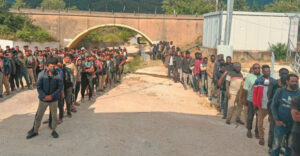
At the foot of Mount Beles, just ten kilometers from the border crossing of Promachonas, is a facility that embodies more than any other the direction of Greece’s new immigration policy. The administrative detention structure of Sintiki Serres, designed with strict security and restricted access criteria, now serves as a model – or, as they call it in the Ministry of Immigration and Asylum, a “pilot” for the new system of managing migration flows. Its position is no accident. It is located in a mountainous area, with the river Struma as a natural barrier, and is guarded daily by 148 border guards.
It is a closed-type detention centre where immigrants remain under administrative restriction until the process of examining or rejecting their application for international protection – that is, recognition of refugee or non-refugee status – is completed. This model consistently implements the new fast track procedure provided for in the recent law, speeding up procedures and drastically reducing the scope for delay.
While in the United States the Trump administration was inaugurating in the summer the new immigration detention center in the swamps of the Everglades National Park, which was called “Alcatraz with alligators”, in Greece the choice is different, but the message is similar: strictness, control and a clear framework for those who enter the country illegally.
The Sinti structure currently houses 758 residents: 552 Egyptians, 223 Bangladeshis and 3 Pakistanis. Most of them entered Greece through eastern Libya during the three-month suspension of asylum applications.
Speeding up procedures
Following the lifting of the suspension, on 14 October, it became possible to submit applications for international protection. The procedures have been accelerated following instructions from the Asylum Service Commander, Marios Kaleas. Thus, within two weeks, 314 applicants were registered, 255 interviews were conducted, and for 202 of them, the application was rejected in the first instance, mainly because they came from countries considered safe and displayed a profile of a pure economic migrant.
According to sources, the goal is clear: for Greece to implement legality in entry and stay, to prevent illegal immigration, and to manage asylum applications quickly and efficiently. The tool of administrative detention, they argue, is not a punishment, but a necessary means to maintain public order and prevent abuses in the asylum system.
Indicative of the strictness of the new model is the fact that, to date, no detainee in the facility has been granted asylum status. Although access to lawyers and NGOs is allowed, interest in legal representation remains minimal, which is attributed to the fact that most detainees are economic migrants without qualifying for international protection.
Sintiki is part of a broader plan being implemented by the Ministry of Migration and Asylum under Mr Thanos Plevris, with the central aim of transforming open accommodation facilities into controlled detention facilities. The plan includes increased border surveillance measures, accelerated returns and strengthening of repatriation agreements. According to the same media sources, the goal is to complete over 17,000 deportations and returns by 2027.
In Europe
The European dimension is equally important. Countries such as Denmark and Hungary have similar models of closed structures and expedited screening, believing that strictness acts as a deterrent to new flows. Greece, with Sintiki, is attempting to show that it can be a model for implementing a European asylum policy at the external borders of the EU.The strengthening of returns and the creation of controlled structures, such as Sintiki, are seen by the government as key tools for tackling the phenomenon of illegal migration. Government sources leave open the possibility of creating similar structures in strategic points of the country, mainly in northern Greece, with the aim of having a single line of management at the land and island borders.
Sintiki, thus, is not just an isolated structure on the border of Serres. It is the symbol of a new, strict migration policy that attempts to balance the need to protect the borders with the country’s international obligations.
However it is interpreted, one thing is certain: in the Serres Sinti, Greece’s immigration policy is taking shape.
Ask me anything
Explore related questions