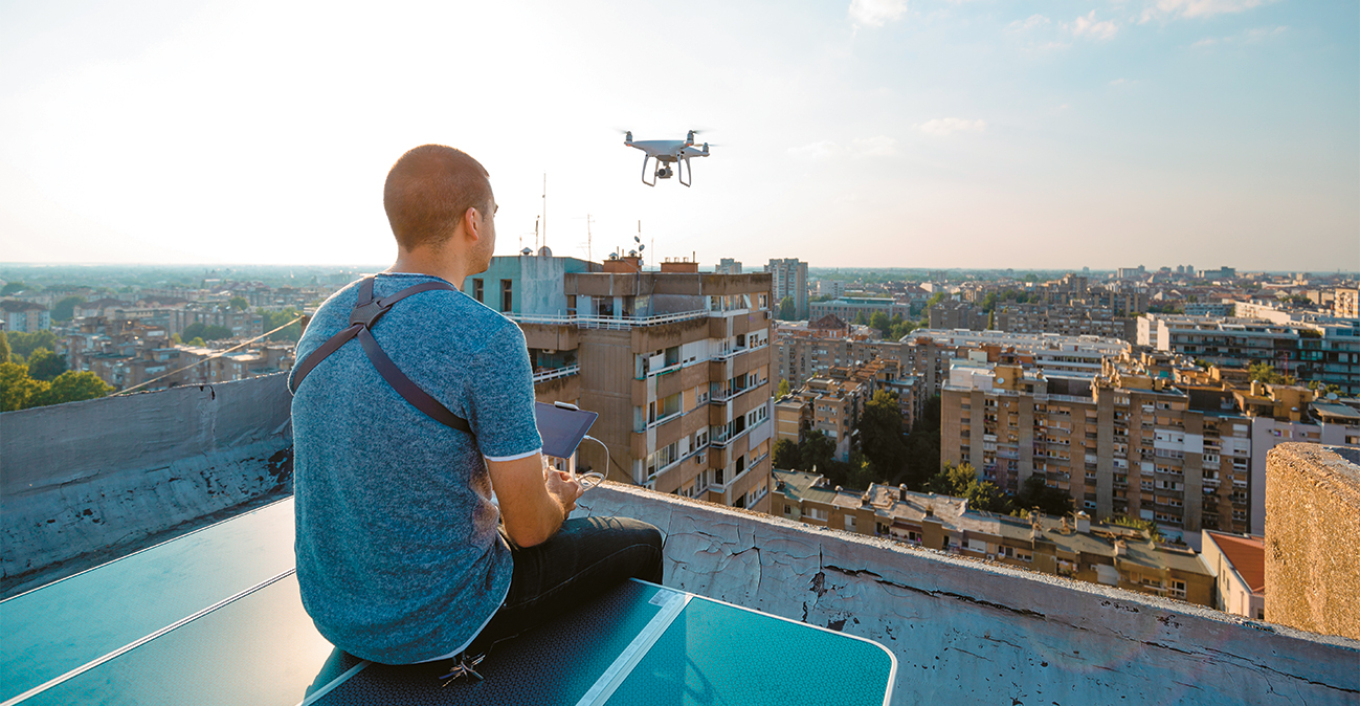
For someone who had never imagined themselves as an amateur drone operator, recording short flights—even on a daily basis—of the construction work of a particular building was something entirely practical, almost unworthy of mention. After all, the drone they used was the simplest and cheapest of the “good” ones (that is, one step above toy drones), the photos and videos concerned exclusively the building under construction, and recording stopped immediately whenever a human presence appeared in the frame.
For months, the drone captured every step of the construction, from the foundations to the concreting of the top floors, then how the bare concrete skeleton was clad with masonry, how the elevator shaft was raised several dozen meters above the ground to be placed in the shaft, and so on. The material was intended from the outset for personal use, as a keepsake, in the form of a small documentary, like a timelapse, with a building as the protagonist.
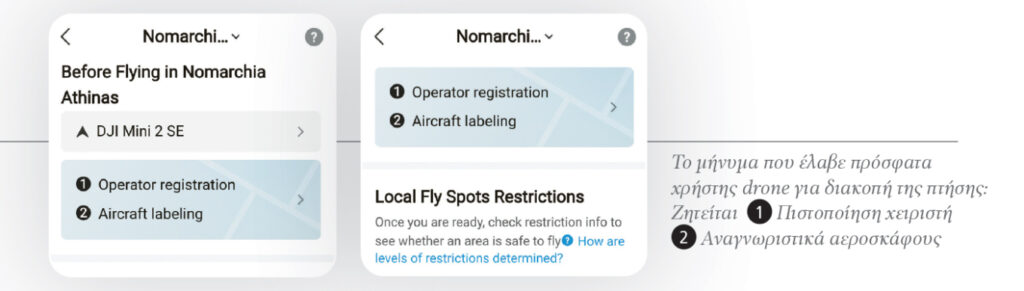
Suddenly, however, as the hundredth shot approached, the remote control’s screen went black. The drone responded to the remote’s commands, the propellers functioned normally, and nothing prevented it from taking off and flying—except for one message: “Athens Prefecture. 1. Operator Certification. 2. Aircraft Identification.”
Excluding the reference to “prefecture,” a concept long replaced by “region,” the drone’s camera was completely blocked. Some supervisory authority, possibly the Hellenic Civil Aviation Authority, intervened remotely, preventing the drone from functioning as a medium for recording still and moving images. Requiring operator certification and machine identification as a binding prerequisite for releasing the camera.
At least, that was what the drone operator assumed. They tried restarting both the drone and the remote, logged in and out of the mobile application that serves as the control screen, but all in vain. The days of free use were over, and it was time for official licensing, even though the device was barely above toy level.
Certification or End
The incident is neither a parable nor part of a fictional, hypothetical scenario. The user in question, one of thousands of amateur drone operators in Greece, suddenly faced a dilemma they thought had been silently bypassed, given that the use was so specific and so limited.
So, under the new conditions, the anonymous drone operator would either begin the process of obtaining the required operator license, certified by the HCAA, etc., or abandon the observation of the building that interested them. However, there was an additional factor that had not been accounted for: the sheer fascination of engaging with drones. Indeed, drones are an admirable invention in many respects, hence their global popularity. Only in EASA member states (European Union Aviation Safety Agency) do certified drone operators exceed 2 million.
It is practically impossible to estimate how many are users of toy drones (“from Jumbo/Temu,” etc., as the standard expression denotes the relevant distinction). Moreover, in real life, the connection between the words “user” and “toy drone” is somewhat ironic, since drones in this category, costing roughly 50 to 150 euros, tend to fly beyond the controller’s range and act autonomously, flying in unknown directions until their battery runs out.
The New Legislation
Drones in Greece—and in the EU and almost the entire world—are governed by a regulatory framework, which in Europe was established in 2021. Until 2024, there was some flexibility, in the form of an adjustment period, but this ended on January 1, 2024. Since then, the legally defined “operator” of a drone—that is, the natural or legal person who owns, rents, or intends to acquire such an unmanned aerial vehicle—is required to register in the information system of the competent domestic authority. In Greece, this system is the special drone platform of the Hellenic Civil Aviation Authority (HCAA). The critical point lies in who is truly obliged by law to register on the HCAA platform.
First, the device itself, under European regulations, does not need to be registered. The operator/user is obliged, unless: a) the drone weighs less than 250 grams and is not equipped with a camera or other sensor capable of detecting personal data, or b) it has a camera or recording sensor, weighs less than 250 grams, but is classified as a toy. All other drone users must compulsorily be certified on the HCAA platform, which requires obtaining a license corresponding to the category of device they intend to operate.
And which drones does the regulation consider toys? The relevant provision is somewhat vague and specifically states: “Products designed and intended—exclusively or not—to be used as toys by children under 14 years of age shall be considered toys and must comply with Directive 2009/48/EC on the safety of toys.”
The drone of the user mentioned earlier, a basic flying device purchased for a very specific purpose—the surveillance of the building—practically does not differ from a toy. However, due to its build quality and technical characteristics, this drone perfectly meets the operator’s requirements, almost with professional results. The device manual states that it “is a 4-rotor aircraft (quadcopter).
The maximum takeoff weight is 246 g, including a microSD data storage card. It has a foldable design and extremely light weight, downward vision system and infrared detection system. It can hover and fly indoors and outdoors, and automatically return to its starting point. With a fully stabilized 3-axis gimbal and 1/2.3” sensor camera, it records 2.7K video and 12 MP photos. The maximum signal transmission range from the remote to the aircraft is 10 km, with video quality up to 720p from the aircraft to the smartphone application. The remote operates on both 2.4 GHz and 5.8 GHz and can automatically select the best transmission channel without delay. The maximum flight speed is 57.6 km/h, and the maximum flight time is 31 minutes.”
Consequently, on the surface, such a drone, costing 350–400 euros, could be considered an expensive toy. But its technical characteristics and capabilities explain why its operator is obliged to be certified with the HCAA.
Up to 120 m Height
Although this is a spoiler for the story’s ending, the message that locked the mobile screen and called on our example operator to be certified according to EU legislation for UAS (Unmanned Aircraft Systems) was not sent by a public authority. It was likely a reminder from the application that turns the smartphone into a monitor so that the operator sees exactly what the drone camera records, along with all useful navigation information, such as orientation, flight height, remaining battery power, etc.
After a few days, the message disappeared, and the screen returned to normal operation. However, this mattered little, as the operator had already successfully passed the exam and was now a legal and certified drone user at the lowest amateur level A1/A3. Something they realized they could have done from the very beginning.
The candidate’s exam is conducted remotely, via the Internet, at any time of day, and through the platform of one of the authorized drone schools. The examinee must answer 40 multiple-choice questions. The questions are finite overall, but each exam presents them in a random order.
They are categorized as follows: flight safety for drones, air traffic, aviation regulations, operational procedures, protection against unlawful acts, privacy and data protection, insurance, human factors, general knowledge.
Briefly, during preparation, the candidate learns, for example, that the maximum allowed height for “civil” commercial drones is 120 meters, as above this limit, manned aircraft operate.
Licenses by Category
The primary classification of drones is into Open, Specific, and Certified categories. The latter two are professional and, regarding flight protocols, closely resemble manned aviation. Therefore, the main interest for amateur operators focuses on the Open category, which is further divided into A1, A2, and A3 subcategories.
A1 includes drones weighing less than 900 g with Class C0 and C1 markings, with the ability to fly over people—naturally under conditions. In A2, devices must have a maximum takeoff weight above 900 g and below 4 kg, with C2 marking and permission to fly near people. A3 concerns even larger drones, from 4 to 25 kg, with C3 and C4 markings.
Obtaining a license for categories A1 and A3 costs 45 euros, and the process is handled by the respective drone school. Once the exam is passed, the operator submits a series of documents to the HCAA, along with the required fees, and is guided step by step in registering their details on the HCAA platform via Taxis. They must also affix the “drone operator registration number” in a visible spot on the drone.
The Fascination of the Drone
The entire certification process is neither painful nor time- or cost-intensive—in any case, not enough to deter obtaining the legal license. Compliance with the law is not optional, and it is certain that, along with the multiplication of drones in real life, the scope for arbitrary use will inevitably shrink. The sector of commercial or “civil” drones—flying machines not intended for military use—has been in explosive growth in recent years.
Aside from specialized DIY builds, mass-produced drones—mostly from China—often surprise with their continually improving capabilities, attracting, beyond gadget maniacs, anyone who discovers the ease of use and enjoyment provided by their operation.
People in the Greek market, such as Mr. Giannis Koutsoulas (Greek Rotors, Drone Pilot School), with over a decade of experience in sales, technical support, and operator training, note both the lack of reliable statistics on drone owners and the growing public interest, which exceeds the superficial desire of children to own a drone, often as a school reward or festive gift.
“Today, anyone can buy a drone of any kind, from something simple, under 250 grams costing 300–400 euros, to specialized models costing, for example, 30,000 euros, capable of carrying loads up to 30 kg. Usually, these very large and powerful drones are used by public authorities, such as the Fire Service, to transport hoses to remote areas where a fire has broken out. But there are also drones that carry heavy high-resolution cameras, others used by surveyors or in agriculture (spraying, crop inspection with special cameras, etc.), or transporting components for wind turbines from peak to peak. I believe we will see many interesting developments in Search and Rescue, or even how drones of the future will transport us from point A to point B.”
Ask me anything
Explore related questions