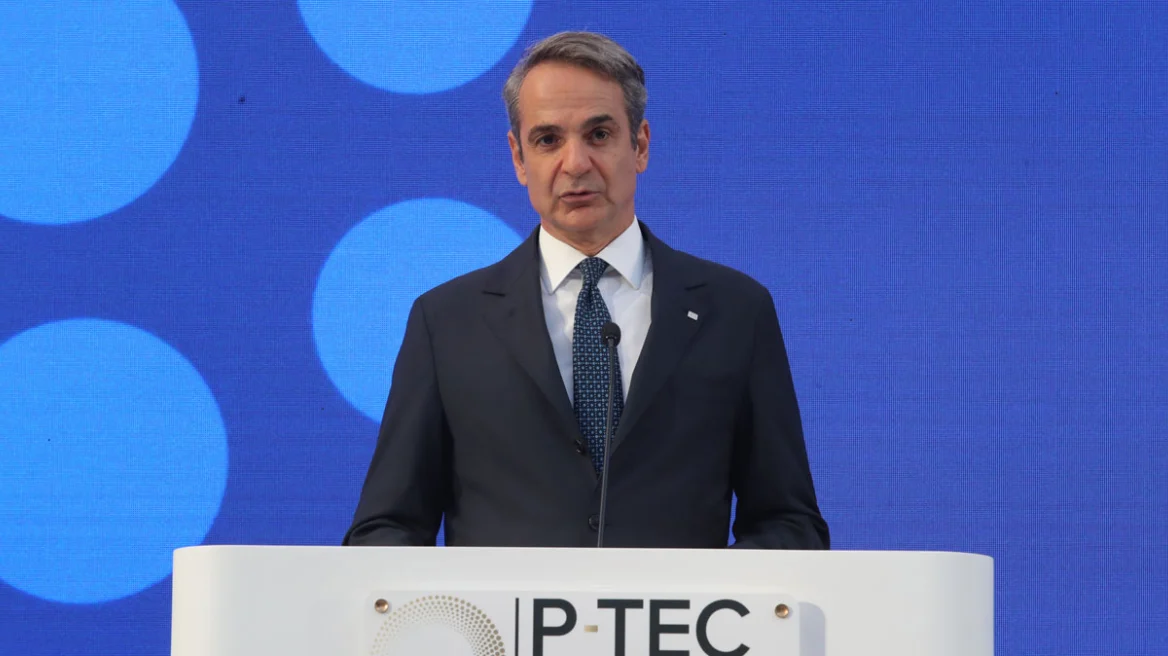
Speech at the 6th Ministerial Meeting of the Transatlantic Partnership for Energy and Climate (P-TEC) at the Zappeion Hall is being delivered at this moment by Prime Minister Kyriakos Mitsotakis — one day after the agreement with ExxonMobil for drilling in the Ionian.
The agreement between ExxonMobil, Energean and HelleniQ Energy for the concession of offshore Block 2, west of Corfu, opens a new era in the hydrocarbons sector in Greece.
The agreement — with strong geopolitical and investment footprint — brings the country closer to the prospect of acquiring the status of a natural gas producer, for the first time in its modern history.
The investment plan
According to the agreement, ExxonMobil undertakes 60% of the concession and becomes operator of the project, with HelleniQ Energy retaining 20% and Energean the remaining 20%. Block 2 is considered the most mature for an exploratory drilling, as it has complete seismic data and positive indications of natural gas reservoirs.
ExxonMobil Vice President John Ardill said yesterday on the sidelines of the Transatlantic alliance summit that the investment size for the exploration stage is estimated between $50 and $100 million. Work is expected to begin with exploratory drilling, while the first natural gas production is estimated to be able to start in the early 2030s. As he pointed out, the drilling decision is expected to be taken in 2026, while the technical design will be developed in the 2026-2027 period.
“We are planning very carefully,” Mr. Ardill underlined, noting that if exploration is successful, total investment could reach $5 to $10 billion in a seven-year horizon — that is, up until 2030. From 2030 to 2035, he added, if results are positive, Greece could move to the production phase. “We have not completed the evaluation yet,” he clarified, adding that final decisions are expected next month.
The strategic significance for Greece and Europe
ExxonMobil’s participation represents the most substantial return of American presence in the Greek energy sector in decades. Beyond the investment dimension, the multinational’s presence acts as a signal of confidence in the stability and institutional maturity of the Greek energy market. Market sources estimate that American involvement significantly raises the level of the undertaking, ensuring access to global-scale know-how and capital.
Economically, the prospect of identifying commercially recoverable deposits could translate into a development advantage for the country, reducing dependence on imported resources and strengthening public revenues.
At the same time, Greece strengthens its position as an energy hub for Southeast Europe, connecting the Mediterranean with Central Europe through new LNG infrastructure and natural gas pipelines.
Ask me anything
Explore related questions