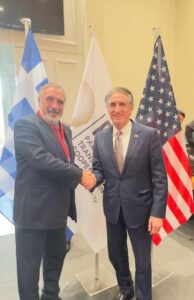
At the heart of the discussion between Greek shipowners and the American delegation in the framework of the Transatlantic Energy Cooperation (P-TEC) was the intervention of Dr. Nikos Tsakos, who clearly raised the need for the creation of a financial institution, the American leasing as a counterbalance to the powerful Chinese leasing schemes that have dominated the shipping market in recent years.
The founder and CEO of Wall Street-listed Tsakos Energy Navigation pointed out, addressing US Secretary of the Interior, and Chairman of the Energy Sovereignty Council Doug Bergham, that the US side must formulate an attractive and competitive financing framework for the global fleet that serves the US economy: “If there is to be a real alternative to Chinese financing structures, then America must promote its own leasing,” he said, noting that the industry is willing to support such an initiative if the right conditions are in place.
In his remarks, Nikos Chakos highlighted the central contribution of shipping to the global economy, conveying what he said are often overlooked figures. “We transport 60% to 80% of the goods and energy the world uses. We are the most economical, efficient and environmentally friendly way of transporting large volumes,” he said, recalling that the industry bears a disproportionate burden without unified political representation.
Referencing the dimension of shipping’s geographical dispersion, he said, “We are a fragmented industry. We are not concentrated in one place, nor are we voters in any particular country. That is why we often remain on the margins of public debate.” Nevertheless, he acknowledged the recent efforts of the U.S. government to reintegrate shipping into the core of its energy and industrial policy.
Nikos Tsakos also highlighted the close cooperation of Greek-owned vessels with the American market. “Seventy percent of our activity comes from the major U.S. oil companies. We primarily operate in the United States,” he said, emphasizing that the daily operational reality of Greek-owned ships is already directly linked to the needs of the American economy.
In this context, he stressed that strengthening the U.S. shipbuilding base could reduce unnecessary voyages of ships to Asia for dry-docking. “Instead of traveling empty to China, with high costs and a negative environmental footprint, we would prefer to go to American shipyards, whenever and wherever this is feasible,” he noted. “With the right investments, this can become a reality.”
He also made special reference to the dimension of maritime education. “Greece has centuries of maritime tradition. All our islands are maritime islands. We have academies; we continuously train people,” he said, recalling that the Tsakos Foundation has funded the first private maritime academy in Maryland. He added that Greek companies would welcome American cadets on their ships, so they can gain experience in the international shipping environment.
Concluding his remarks, Tsakos publicly expressed his appreciation for the U.S. Coast Guard. “I want to warmly thank the U.S. Coast Guard for its significant role, the support to the crews, and the transparent procedures,” he stated, noting that this cooperation contributes to stability in the operations of Greek-owned vessels in the United States.
Ask me anything
Explore related questions