The choice of the name of the Tactical Exercise with Troops (TAMS), which will take place at the end of next week in Xanthi, can hardly be considered accidental. TAMS “Aisios Oionos 25”, as this medium scale exercise is called, essentially marks the transition of the Hellenic Armed Forces into the new era, incorporating for the first time in its scenario domestic defence innovation – that is, new drone and anti-drone systems, as well as the lessons from the conflicts in Ukraine and the Middle East, which radically changed developments in the theaters of war in the 21st century.
At its core, the exercise aims at training participants in the planning and execution of land operations, increasing combat capability at the tactical level and strengthening cooperation – goals which are expected to be further served by the integration of new technologies on the field. For this reason, units of the Supreme Military Command of Thrace (ASDITH), which replaced the IV Army Corps, will participate in the exercise, with armored vehicles, mechanized vehicles, self-propelled artillery, anti-tank missiles, transport/attack/reconnaissance helicopters, fighter aircraft, Special Forces and for the first time Unmanned Aerial Vehicles (UAVs).
Surprises in Thrace
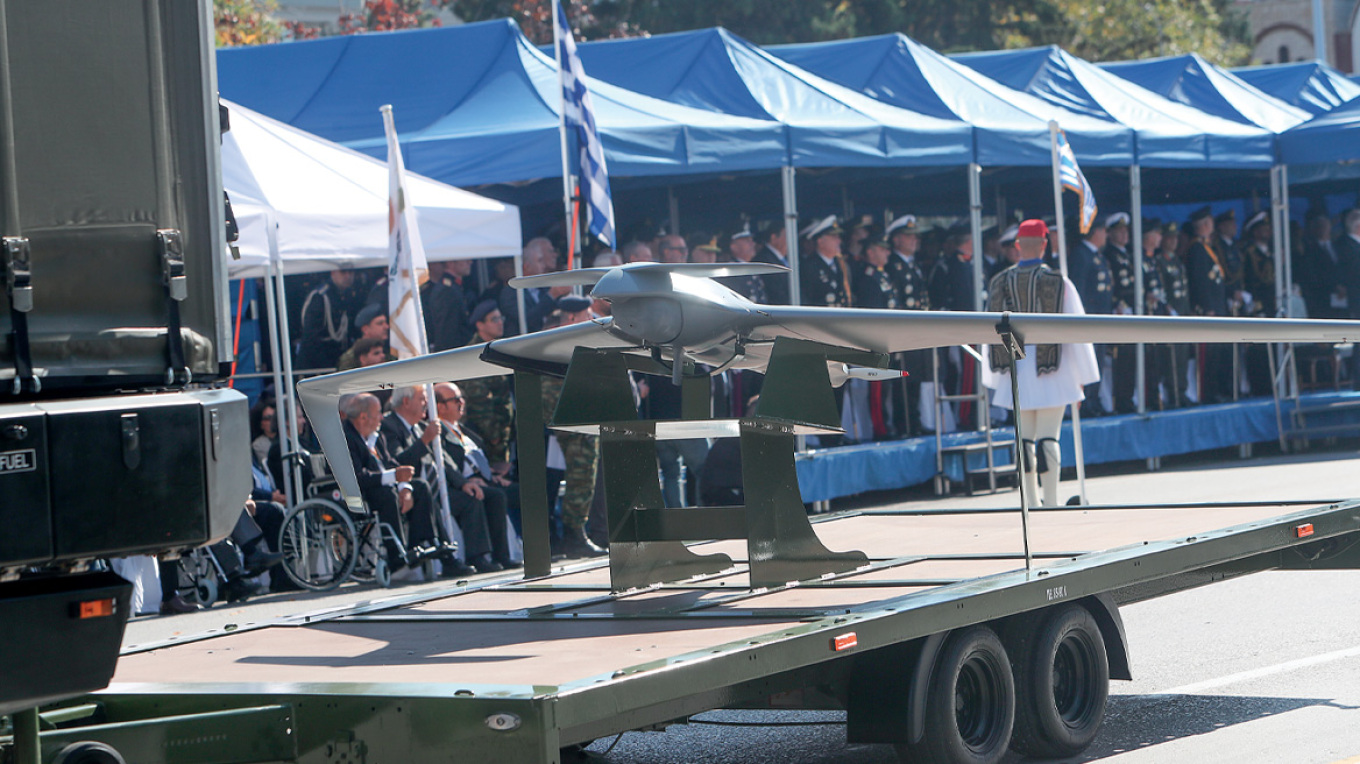
Even more interesting, though, is that the scenario of this particular exercise also includes drone and anti-drone systems that were not presented publicly during this year’s military parade for the celebration of the national anniversary of October 28th in Thessaloniki, where a total of 17 new weapons systems participated as a form of validation of the strategic transition of the Armed Forces into a new era of technological autonomy. And although on Nikis Avenue the weapons systems that basically constitute the “Shield of Achilles” were presented – that is, an integrated protective dome with multiple layers of defence, such as unmanned aerial vehicles, autonomous maritime systems, surveillance, communications and network-centric control systems – nonetheless the Pentagon’s “arsenal” does not appear to end there. On the contrary:
- The “HERON” unmanned aircraft.
- The M1117 wheeled vehicle, which is an autonomous surveillance system.
- The SPIKE NLOS precision missile system.
- The “Centaurus” anti-drone system, which has already been installed on Naval frigates operating in the Red Sea.
- The “Hyperion” drone detection and neutralization system.
- The ultra-modern S-100 drone, included in the equipment of the new Belharra (FDI HN) frigates.
- The “Archytas” Unmanned Aerial Vehicle system.
- The A900 unmanned helicopter used by Navy vessels.
- And the four “V-BAT” UAV systems.
Even more and previously “invisible” systems will participate in the “Aisios Oionos – 25” exercise. Specifically, the Department of Innovation and New Weapon Systems is said to have in its strategic plan a much broader range of systems, as part of the new deterrence doctrine in order to serve the dynamic transformation of the Armed Forces, while simultaneously supporting the domestic defence industry.
Within this framework, Minister of National Defence Nikos Dendias referred to the effort to create an innovative defence ecosystem with the establishment of the Directorate of Innovation of the Hellenic National Defence General Staff and the Hellenic Defence Innovation Center (ELKAK), meeting this week with the General Council of SEV, with the main aim being the support of domestic productive capability in the Defence sector.
Industry present as well
In this direction, one of the innovations of TAMS “Aisios Oionos – 25” is that in this specific military exercise there will be a demonstration of drones, but also loitering munitions, both from the Center for Research Technological Development and Innovation as well as Greek companies active in the defence industry, effectively promoting the domestic ecosystem. Describing the new cooperation model between the Pentagon and domestic industry, “ELKAK receives the questions from the Directorate of Innovation and forwards them to the Greek ecosystem of defence companies. It is also responsible for receiving the answers and passing them on to the Directorate of Innovation, which in turn will evaluate them,” Mr. Dendias stated, in an attempt to simplify procedures and accelerate Greek production, given the high European demand for reliable products in the defence sector.
Ask me anything
Explore related questions