





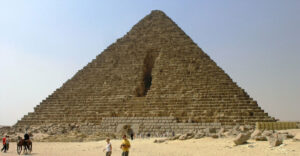
After 4,500 years, scientists may have uncovered a hidden entrance inside one of Egypt’s most iconic pyramids — a discovery that could rewrite what we know about the ancient tombs of Giza.
Built around 2510 BC and standing 61 meters tall, the Pyramid of Menkaure is the smallest of the three Great Pyramids on the Giza Plateau. It was constructed as the burial place of King Menkaure, ruler of Egypt’s Fourth Dynasty — whose sarcophagus mysteriously vanished nearly two centuries ago.
Now, thanks to advanced scanning technologies, researchers from Cairo University and the Technical University of Munich (TUM) have identified two hidden air-filled voids within the pyramid’s eastern face. These anomalies, experts believe, may point to a secret second entrance that has remained undiscovered since antiquity.
Two Hidden Cavities Detected Beneath the Surface
The team used a combination of non-invasive techniques — including ground-penetrating radar, ultrasound, and electrical resistivity tomography (ERT) — to examine the pyramid’s granite blocks without damaging them.
They found two air-filled cavities of different sizes:
- One located 1.4 meters deep, measuring 1 meter high by 1.5 meters wide.
- Another, 1.13 meters deep, measuring 0.9 by 0.7 meters.
Although the exact purpose of these voids remains unclear, their alignment suggests they may form part of a concealed passageway or secondary entrance on the pyramid’s eastern side, facing the Nile River.
Professor Christian Grosse, an expert in non-destructive testing at TUM, described the discovery as “a major step forward” in pyramid research:
“Our testing methodology allows us to draw precise conclusions about the pyramid’s internal structure. The scenario of another entrance is highly probable — and our results bring us much closer to confirming it,” he explained.
Hidden voids found in Egypt's Menkaure Pyramid. Researchers have discovered two hidden air-filled voids behind the eastern facade of the Menkaure Pyramid at Giza, providing the first evidence supporting a long-standing hypothesis about a previously unknown entrance to the ancient… pic.twitter.com/oHC2wMkmtE
— Stephen hawking (@hawking2023) November 8, 2025
Smooth Stones Hint at Hidden Design
Researchers noted that the granite blocks on the pyramid’s eastern face are unusually smooth and polished — just like those surrounding the known main entrance on the north side. This architectural detail supports the theory that a second entryway may have existed and been sealed thousands of years ago.
If confirmed, the discovery could lead to new chambers or corridors still hidden within the monument — potentially containing artifacts or treasures unseen by modern eyes.
Mystery of the Missing Sarcophagus
Menkaure’s pyramid was built as a royal tomb, but his sarcophagus was lost at sea in 1838 when the British ship Beatrice sank off the coast of Malta while transporting it to the British Museum.
Since then, the inner layout of the pyramid has been partially explored, with tourists today able to visit the main burial chambers and tunnels. Yet, this new find suggests that whole sections of the pyramid remain untouched — keeping their ancient secrets sealed for millennia.
The Great Pyramids: Still Shrouded in Mystery
The Giza complex, west of Cairo, includes the Pyramids of Khufu, Khafre, and Menkaure, along with the Great Sphinx. Despite centuries of study, their construction methods, astronomical alignment, and true purposes continue to puzzle archaeologists.
As technology advances, discoveries like this prove that the pyramids of Egypt still have stories to tell — waiting beneath layers of stone, sand, and time.
Ask me anything
Explore related questions




