





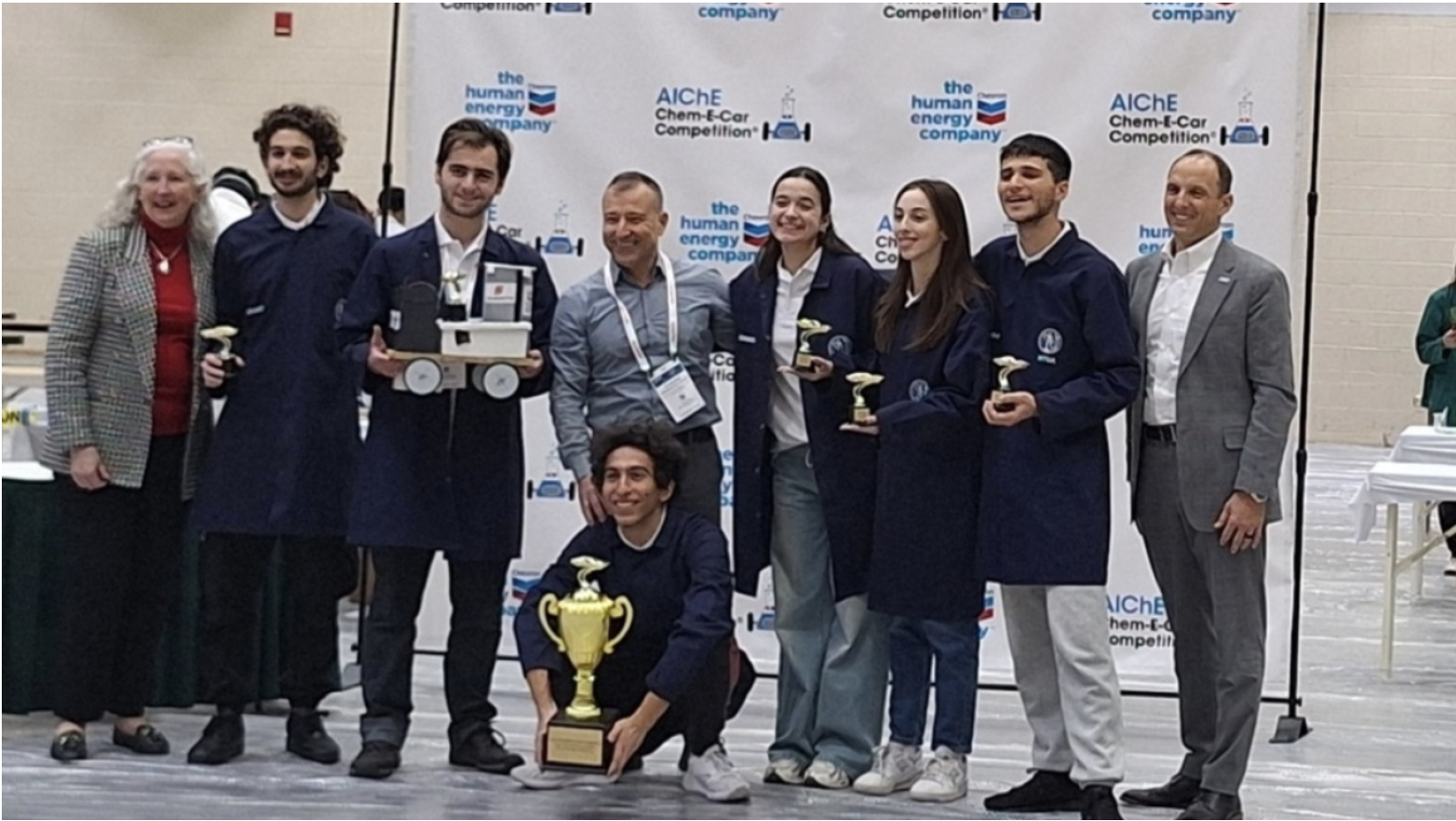
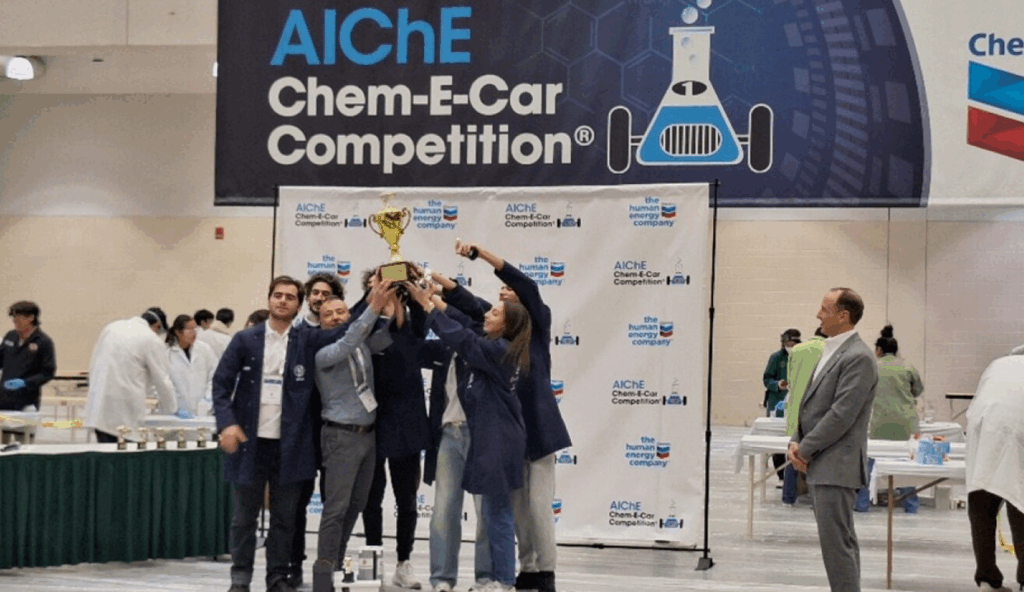
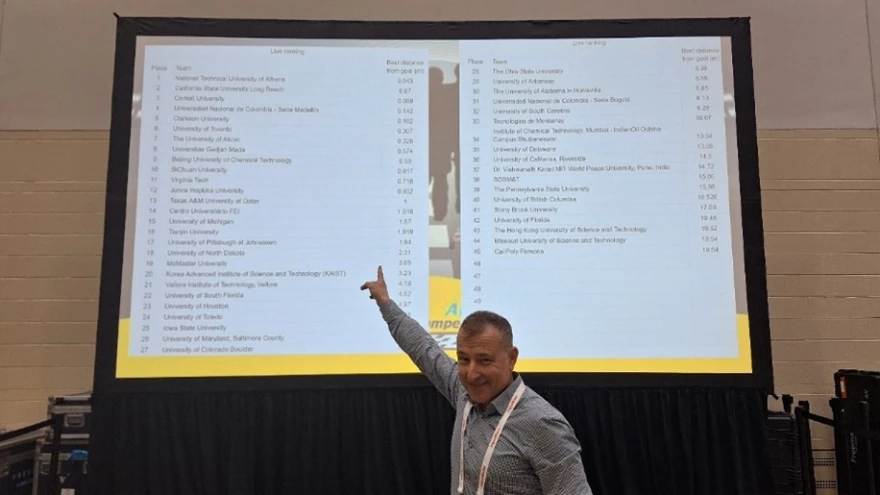
The “CHAOS” team from the School of Chemical Engineering of the National Technical University of Athens (NTUA) won 1st place in the annual global Chem-E-Car Competition®, which took place in Boston, USA, on November 2, 2025, within the framework of the “2025 American Institute of Chemical Engineers (AIChE) Annual Meeting,” held annually in the United States.
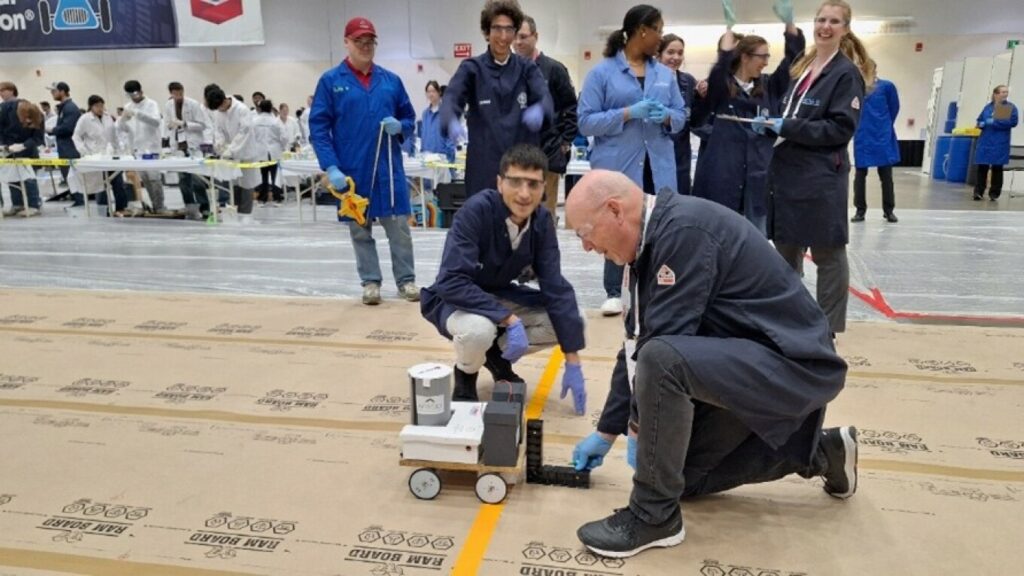
The competition, in which 53 teams from around the world participated, has an educational character. It focuses on developing skills in experimentation, design, and precision through the construction of a small vehicle powered by chemical or electrical energy, which must travel a predetermined distance without external intervention.
The NTUA team achieved an impressive performance, as the chem-e-car constructed by the students of the School of Chemical Engineering of NTUA covered the required distance of 19.54 m with a deviation of only 0.04 m (4 cm)!
The educational objective of the competition
As Professor Thanasis Papathanasiou of the NTUA School of Chemical Engineering explains to protothema.gr, “the competition aims to teach students the value of measurable results and experimental accuracy.
Participants are asked to construct a small car that must reach exactly the finish line, which is between 15 and 30 meters from the starting point. The exact distance is announced only one hour before the race, a fact that increases the level of difficulty.”
According to the rules, the vehicle must move using a power source designed by the students themselves. It is usually a battery or a chemical reaction that produces a propellant gas.
However, the unique aspect of the competition is that the measurement of time, distance, or the use of brakes or remote control is not allowed: the car must stop on its own when its energy is depleted or when a chemical or electronic control mechanism is activated.
“The objective is for the vehicle to travel the specified distance exactly, without external intervention,” notes Professor Papathanasiou, adding that students must design the chemical reaction in such a way that it functions as an internal “clock.” Some teams, for example, use chemical solutions that change color after a specific amount of time.
This change is detected by a sensor, which signals the circuit to cut off the power supply. Other teams choose different methods, such as detecting changes in the conductivity or pH of a solution.
Success, therefore, depends on how well students have calibrated their reactions so that the vehicle stops exactly at the finish line.
Through this process, participants learn to work with precision, to meticulously monitor the condition of their chemicals, and to build mechanisms with high energy efficiency. “Under pressure and competition, the students learn to be professionals and to pay attention to every detail,” emphasizes the professor.
It is worth noting that the recent change in the competition regulations (banning the use of voltage regulators) pushed the students to show even greater creativity and to design a durable and efficient propulsion system, which led to this year’s global distinction.
NTUA’s participation and the level of competition
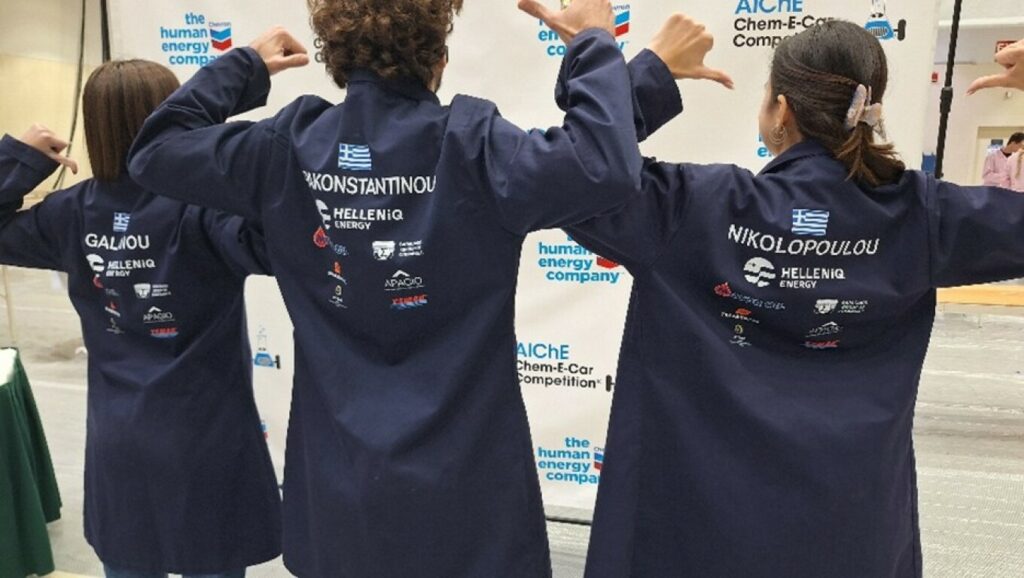
The NTUA team consisted of seven members: Dimitris Vlatas, Kalliopi Galanou, Giannis Bartsotas, Vasiliki Nikolopoulou, Zacharias Koureles, Orestis Papakonstantinou, and Anastasis Chatzakis – six of whom traveled to Boston – mostly third-year students, along with Professor Papathanasiou as their coach.
The level of competition is particularly high: each year, about 50 universities participate, 40 of which are from the United States, while the rest represent countries from around the world. The teams that reach the final have previously qualified through regional competitions held in the spring.
The international final takes place each year in the United States, within the framework of the large AIChE conference, which gathers up to 5,000 participants from the field of chemical engineering and enjoys significant recognition. In Greece, the qualifying competition is organized by NTUA as part of the Greek Chemical Engineering Conferences, which are hosted in various cities in rotation.
NTUA’s first participation in the global event took place in 2016, following the encouragement of two distinguished Greek professors in the United States: Professor Stephanopoulos from MIT and Professor Georgakis from Tufts University. NTUA’s participation was organized through the collaboration of these two professors and the then Dean of the School of Chemical Engineering, later NTUA Rector, Professor Andreas Boudouvis.
The two academics mobilized the Greek-American community, which proceeded to raise funds to support the first participations of Greek students. Since then, NTUA’s participation has been firmly established, with the specific school not only competing but also steadily improving its standing.
More specifically, this year’s success follows last year’s 3rd place achieved by the “ATHENA” team in the corresponding competition in San Diego in 2024, demonstrating the continuous progress and dedication of NTUA’s students.
In their first participation in 2016, the students achieved 16th place, and later reached 5th and 3rd place in the international competitions held in Orlando (2019) and San Diego (2024), respectively.
The steps that led to success and the significance of the experience
The team’s preparation lasts about one year, with the members being renewed each time. The experience, according to the professor, offers students much more than a simple distinction.
“The students are exposed to an international environment, they meet other students and professors, and they gain recognition. They feel their efforts have been rewarded and are filled with enthusiasm—they say, ‘it was worth it!’” notes Professor Papathanasiou.
Participation in such a highly recognized competition opens new paths for the students. The Greek-American community in the U.S. warmly supports such efforts, as many Greeks excel in the field of chemical engineering at American universities.
The successes of the Greek teams enhance the prestige of Greek institutions and highlight the potential of the country’s young scientists.
As for the students’ future aspirations, opinions appear divided. “Some want to stay in Greece, others to go abroad for postgraduate studies or work. I would say it’s fifty-fifty,” comments the professor. In any case, the competition experience serves as a valuable step in both professional and personal development.
Ask me anything
Explore related questions




