





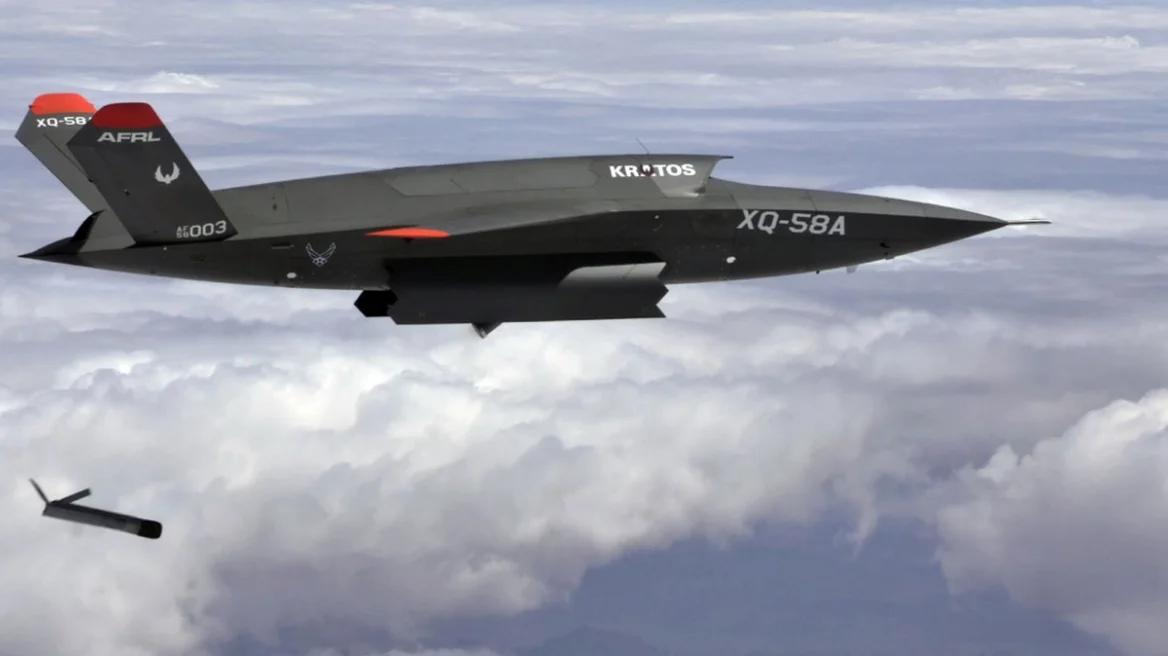
Artificial intelligence is now entering the military mechanism dynamically — not as an aid, but as a fundamental force multiplier. From Washington to Beijing, AI is becoming the factor that shifts the balance of power.
Weapons factories no longer produce only steel. They now produce code — machines that decide, predict, and adapt.
The logic is clear: in the battles of the 21st century, victory belongs to those who read the environment first — those who see threats before they appear.
Those who manage data faster than any human being. AI is the new nuclear technology of the century. You don’t have it to impress — you have it to survive.
The U.S. has realized this. China is already implementing it. Russia is trying to catch up.
The Collaborative Combat Aircraft (CCA) is the first program entirely built on this logic — the first where the algorithm does not merely assist the pilot, but acts as their partner.
CCA vs Conventional Fighter — an unequal comparison
Cost, time and production line
An F-35 needs more than a decade to go from design to combat. It has thousands of parts, hundreds of subsystems, dozens of suppliers. It requires massive support, training personnel, specialization. Each variant costs $80–110 million. And its maintenance is even more expensive.
The CCA operates on a different logic
It is smaller. Lighter. Simpler in structure. Its engine does not need to reach the performance of an F-35. It needs reliability and economy. That drops the cost to $25–30 million and allows production of many units in a short time.
The conventional fighter is a “jewelry store” — the CCA is a “tool.” The first is unique. The second is produced by the dozens…
Ease of manufacture — why CCA is faster
Companies building CCAs use digital models, automated factories, real-time design software. They don’t need the traditional huge technical setups. They can test a flight within months, not years. The difference isn’t only size. It’s doctrine. A conventional fighter must “live” 40 years. A CCA can live 6 or 7. It does not require long maintenance because the goal is not longevity in an environment that changes and evolves at unprecedented speed.
What engine does a CCA “wear”?
CCAs use engines more like the generation of small stealth UAVs, not the monstrous engines of an F-35. They don’t need hypersonic 9G acceleration. They don’t require huge air intakes. They don’t carry the weight of a human cockpit. They can fly with more economical, more easily maintainable, and cheaper engines.
The philosophy is simple: the CCA doesn’t have to perform all the missions of an F-35; it must perform the most dangerous ones and cost so little that its loss doesn’t materially matter.
In practice, these engines allow high-volume production. The production line isn’t choked by high-strength materials or specialized sensors found only on manned fighters.
What does the operator do in an AI fighter
Here lies the real leap. The operator does not fly. The operator supervises. The CCA gives them situational awareness, options and probabilities. The human makes the critical decisions.
AI takes care of everything else. The human sets the framework — the AI makes decisions within that framework. The operator defines: the target, the mission type, the rules of engagement, the “risk level” allowed for the CCA.
AI determines: flight path, threat avoidance, target recognition, fuel management, tactics to evade fire, choice of routes and attack points.
This does not reduce the human role. It upgrades it. Because the operator doesn’t have to wrestle with hundreds of parameters. They don’t have to chase lost seconds. They only need to understand what they want the machine to do — and approve or change it.
Combat is no longer a matter of manual control. It is a matter of oversight. The operator becomes a commander — not a pilot.
With CCAs, one operator can control a “strike team” of 3, 4 or 5 autonomous fighters. The human acts like a commander at the center of the air force “hive.” They do not pilot a single aircraft. They orchestrate many. That is the truly revolutionary doctrine.
AI in the defense industry — global picture
USA
Washington places AI at the center of its defense policy. The CCA, the Replicator program, naval autonomous systems — all point in the same direction: mass production, low cost, autonomous operation.
China
China is moving just as aggressively. It produces UAVs at the pace of civilian factory output. It embeds AI at every level — from drones to autonomous submarines. The aim is to create numbers that will overwhelm the qualitative superiority of the US.
Europe
Europe follows more slowly. Future fighters FCAS and Tempest anticipate autonomous wingmen. But bureaucracy delays them. The gap with the US and China widens.
Middle East
The UAE and Saudi Arabia invest in AI-driven UAVs, seeing that they can gain power without paying for F-35s and Eurofighters.
Russia
Russia talks about AI but has industrial constraints. Its main program is the S-70 Okhotnik — a drone that nevertheless falls short of the production speed of American projects.
Why CCA is “superior” as a concept to a conventional fighter
- Produced quickly
- Costs less
- Does not put a pilot at risk
- Can operate in numbers
- Absorbs the first wave of fire
- Connects to a network and operates cooperatively
- Upgraded via software without huge physical changes
- Can change role immediately depending on the algorithm
The conventional fighter still has value. But the CCA is the future.
The leap in the AI century
The CCA is not just a drone. It is a new way of thinking about combat — a way based on data, tempo and autonomy. Artificial intelligence makes armies more agile, faster, deadlier. Humans are not replaced. They are upgraded.
If the F-35 is the king, the CCA is the swarm that changes the game.
Ask me anything
Explore related questions




