





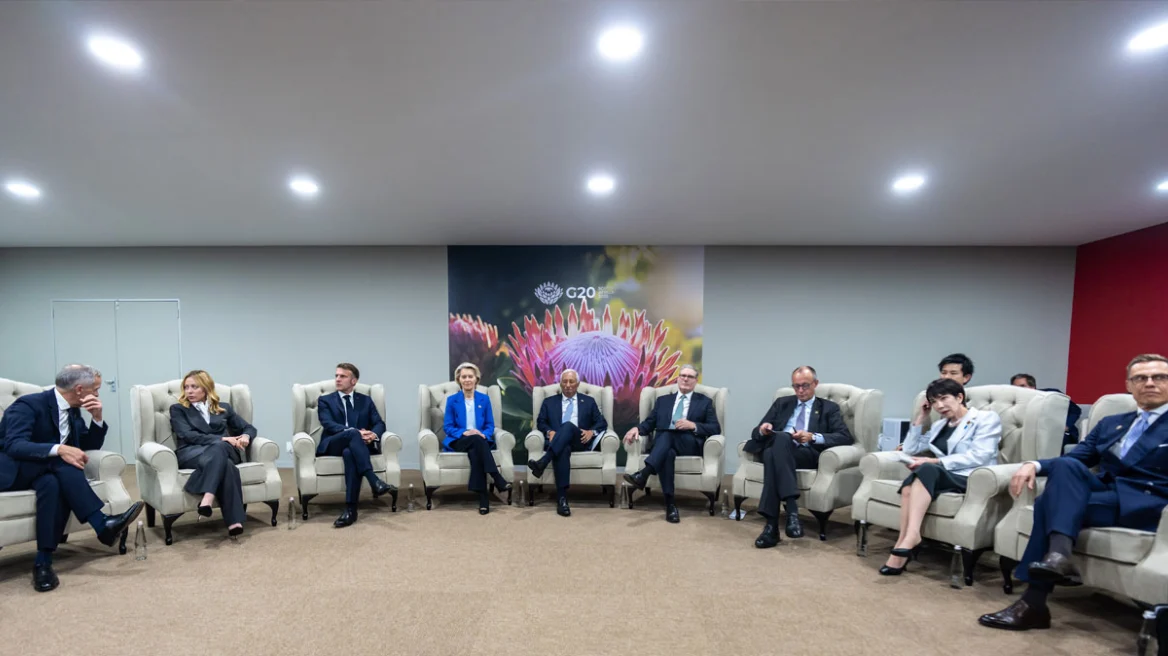
A joint statement on the American 28-point plan for ending the war in Ukraine was adopted by European and other Western leaders on the sidelines of the G20 summit in South Africa.
The leaders reiterate that they are “clear in the principle that borders must not be changed by force.” At the same time, they note that they are “concerned about the proposed restrictions on Ukraine’s armed forces,” stressing that such terms “would leave Ukraine vulnerable to a future attack.”
In the communiqué, they state that they “welcome the ongoing efforts by the United States to bring peace to Ukraine” and note that the initial version of the plan “contains significant elements that will be essential for a just and lasting peace.” They add that they regard the text as “a basis that will require additional work” and express readiness “to engage” so that any future peace agreement will be viable.
Special reference is made to the provisions of the American plan that concern the European Union and NATO. “We reiterate that implementation of certain elements will require the consent of the EU and NATO member states, respectively,” the statement notes.
At the end of the text, the signatories “underline the strength of their continued support for Ukraine” and state that they will maintain close, coordinated cooperation “with Ukraine and the United States in the coming days,” as work continues around the 28-point plan and the prospects for a peace process.
The document is co-signed by European Council President António Costa, European Commission President Ursula von der Leyen, German Chancellor Friedrich Merz, French President Emmanuel Macron, UK Prime Minister Keir Starmer, Italian Prime Minister Giorgia Meloni, Spanish Prime Minister Pedro Sánchez, Finnish President Alexander Stubb, Dutch Prime Minister Dick Schoof, Irish Prime Minister Micheál Martin, Norwegian Prime Minister Jonas Gahr Støre, Canadian Prime Minister Mark Carney, and Japanese Prime Minister Sanae Takaichi.
What the implementation of Trump’s plan for Ukraine means for Europe
Meanwhile, as protothema.gr wrote earlier, the 28-point text is not “peaceful” in the classical sense. It is the first American framework that accepts that Russia remains where it currently is, that Ukraine becomes smaller, and that the West must close a war it cannot—or does not want to—fund indefinitely.
The United States presents this as “realism.” For Europe, however, it is the beginning of a geopolitical storm that brings new balances, new fractures, and new responsibilities.
The stakes
What is at stake is not just the future of Ukraine, but the cohesion of Europe itself. The 28-point plan moves along three axes:
• Freezing the lines at today’s fronts.
• Commitments to neutrality for Ukraine—outside NATO, with a reduced military footprint.
• Gradual reintegration of Russia into the international system, in exchange for limited security guarantees.
For Europe, this translates into something simple and weighty: the continent will live for years with a Russia dominant in the East and a weakened Ukraine. The security balance of recent decades is collapsing.
• For the first time since 1945, a foreign power is changing borders in Europe, and the only question is whether the EU will legitimize this fait accompli or challenge it—without an American umbrella.
• In this context, Volodymyr Zelensky faces the most difficult dilemma of his presidency—perhaps of his life.
Ask me anything
Explore related questions




