





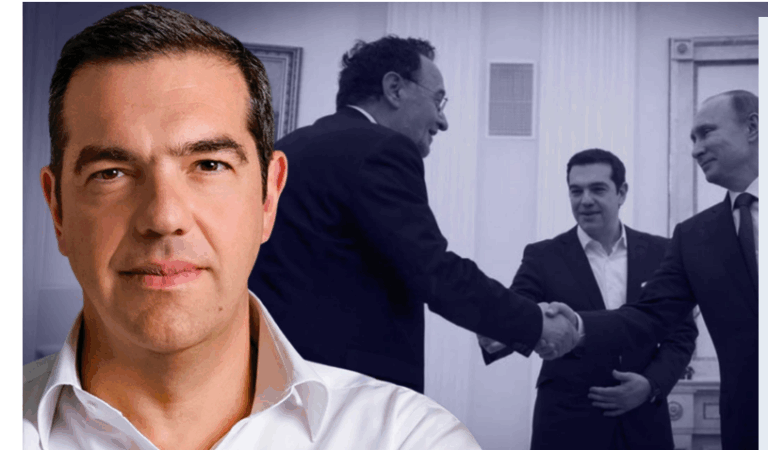
According to Tsipras, President Putin responded quite bluntly, saying he would prefer to donate such funds to an orphanage, as providing them to Greece “would be equivalent to throwing them away,” given the country’s financial collapse at the time. Greece, he noted, did not need hundreds of millions, but hundreds of billions; and while Russia was a wealthy state, it was not in a position to assume Greece’s debt burden. Ultimately, Putin advised that Tsipras would need to reach an agreement with Greece’s European partners: “You should come to terms with Merkel,” he said plainly.
Tsipras recounts in his book:
“On the afternoon of my speech at the St. Petersburg Forum [19 June 2015], I met with Vladimir Putin. It was only our second private meeting, but a truly significant experience. We sat alone in the room, accompanied only by a translator. After I described the difficulties of the negotiations and he acknowledged the tenacity of our efforts, we moved to the more delicate issues. I explained that I sought an honourable agreement with our partners and had already taken several steps back to achieve it. Yet I was not prepared to leave my country at the mercy of the lenders.
I wanted clarity — to know exactly where Russia stood, especially if, despite our efforts, the negotiations collapsed. Why had Russia declined even a symbolic investment of €200–300 million in Greek T-bills?”
Tsipras writes that Putin’s answer was “not only honest, but strikingly direct”: Greece was bankrupt, could not be saved with such sums, and Russia could not cover Greece’s financial needs. Consequently, a compromise with the European institutions was the only realistic path.
Putin then elaborated:
“I want excellent relations with Greece — particularly with your government. But I must also tell you that I have very good relations with Merkel. Germany has long been a country with which we maintain close ties; we share major energy interests, including two natural‐gas pipelines. I wish to strengthen relations with Greece, and I believe we can make significant progress together. But Greece belongs to another sphere of influence.”
When Tsipras interjected, asking whether he meant NATO, Putin replied:
“Yes — NATO and the European Union. Greece lies within the German sphere of influence.”
Tsipras responded that while Greece was part of Western alliances, it could still pursue constructive relations with other countries and follow a multidimensional foreign policy.
As the meeting drew to a close, the conversation touched on Cold War history and the post-war division of spheres of influence. In a light, almost humorous tone, they exchanged remarks about the Yalta arrangements, with Putin gently correcting Tsipras on a historical detail — that the famous note dividing the Balkans was written not on a napkin, but on a cigarette paper.
“Comrade Prime Minister”
Tsipras also recounts his first official visit to Moscow in April 2015, a trip that drew considerable attention in European decision-making circles. He notes that the European concerns were not limited to traditional Russo-skepticism or fears of a Greek divergence from the EU line after the annexation of Crimea; there was also apprehension that Greece might be seeking alternative sources of financial support.
The Greek delegation included Kotzias, Isychos, Lafazanis, and Valavani. Tsipras writes:
“It became clear during the trip that some members of the delegation seemed to believe they were visiting the Soviet Union rather than the Russian Federation — a reflection of how powerful the legacy of the USSR remained for many of us.
When our ministers spoke after my meeting with Medvedev, they repeatedly addressed him as ‘Comrade Prime Minister.’ Medvedev responded with polite smiles, though a brief expression of mild embarrassment flickered across his face — the unmistakable look of a diplomat wondering what exactly he had suddenly found himself in the middle of.”
Tsipras recalls exchanging a knowing glance with Medvedev and imagining the Russian leader’s internal monologue: “These are not simply former communists — they appear to be time-travelers.”
Ask me anything
Explore related questions




