





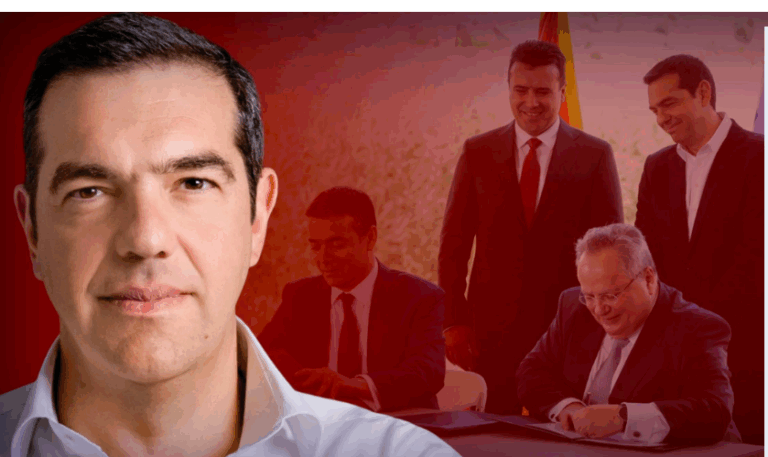
Throughout his memoir Ithaca, Alexis Tsipras frames the Prespa Agreement as a heroic and personal feat. In connection with this defining achievement of his tenure, Tsipras portrays securing the necessary parliamentary majority to remain in power and ratify the Agreement as a healthy expansion of SYRIZA through alliances with forces from the left-wing Social Democracy and the Renewing Left.
However, what was glaringly evident was that Tsipras engaged in a transparent political bargain, securing votes through the purchase of support from MPs of other parties (such as Katerina Papakosta from New Democracy, a “rag” from the dissolved ANEL, Danellis from Potami, and others.
Below are excerpts from the former prime minister’s Ithaca, in his own words:
The Demonstrations
I distinctly recall that when the two large protest rallies took place in Athens and Thessaloniki in early 2019, some of those around me faltered. A few associates advised me to abandon the matter, to refrain from attempting a resolution. If necessary, they suggested calling early elections before resolving the issue, so as to pass the hot potato to my successor in case of defeat.
One of our MPs even approached me during a tour, pulled me aside, and said: “So, the government will fall over a damn name?” His reference was unmistakably to the well-known phrase of the late Vangelis Giannopoulos: “Well, the government wouldn’t fall over a damn little house!” I laughed spontaneously but quickly sobered. I calmly explained that this issue was neither trivial nor simple. It did not lend itself to electoral cynicism or petty partisan calculus. It required a sense of responsibility because it concerned peace, stability, and geopolitical balance in the broader region.
The Dialogue with Merkel
[note: During negotiations from early 2015 onwards, Alexis Tsipras confided in Angela Merkel his ambition to resolve the Macedonian issue].
- “Angela, it will also be an opportunity to address the Macedonian issue if the government changes and Zaev is elected.”
- “Well, forget about that.”
- “Why? I want to resolve the Macedonian issue,” I told her.
She was taken aback and smiled awkwardly. - “Come on, let’s not discuss this now.”
- “Why not?” I asked decisively.
- “I want to solve the Macedonian issue because I believe it must be solved,” I insisted.
My persistence led to a brief exchange during which I made clear that resolving the Macedonian issue was a priority for me, as it would enhance my country’s regional role and its credibility on the international stage.
“I hold a different view of my country’s international position,” I emphasized, “I want Greece to be a pillar of stability, a member of the Eurozone, and I want this long-standing dispute with our neighbors to be resolved on the basis of International Law.”
I firmly believed that at that moment a window of opportunity had opened, as it seemed a Social Democrat, Zoran Zaev, would be elected in (what is now) North Macedonia, which would facilitate a joint effort to overcome the undoubtedly significant obstacles. However, she listened cautiously and did not appear to share my optimism. - “Alright, we are very weary of this issue. Others have promised to resolve it but never did. Best leave it be. It is not a priority now.”
- “Very well,” I said, slightly disappointed by her stance, “let’s move on to other matters.”
“Nonetheless, rest assured,” I told her confidently, “that if given the opportunity, I will resolve it. But this is not your concern — it is mine.”
The Double Gamble
At the outset of my tenure, I placed a double wager: that by the end of the four-year term, Greece would have exited the Memoranda and emerged as a leading power in Southeast Europe — a champion of peace, stability, and cooperation among the peoples of the region. The first goal was achieved.
To realize the second, the ratification of the Prespa Agreement by the Greek Parliament was indispensable. However, after Kammenos’ withdrawal of support, the government majority was fractured. I thus faced a dual challenge: securing the Agreement’s ratification and maintaining the government’s hold on power. It was far from simple. All odds were stacked against us.
I decided the time had come to sever ties with Kammenos. On January 13, 2019, he resigned as Defense Minister. I accepted his resignation, thanked him for our four years of collaboration, but explained that my principal objective, following the conclusion of the Memoranda, was to restore Greece’s standing in the international arena.
The Aftermath
Ultimately, the Prespa Agreement and the termination of the coalition with Panos Kammenos as a consequence allowed SYRIZA to broaden its ranks with forces from the left Social Democracy and the Renewing Left, thereby strengthening its position as the principal representative of the modern center-left in Greece.
The Vote
Minutes before the vote, I stood in my office at Parliament, watching the clock. I knew there was no room for error. I had 145 MPs. I needed 151. Not one less.
In the end, my government won a vote of confidence with 151 MPs. Apart from the 145 SYRIZA MPs, four MPs from ANEL (Kostas Zouraris, Vasilis Kokkalis, Elena Kountoura, Thanasis Papachristopoulos), the independent Katerina Papakosta, and Spyros Danellis from Potami voted in favor.
Ratification of the Prespa Agreement
The Prespa Agreement was ratified by the Greek Parliament on January 25, 2019, the fourth anniversary of our first electoral victory, following one of the most polarized and historically charged parliamentary debates since the restoration of democracy.
We ultimately gathered 153 votes in favor of the Agreement — two more than the number secured during the confidence vote just days earlier. Besides the 145 SYRIZA MPs, votes in favor came from Thanasis Papachristopoulos and Elena Kountoura from ANEL, Stavros Theodorakis, Giorgos Mavrotas, Spyros Lykoudis, and Spyros Danellis from Potami, Thanasis Theocharopoulos from KINAL, and the independent Katerina Papakosta.
Ask me anything
Explore related questions




