





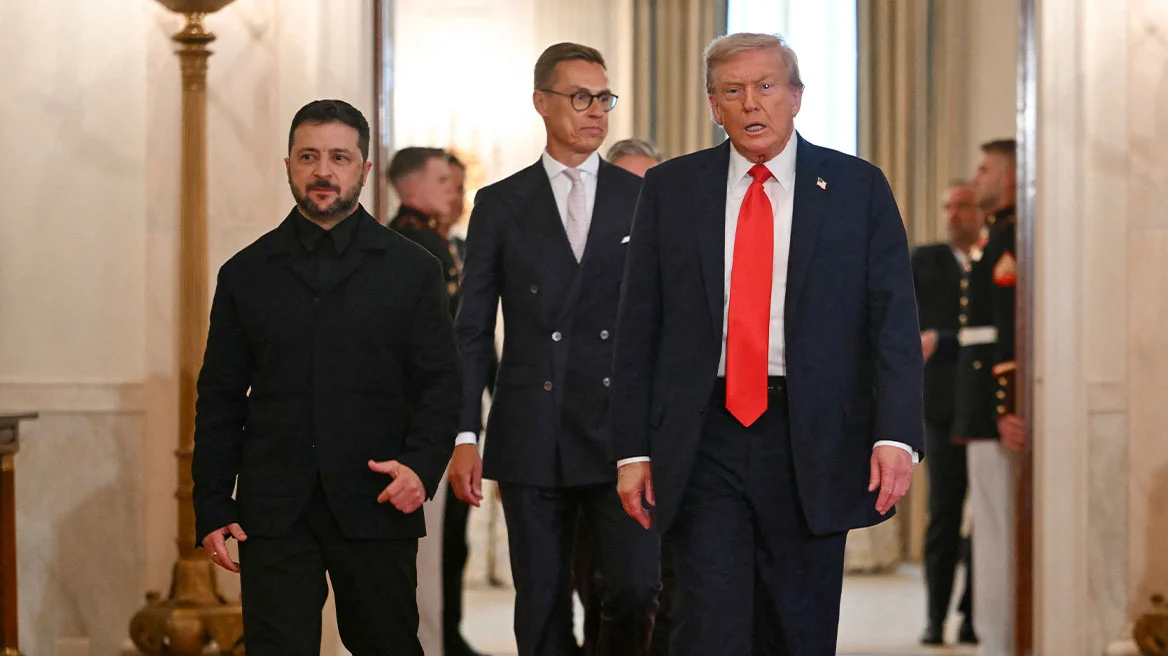
The governments of the United States and Ukraine stated late Sunday in a joint announcement released by the White House that any potential agreement to end the war with Russia “must fully respect” Kyiv’s national sovereignty, following talks held earlier in the day between American, Ukrainian, and European officials in Geneva.
The U.S. presidency praised the talks in Switzerland, attended by U.S. Secretary of State Marco Rubio, describing them as a “significant step forward” toward resolving the conflict that has been ongoing since February 2022.
U.S. Secretary of State Rubio assured after the talks that he feels “very optimistic” about the possibility of reaching an agreement “very quickly.”
The Geneva talks, which officially concluded late Sunday, were based on a 28-point plan by former U.S. President Donald Trump aimed at ending the nearly four-year armed conflict triggered by Russia’s military invasion of Ukrainian territory on February 24, 2022.
“The talks were very productive, focused, and respectful, emphasizing the shared commitment to achieving a just and lasting peace,” the text released by the U.S. presidency states, described as a “joint” statement with the Ukrainian delegation in Geneva.
The parties “reaffirm that any future agreement must fully respect Ukraine’s national sovereignty,” the text continues, clarifying that Washington and Kyiv “have drafted a new version” of the “peace framework,” “updated” and “reworked.”
Ukrainian negotiator Andriy Yermak, the right-hand man of Ukrainian President Volodymyr Zelensky, also spoke in Geneva about “very good progress” in the talks, while the Ukrainian president himself said that the new version now reflects “the majority of Kyiv’s key priorities.”
Trump had given Zelensky a deadline of November 27 to respond before stating on Saturday that the plan was not his “final offer.”
The original version of the document faced resistance in Kyiv and among European allies, who went to Geneva yesterday to prevent Ukraine from being forced to capitulate, notes the French Press Agency (AFP).
The Full 28-Point European Counterproposal for Ukraine
European governments have drafted a revised peace plan for Ukraine, incorporating several changes to the 28-point framework presented by the United States, which had faced strong criticism for being overly favorable to Russia. The European plan, prepared by the UK, Germany, and France, includes provisions such as the possible reintegration of Russia into the G8 and a cap on the number of Ukrainian armed forces.
The text was presented at the emergency meeting in Geneva, where U.S. Secretary of State Marco Rubio stated that the U.S. is already making “some adjustments” to its own plan. Rubio described yesterday’s talks as “the most important day” of the process so far. However, he added that the final text still requires approval from both President Trump and the Russian government, which has repeatedly changed its positions.
Key Provisions of the European Plan
The European text includes major concessions, including:
- Reintegration of Russia into the global economy, including possible return to the G8.
- Peace-time cap of 800,000 soldiers for the Ukrainian army (the U.S.-Russia proposal had set a 600,000 limit).
- Holding elections in Ukraine as soon as possible after signing an agreement.
At the same time, the text removes provisions for conceding the Donbas region, included in the U.S. draft, as well as the clause giving the U.S. 50% of revenues from frozen Russian assets invested in Ukraine’s reconstruction.
The European document also proposes that negotiations for potential territorial settlements begin from the frontline rather than requiring surrender of areas not occupied by Russian forces.
Additionally, it proposes a U.S. security guarantee similar to NATO Article 5, while Russian state assets would remain frozen until compensation is paid for war damages.
Reuters, which has seen the European document, reports that it retains the basic structure of the U.S. plan but introduces substantial differences.
The European 28-Point Counterproposal
- 1. Reaffirmation of Ukraine’s sovereignty.
- 2. Full non-aggression agreement among Russia, Ukraine, and NATO, clarifying outstanding issues from the past 30 years.
- 3. Deletion of point 3 from the U.S. plan, which stated expectations that Russia would not invade neighbors and NATO would not expand further.
- 4. Begin Russia-NATO dialogue post-agreement for overall security review and de-escalation.
- 5. Strong security guarantees for Ukraine.
- 6. Ukrainian armed forces capped at 800,000 soldiers in peacetime.
- 7. Ukraine’s NATO membership dependent on unanimous member consent (currently not in place).
- 8. NATO will not permanently station troops in Ukraine in peacetime.
- 9. NATO combat aircraft will be stationed in Poland.
- 10. U.S. security guarantee similar to Article 5, with conditions:
a. The U.S. will receive financial compensation for the guarantee.
b. If Ukraine invades Russia, the guarantee is void.
c. If Russia invades Ukraine, there will be a coordinated military response, reinstatement of sanctions, and revocation of recognition for new territories. - 11. Ukraine eligible for EU membership, with temporary preferential access to the European market.
- 12. Comprehensive global reconstruction package, including:
a. Creation of a Ukraine Development Fund.
b. U.S.–Ukraine collaboration on gas network restoration and operation.
c. Reconstruction of war-affected areas.
d. Infrastructure development.
e. Utilization of mineral resources.
f. World Bank funding package. - 13. Gradual reintegration of Russia into the global economy:
a. Gradual lifting of sanctions.
b. Long-term U.S.–Russia economic cooperation agreement.
c. Reintegration of Russia into the G8. - 14. Full reconstruction and financial compensation for Ukraine using frozen Russian state assets.
- 15. Creation of a Joint Security Group with U.S., Ukraine, Russia, and European participation.
- 16. Russia enacts a policy of non-aggression toward Europe and Ukraine.
- 17. U.S. and Russia expand nuclear control agreements, such as Fair Start.
- 18. Ukraine remains a non-nuclear state under the Non-Proliferation Treaty.
- 19. Restart of the Zaporizhzhia nuclear plant under IAEA supervision, with 50-50 energy distribution.
- 20. Ukraine adopts European rules on religious tolerance and minority language protection.
- 21. Ukraine commits not to retake territory militarily; territorial exchange negotiations start from the frontline.
- 22. Clause prohibiting border changes by force; violation voids security guarantees.
- 23. Russia will not obstruct Ukraine’s use of the Dnipro River and agrees to unobstructed grain transport via the Black Sea.
- 24. Humanitarian committee for:
a. Prisoner and remains exchange (“all for all”).
b. Release of civilians and hostages, including children.
c. Family reunification programs.
d. Measures for conflict victims. - 25. Conduct elections in Ukraine as soon as possible after signing.
- 26. Additional provisions for war victims.
- 27. The agreement will be legally binding, with enforcement overseen by a “Peace Council” chaired by Donald Trump.
- 28. Immediate ceasefire upon acceptance by all parties and withdrawal to agreed points under U.S. supervision.
Ukraine’s Position and Zelensky’s Red Lines
The Ukrainian government emphasizes that any agreement cannot legitimize Russian control over Donetsk, Luhansk, Kherson, and Zaporizhzhia, nor impose a “frozen” border that would trap Ukraine in de facto territorial loss. Diplomatic sources say Kyiv opposes the U.S. draft’s requirement to redeploy forces in Donetsk and requests a full revision of those points.
Volodymyr Zelensky stresses that Ukraine seeks a framework ensuring “just and sustainable peace,” emphasizing that “Ukraine will not cede territory in exchange for temporary calm.” Kyiv also demands explicit provisions for the return of prisoners and abducted children and insists that frozen Russian state assets remain frozen until compensation is paid.
Furthermore, Ukrainian leadership insists the final text include strong security guarantees and leave open—over time—the possibility of continuing its Euro-Atlantic path, even if NATO accession discussions are temporarily “frozen.”
Ask me anything
Explore related questions




