The concept of “circularity” is no longer a technical term reserved for experts — it is becoming part of everyday thinking. That’s one of the most revealing findings of the new international survey conducted by Every Can Counts, spanning 16 countries and more than 16,000 participants.
Greeks Lead the World in Understanding Circular Packaging
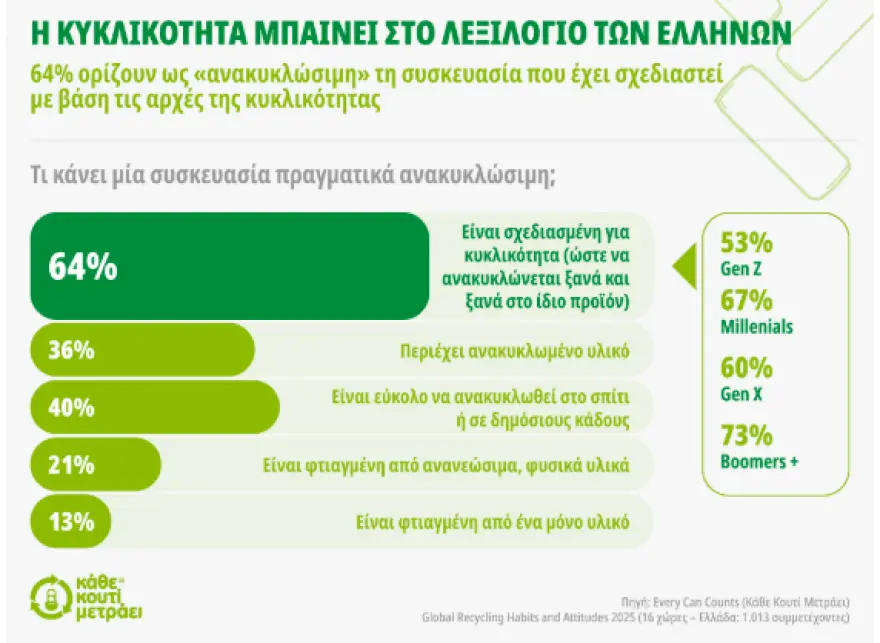
In Greece, awareness of circular packaging is remarkably high: 60% of respondents connect it with a material that can be recycled over and over into the same product — significantly higher than the global average of 50%.
Even more striking, 64% believe that a package is truly recyclable only if it is designed with circularity in mind. The term, in other words, is gaining meaning and momentum among the public.
Yet there is a generational twist: only 53% of Gen Z sees recyclable packaging as circular, compared to 73% of Baby Boomers — a clear sign that younger audiences may need more targeted communication.
“Circularity doesn’t have to be complicated,” emphasizes David Van Heuverswyn, Global Director of Every Can Counts. “Aluminum cans are living proof that truly circular packaging already exists. What’s missing is the awareness that drives people to take action.”
Greeks Support a Deposit Return System — But Few Know How It Works
Across the globe, Deposit Return Systems (DRS) are seen as one of the most effective ways to achieve true circularity. Under a DRS, consumers pay a small deposit and get it back when they return their empty bottle or can.
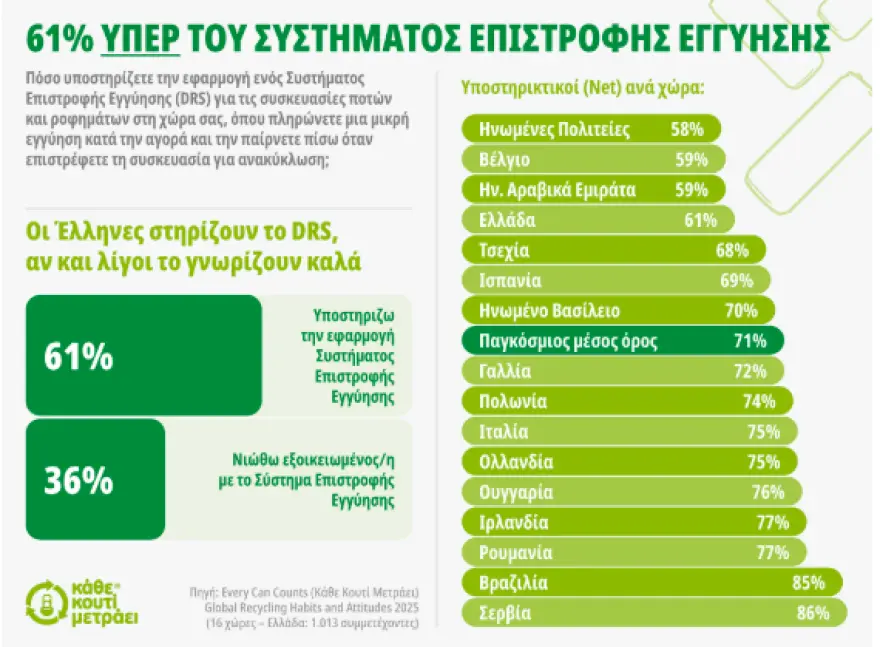
While Greece does not yet have an active DRS, 61% of Greeks support adopting one. However:
- Only 36% know what a DRS actually is
- Just 10% feel “very familiar” with it
Support, therefore, is more emotional than informational.
EU Mandate: Greece Races Against Time
The findings come at a critical moment. Under the new EU packaging rules (PPWR), all member states must have a functioning DRS for PET bottles and aluminum cans by 2029 — with Greece’s start date set for December 1, 2025.
But since the implementing body, DRS Hellas, was only established in October 2025, a delay seems almost inevitable.
Meanwhile, countries like Ireland, Romania, and the Netherlands — where DRS is already active — report 90% public participation.
In Greece, the desire is there:
- 91% believe the system should cover all single-use beverage packaging
- 83% say they would be more likely to participate if they better understood the environmental benefits
DRS, once implemented, is expected to bring Greece significantly closer to its EU circular economy goals for 2030.
What Would Make Greeks Recycle More?
When asked what would encourage them to recycle more often, Greeks were clear:
- 52% want a financial incentive
- 52% want convenient, nearby return points
- 93% would recycle more if they were assured materials are properly sorted
- 81% want the experience to be more fun or interactive (rewards, gamification)
Myths, Gaps & Realities: What Citizens Don’t Know
Despite the high enthusiasm, major knowledge gaps persist:
- Only 17% worldwide, and 23% in Greece, know that aluminum cans are the most recyclable beverage package on the planet.
- The real recycling rate for aluminum cans is 71%, compared to just 34% for glass and 40% for PET.
“Aluminum is perhaps the purest example of true circularity,” notes Irini Topouzidou, Head of Every Can Counts Greece. “It can be recycled endlessly with no loss of quality. But when so few people know this, it becomes clear that awareness is just as important as infrastructure.”
Citizens Take Responsibility — and Expect the Same From the System
Most Greeks (92%) believe recycling relies mainly on individual effort, due to a lack of long-term national strategy.
But they aren’t deflecting blame:
- 64% say consumers should take responsibility
- 59% point to collection agencies
- 41% say government
- 91% believe beverage brands must use fully recyclable or recycled packaging
About the Survey
This is the third wave of the global “Recycling Habits and Attitudes” study by Every Can Counts, conducted by Made with Insight.
- Total sample: 16,195 people
- Greek sample: 1,013 participants
Ask me anything
Explore related questions