





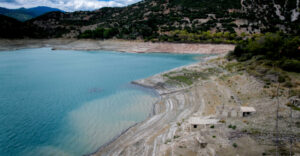
The Regulatory Authority for Waste, Energy, and Water (RAEWW) has formally recommended, following its board meeting, the declaration of a state of emergency for Attica and Meganissi (Lefkada). This comes after similar recommendations were issued for Leros and Patmos, which are already facing severe water shortages.
The request concerning Attica was submitted by EYDAP in late October, aiming to demonstrate the urgent need for immediate projects to address dwindling water reserves. Central to the plan is the partial diversion of two rivers in Evritania into the Evinos reservoir, a measure intended to boost the region’s water security.
The Study
A few weeks ago, the Authority commissioned a study and legal opinion on Attica’s water resources from Professor Christos Makropoulos, head of the Hydrology and Water Resources Exploitation Laboratory at NTUA’s School of Civil Engineering, together with the Athens-based law firm Flogaitis–Siouti. It remains unclear whether the final deliverable has been completed and submitted—an issue considered crucial for shaping final decisions.
Why Emergency Measures Are Needed
Declaring a state of emergency enables the expedited launch of studies and the immediate implementation of infrastructure projects in areas at risk of hydrological collapse.
In Attica—and by extension the islands now entering “red alert” status—EYDAP and the Ministry of Environment are activating fast-track procedures under Article 55 of the recent law on nationally prioritised projects, similar to the accelerated framework used in Thessaly. This allows processes to be compressed in time and executed without delays.
The “Eurytos” Project and River Diversions
At the centre of the response plan is the €500 million “Eurytos” project, which includes:
- The partial diversion of the Karpenisiotis and Krikeliotis rivers into the Evinos reservoir,
- upgrading water-supply networks, and
- new desalination infrastructure.
The tender for the Eurytos project is scheduled for summer 2026. The technical design includes two tunnels, 14 km and 6 km long, every four metres in diameter, capable of transferring up to 200 million cubic metres of water per year.
Ask me anything
Explore related questions




