





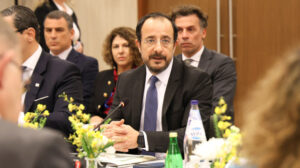
Nicosia found itself tonight at the center of European developments, with the President of the European Parliament Roberta Metsola sending a clear message of support for the upcoming Cypriot Presidency of the Council of the EU, stating that “the European Union is relying on the Cypriot Presidency.”
Standing beside her, the President of the Republic of Cyprus, Nikos Christodoulides, spoke of a national mission, highlighting Cyprus’ role as a bridge in the Eastern Mediterranean and a point of convergence for interests between the EU and the US. He reiterated his intention to invite Turkish President Recep Tayyip Erdoğan and Foreign Minister Hakan Fidan to Cyprus, adding that it is up to them whether they accept the invitation.
Close alignment between Nicosia and the European Parliament
At a joint press conference at the Presidential Palace in Nicosia, following their meeting and participation in the Conference of Presidents of the European Parliament, Metsola emphasized that the European Parliament looks forward to close cooperation with the Cypriot Presidency across a wide range of issues. At the top of the agenda, she placed migration, the revision of the Multiannual Financial Framework, the housing crisis, and the continuation of support for Ukraine.
She reminded that the Conference of Presidents traditionally visits the capital of the member state that assumes the Presidency, to ensure timely coordination on the legislative priorities for the six-month term. Cyprus takes over the Council Presidency on January 1, 2026, at a time when the Union must simultaneously deal with war on the continent, migratory pressures, and social inequalities.
President Christodoulides, for his part, assured that the Republic of Cyprus takes on the Presidency with a strong sense of pride and institutional responsibility, referring to the goal of strengthening the EU’s strategic autonomy and the need for the Union to come “closer to the region” of the Eastern Mediterranean.
Cyprus as a bridge between the EU and the US — and a message to Turkey
The Cypriot President made special reference to Cyprus’ regional role, noting that the Cypriot Presidency aspires to act as a bridge of cooperation and a point of convergence of interests between the EU and the United States, in an environment of heightened geopolitical tensions.
Within this context is his intention to invite Turkish President Recep Tayyip Erdoğan and Turkish Foreign Minister Hakan Fidan to the Informal Meeting of EU Foreign Ministers (Gymnich-type), scheduled to be held in Cyprus in April. He stressed that the invitation will be extended, though it is up to Ankara whether it accepts.
Nikos Christodoulides has already, in his public interventions, linked the Cypriot Presidency with a different approach toward Turkey, based on the logic that “geography does not change” and that it is preferable for Turkey to remain closer to the European sphere rather than drift away.
At the same time, both he and Metsola reiterated that the Cyprus Problem remains a European issue, with the President of the European Parliament underscoring the Parliament’s support for any effort to restart negotiations on the basis of UN resolutions and the EU acquis.
Migration and Ukraine at the heart of the agenda
Migration dominated the discussion, with Nicosia reminding that Cyprus continues to be proportionally one of the most burdened member states in terms of asylum-seekers, particularly through the Green Line. Metsola referred to the need for full implementation of the new Pact on Asylum and Migration and for stronger, tangible solidarity toward frontline states.
Ukraine also had a central place in the talks. The President of the European Parliament reiterated that support for Kyiv remains non-negotiable, noting that the Parliament maintains a permanent presence in Kyiv and continues to push for sustained military, economic, and political assistance.
President Christodoulides highlighted the revision of the Multiannual Financial Framework as a critical tool to continue financing Ukraine as well as emerging EU priorities such as defense and social cohesion, at a time of heightened pressure on national budgets.
Housing crisis and the need for a European financial instrument
Particular emphasis was placed on the housing issue, acknowledging that the housing crisis is developing into a pan-European problem that fuels social dissatisfaction and strengthens extreme political forces. They agreed that the plan to be presented by the European Commission must include tangible solutions and be accompanied by a specific financial instrument to help member states tackle soaring rents and the lack of affordable housing.
The Commission is preparing the first European Affordable Housing Plan, expected to be presented in December. The plan aims to create a Europe-wide investment platform for affordable and sustainable housing, mobilize additional funds, and facilitate public and private investment.
Nicosia is attempting to bring the issue to the center of the political debate during its Presidency, seeking to link the European response to the housing crisis with cohesion policy tools and the green transition, so as to ensure a real impact on citizens’ daily lives.
Ask me anything
Explore related questions




