





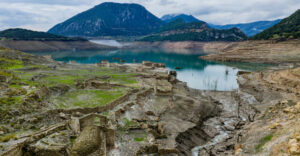
The latest footage of the water reserves in Mornos and Yliki is intensifying concerns about water sufficiency in Attica, as the two main reservoirs supplying the capital show unprecedented decline. The current state of these sites—resulting from years of drought—has triggered alarm among the authorities.
Using drones to document the situation, EYDAP crews are continuously recording the drop in water levels. Areas that were underwater just a few years ago have resurfaced, forming new shorelines around both lakes. In Mornos, parts of the old village of Kallio, which had been submerged for decades, are reappearing.
“Mornos and Yliki are drying up despite the rains – Shocking new drone images”
Recent measurements show that Mornos has lost over 40% of its total volume within two years, with its surface area almost halved. Similarly, Yliki’s reserves have fallen by 40% within just one year. Warmer, drier winters and reduced snowfall—crucial for the natural replenishment of lakes and rivers—play a decisive role.
At the same time, water consumption in Attica increased by 6% in 2024 compared to the previous year, putting even more pressure on already depleted reserves.
Despite repeated calls for responsible water use, a University of West Attica study shows that although most citizens understand the severity of the issue, only half believe that water scarcity directly affects their area.
Why the reservoirs aren’t filling despite heavy recent rainfall
A scientific explanation for why the intense rainfall of recent days has not significantly increased the water levels in Mornos and Yliki was provided today by the president of the Earthquake Planning and Protection Organization (OASP) and professor of Natural Disaster Management at the University of Athens, Efthymis Lekkas.
“Reservoirs essentially fill from runoff—surface water flowing into the basin—but mainly from the slow melting of snow that we might have in the coming period,” noted Lekkas on SKAI. He added that rainwater that does not fall directly into the reservoirs “requires a very long time to enrich the underground aquifers” and even more time before it can be extracted.
Lekkas also highlighted possible solutions that could help retain more water for consumption. One potential approach is the construction of small dams or micro-reservoirs, which can “slow down the water, allowing it to infiltrate the ground and replenish the aquifers.”
A second solution could be desalination, which “has advanced significantly in recent years,” and energy consumption has also decreased compared to older, highly energy-intensive desalination plants. However, he noted that energy consumption remains “high” and that desalination still carries an environmental footprint.
Lekkas added that reducing water losses in supply networks could also help, though he acknowledged that “it is not easy to replace all pipelines.”
The final requirement is the development of a “consumption awareness,” both in cities and in agriculture. “When we have water, we waste it; when we don’t, it creates enormous problems,” he said.
Ask me anything
Explore related questions




