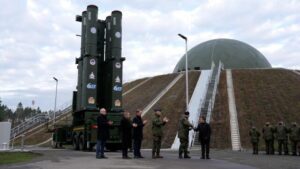
The Germany today became the first European country to deploy the Arrow 3 anti-aircraft systems, built to intercept medium-range ballistic missiles such as the Russian Oreshnik missile, as it seeks to counter what it sees as a growing threat from Moscow.
The fixed Arrow system, operating at an altitude of more than 100 kilometers outside the Earth’s atmosphere with the capability to intercept missiles of a range up to 2,400 kilometers, complements shorter-range air defense systems such as the Patriot and IRIS-T, which are mounted on trucks.
Some countries have expressed interest in purchasing this technology since the Arrow system helped prevent Iranian missile attacks on Israel in April and October 2024, according to IAI (Israel Aerospace Industries).
The ceremony took place at an airbase in Holzsdorf, about 100 kilometers south of Berlin.
Defense Minister Boris Pistorius emphasized the system’s value for early warning and protection of the population and critical infrastructure.
“With this strategic capability, which is unique among our European partners, we ensure our central role in the heart of Europe,” he said in a statement. “Thus, we are not only protecting ourselves but also our partners. In this way, we strengthen NATO’s European pillar and achieve a NATO objective.”
Germany aims to have a system designed to cover the entire country, which will be deployed in three locations—north, south, and central parts of the country—and will be operational by 2030.
The Arrow system can detect and intercept incoming missiles with a range exceeding 1,000 kilometers, launched from land, air, and sea, thereby filling a critical gap in the country’s territorial defense.
Developed by the Israeli aerospace company Israel Aerospace Industries (IAI) in cooperation with the U.S. Missile Defense Agency, the Arrow represents the highest level of Israel’s missile defense, alongside the Iron Dome, which neutralizes short-range threats.
Germany purchased the Arrow system in 2023 at a total cost of €3.6 billion, considering Russia’s medium-range missiles as a primary threat to its population and critical infrastructure.
In contrast, Russian short-range Iskander missiles deployed in the Kaliningrad enclave, about 500 kilometers from Berlin, are considered a threat that can primarily be countered by Patriot air defense units.
NATO’s eastward expansion has moved the first line of defense to countries like Poland and the Baltic states. However, Germany remains a key battleground in the event of a conflict.
Ask me anything
Explore related questions