





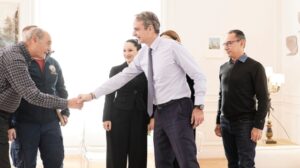
Kyriakos Mitsotakis met with volunteers at the Maximos Mansion, listening to their personal stories and what motivated them to engage in volunteering. He also had the opportunity to discuss how the volunteer movement can be supported and further developed, as well as issues that relate to key aspects of citizens’ daily life—from civil protection and the ‘112’ alert system to the environment and road safety.
“I wanted us to have a broader discussion and to hear your stories, in the context of celebrating International Volunteer Day. And I want to tell you that I truly appreciate the efforts of all active citizens who, in their own way, offer to fields they deeply care about,” the Prime Minister said in his opening remarks. “I believe that, at a time when there is a general sense that social bonds are not as strong as they once were, these stories of contribution give us great strength,” he added.
Alexis Andronopoulos, co-founder of the organization Salvia for burn victims, began volunteering after the deadly fire in Mati, where he rescued 18 people on his motorcycle. Today, he focuses on improving the treatment of burn patients.
“We fought for the rights the state should provide to burn victims, and your government created the Burn Registry. Now EOPYY covers all necessary materials for burn patients, and coverage applies to all,” he said. He emphasized the importance of the “112” alert system, noting in relation to the Mati tragedy: “If people had been notified earlier, everyone would have been saved—both the victims and the burn survivors. ‘112’ is something life-saving.”
“It was my top priority, the ‘112’, when the citizens first trusted us in 2019,” the Prime Minister responded. “And I believe that now—with the help of volunteer organizations—we have managed to build a culture of evacuation. We already have a better understanding of what it means to protect human life above all else.”
Eleni Zerva, from the volunteer group Leschi Ellinon Katadromeon of Preveza, took part in rescue operations during storm “Daniel” in Megala Kalyvia, Trikala, where she rescued a 90-year-old woman living alone who had no way to communicate. “We were shocked. Even after two years, we still discuss how we can find a way for elderly people who don’t use mobile phones to inform us that they’re alive and need help,” she said.
Mitsotakis noted that while fire response receives great attention—especially after the Mati tragedy—Greece will continue to face floods and, unfortunately, earthquakes. “We cannot simply hope nothing will happen; we must be prepared. Your story is very moving, and it shows how personal experiences can inspire more people to engage in volunteering.”
Varvara Tsismetzoğlu, motivated by her father’s need for a bone marrow transplant and the fact that her mother became the first volunteer bone marrow donor in Greece, helped launch—together with the Hellenic Hematology Society and later “Orama Elpidas”—a nation-wide campaign to raise awareness and increase the number of volunteer bone marrow donors. Today, they number more than 250,000—a success story of the volunteer movement.
“There are very moving stories of transplants from living donors, and even more so when there are no family ties involved. That sense of altruism is even stronger,” Mitsotakis noted. He highlighted the country’s significant progress in transplants, both in donor numbers and infrastructure, with the Onassis Center now operating as a state-of-the-art transplant hospital.
The Prime Minister also stressed the importance of raising awareness among children so that they understand, from an early age, that “within this act of giving, there is also a sense of individual fulfillment.”
Stamatis Damianoglou, a volunteer forest firefighter in Marathonas covering the wider Eastern Attica area, proposed prioritizing the education of adolescents and children in civil protection. His organization has already taken initiatives, founding a Youth Volunteer Academy and promoting awareness programs in schools.
Mitsotakis noted that fires around Attica—mixed residential and forest areas—create the greatest difficulties and stressed the importance of land clearing: “The behavior of a fire is completely different when it reaches a cleared plot versus one full of fuel.”
Vasilis Savvidis engages in extensive social work in Agia Paraskevi, supporting homeless and isolated individuals and performing with a music group in nursing homes. “We move every day trying to solve problems. We don’t ask what the state is doing for us; we ask what we are doing for the state—that’s the mindset,” he said.
“You are an example of an active citizen with multifaceted work,” Mitsotakis commented, adding that there is vast room for active citizen participation—including retirees with more free time—who can accomplish many meaningful things through self-organization.
The Prime Minister also referred to government programs that support homeless individuals by providing housing, employment, and psychological assistance. “When you see that you can change someone’s life through a state program, you say: this is worth it.”
Efi Paspalaki, who survived a serious traffic accident 15 years ago, has worked to ensure that people with disabilities can volunteer in all sectors—sports, arts, and civil protection—where seven young people with severe disabilities are already employed as professional rescuers. “My goal is that people with disabilities can be integrated everywhere, wherever each one finds joy,” she explained.
Mitsotakis emphasized: “Active participation is the remedy for many problems—loneliness, stigma, social exclusion. Sometimes emotional scars are harder to heal than physical disabilities. There is nothing more beautiful than allowing people to feel useful—disability does not hold them back.”
He added that people with disabilities have been a cross-cutting governmental priority, with a dedicated strategy from the Prime Minister’s Office due to the wide range of actions—from accessibility to education and employment inclusion.
The Prime Minister warmly thanked the volunteers for their valuable and selfless contribution, noting that their experiences serve as positive examples for all. “This discussion was very enlightening for me. These stories need to be heard. Congratulations from the heart for everything you do. Thank you very much, and I wish you and your loved ones happy holidays.”
Ask me anything
Explore related questions




