





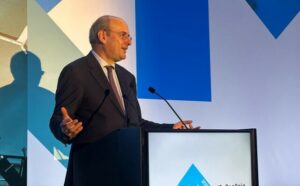
During the Capital Link conference banquet, representatives of the NYSE and the Athens Stock Exchange delivered greetings. The keynote speakers were Greece’s Vice Prime Minister Kostis Hatzidakis and U.S. Deputy Assistant Secretary of Energy for Europe, Eurasia, Africa, and the Middle East, Joshua Volz.
Mr. Hatzidakis described Greece as experiencing one of the strongest economic turnarounds in Europe, while Mr. Volz emphasized the country’s pivotal role in advancing Europe’s energy independence from Russia during this high-level economic and energy event.
“Greece is currently one of the strongest economic turnarounds in Europe,” Hatzidakis said, noting that this progress is recognized internationally. “The IMF sees it, the European Commission sees it, the rating agencies know it, and international media such as Bloomberg and The Economist highlight it.”
He highlighted that Greece is achieving “the fastest reduction in public debt in the history of the eurozone” and pointed out that “83 taxes have been reduced in the last six years” and that “between 2019 and 2025, investment increased by 96%.” At the same time, he said, “the Greek economy is growing at more than twice the European average.”
Hatzidakis stressed that the next phase of growth is based on “fiscal discipline and common-sense reforms,” which “make Greece a magnet for talent, innovation, logistics, and knowledge.” He also highlighted the reduction of bureaucracy and the adoption of new digital tools, noting that “by simplifying procedures and using new digital tools, we have already halved the time required.”
He referred to U.S. investments in Greece, saying, “Since 2019, major American companies such as Microsoft, Google, Amazon, and Cisco have been investing in Greece,” adding that this demonstrates that “what I have described is not Greek mythology.”
In the energy sector, he said the deal with Venture Global “makes Greece a key gateway for American energy in Southeast and Central Europe,” strengthening both the country’s geopolitical position and European energy security. “Today, with the agreements signed in Cyprus, especially those concerning European energy, the energy market in Greece is, to some extent, secure beyond the control of the European Union as a whole.”
In his turn, U.S. Deputy Assistant Secretary of Energy Joshua Volz noted that recent Greece-U.S. energy agreements “move the continent away from the threat of malicious energy coercion” and aim “to provide abundance, not plan for scarcity.”
He emphasized that “by 1 November 2027, the EU is committed to completely eliminating Russian energy resources,” calling it a “huge challenge that requires unprecedented cooperation.” Greece, he said, plays a key role in this process: “There is no country that will play a greater role than Greece in unlocking this potential,” citing the nation’s geography, shipping capabilities, and expertise.
Volz also mentioned the development of a “vertical energy corridor from Greece to Ukraine,” noting that major investments in LNG infrastructure will be required. “If we want to take advantage of the geography and the strategic relationship between Washington and Athens, we will have to build a lot,” he said.
He highlighted regional cooperation: “The longstanding partnership between Greece, the United States, and Greece’s neighbors supports the goals of Greece’s 3+1 format, with Greece playing a leading role alongside Israel and Cyprus, and the United States as like-minded democracies in the region.”
“The U.S. strategic goal,” he said, “is to use energy to bring peoples together, not to divide them. If we don’t succeed on energy, we will remain vulnerable.”
In closing, the U.S. official spoke of “an upgrade in Greece-U.S. relations that will continue, driven by geopolitical necessity, political alignment, and strong personalities on both sides.”
Ask me anything
Explore related questions




