





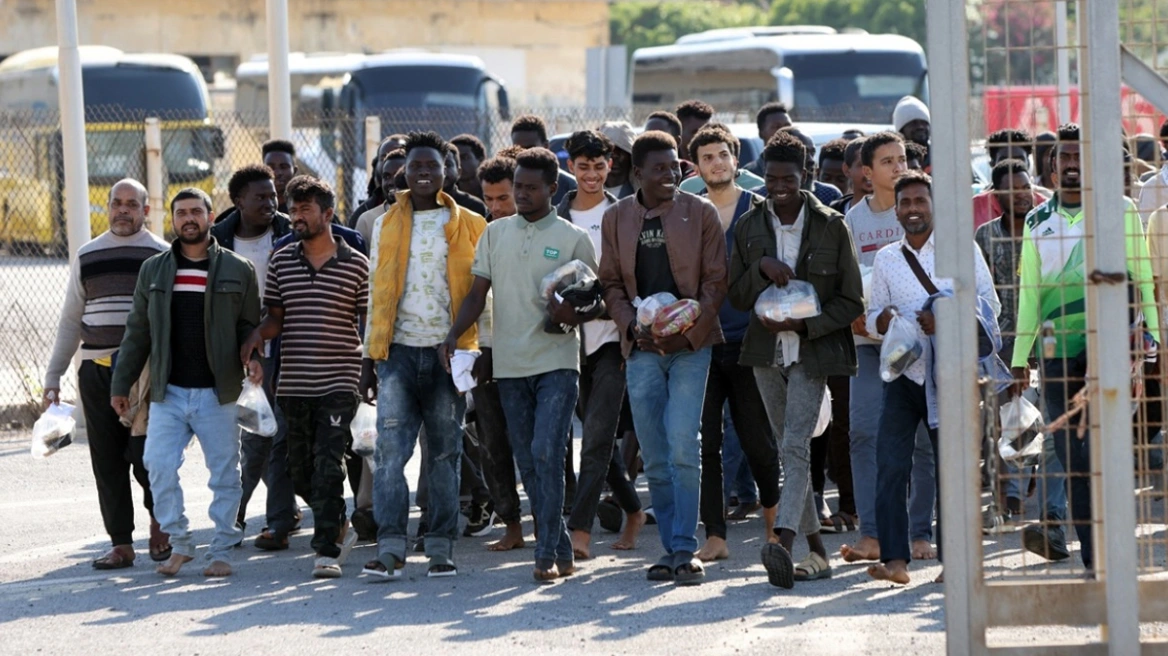
Greece has achieved an important agreement regarding the thousands of cases involving migrants and refugees who had left for other EU countries and whose return to Greece those member states had been requesting.
According to what has emerged after the meetings held by the Minister for Migration and Asylum, Thanos Plevris, in Brussels on the sidelines of the EU Justice and Home Affairs Council, the outstanding cases arising from Dublin III are being brought down to zero. This development comes within the framework of the European “clean slate” plan for old cases, which relieves the country of the long-standing risk of mass returns for asylum applications from previous years.
The measure concerns refugees and migrants who had departed from Greece to other EU member states without the right to do so and whose return those states had subsequently requested.
It is recalled that since 2015 roughly 515,000 people with pending asylum claims or related procedures left Greece illegally for other European countries. At the same time, since 2020 Germany has requested the return to Greece of around 100,000 people for whom, under the system in place at the time, Greece was considered responsible for examining their asylum applications.
In this context, Minister Thanos Plevris, in a bilateral meeting yesterday with his German counterpart in Brussels—and with full mutual understanding of the current migration situation—agreed, pending the full implementation of the new Pact on Migration and Asylum, to the deletion of all outstanding cases from the past.
The agreement provides that these accumulated backlogs are to be erased, while Greece will assume responsibility for examining new applications from 12 June 2026 onward. In essence, all existing cases are cleared, and any that arise over the next seven months, until June 2026, will also not be counted.
With the “clean slate” agreement, the Greek side “wins” the definitive deletion and closure of old cases, while explicitly assuming responsibility for persons entering the country from 12 June 2026 onward. Greece commits that from that point in time it will normally examine return requests according to the new framework of the Pact.
Correspondingly, the German side gains a benefit in the area of “solidarity” under the new Pact, as—according to the information—for the initial implementation period beginning 12 June 2026, it will not be required to provide Greece with the solidarity package that had originally been foreseen.
Under the new Pact, countries facing migratory pressure are entitled to solidarity either through financial support or through relocations. In total, Germany was meant to provide solidarity for 4,000 people, according to the new framework’s provisions. However, this will not be implemented until June 2027, according to the new agreement.
As a result, while Greece is relieved of an extremely large volume of old Dublin-related cases, Germany avoids activating solidarity mechanisms for a specific number of individuals.
As Mr. Plevris stressed, the solution to migration is not returns from one member state to another. “The solution to migration is border protection. Let’s be honest: at some point we need to speak openly about border protection through deterrence and not only through search and rescue. For Greece, it is important that the Pact begins with the deletion of all past Dublin-related backlogs.”
Ask me anything
Explore related questions




