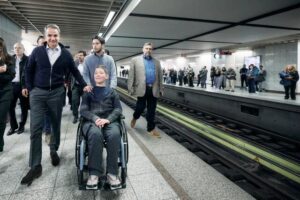
This morning, Prime Minister Kyriakos Mitsotakis had the opportunity to take a ride on the Athens Metro with Panagiotis and Petros, two citizens with disabilities who use the new plastic version of the Disability Card. He saw in practice the improved benefits the Card now provides.
The plastic Disability Card further simplifies the daily lives of people with disabilities, particularly their established right to free public transport. Cardholders can now use it directly at validation points, instead of a ticket, to enter public transport without paying. They no longer need to present medical documents or certificates for unlimited travel passes.
The plastic card can be used on Athens public transport and Thessaloniki buses, without affecting the validity of other existing passes. For the Thessaloniki Metro, free entry is granted simply by showing the Card. The same free-transport rights now apply to the companions of people with disabilities who require assistance. Any form of the Disability Card also grants free entry to museums and archaeological sites under the Ministry of Culture.
The Prime Minister, accompanied by Minister of Social Cohesion and Family Domna Michailidou, Minister of Digital Governance Dimitris Papastergiou, and Deputy Minister of Infrastructure and Transport Konstantinos Kyranakis, viewed the excellent accessibility infrastructure of the Metro. He boarded a train with Petros and Panagiotis and spoke with staff.
Exiting the Metro, the Prime Minister stated:
“I am very pleased because today, together with Petros and Panagiotis, we saw in practice how this wonderful European Disability Card works. It allows our fellow citizens with disabilities to enter the Metro and all public transport without needing to show multiple documents.
As the Minister said, it is a basic gesture of dignity. It improves accessibility and strengthens their rights.
Let me remind you that the Disability Card was legislated back in the 1990s—a reminder of how slowly the Greek state sometimes moves. Today, however, it becomes reality, and it is only one of many reforms we are implementing to support our citizens with disabilities.
The Personal Assistant program is another major reform. It has changed lives, helping people leave their homes, join society, and participate in economic life. We continue working so that you feel you have exactly the same rights as every Greek citizen.
So, I’m handing back the card, and I hope you use it often. Thank you very much.”
Statement by the Minister of Social Cohesion and Family, Domna Michailidou
“With great joy, today together with the Prime Minister, the two relevant Ministers Mr. Kyranakis and Mr. Papastergiou, and of course our two good friends Panagiotis and Petros, we used the Metro—this time with the new card.
The plastic card that people with disabilities can now apply for allows them free entry to the Metro, all public transport in Athens, all buses in Thessaloniki, and all cultural sites, without the past bureaucracy.
Together with ESAMEA, parents’ associations, and disability organizations, we have often described this as a ‘card of dignity.’ A card that safeguards dignity in daily life, especially for invisible disabilities, where people previously had to show files full of personal documents to prove something already certified.
As we must, we are making daily life easier for them, their families, and their personal assistants.”
Enhanced Services of the Disability Card
The upgraded benefits of the Disability Card are part of a broader framework of actions to ensure equal access to employment and social life for people with disabilities.
The Disability Card, although legislated in 1996, was implemented in 2023. Beyond the new plastic version, it is also available:
- digitally through wallet.gov
- and as a printable, digitally verifiable document.
Since 2023, the Disability Registry has been fully operational, containing all certified disability holders through KEPA. Applications for any form of the Disability Card are submitted via the National Disability Portal (epan.gov.gr).
Other Active Programs
- Personal Assistant Program: Helps individuals and families find personal assistants who support disabled people in daily activities.
- Home Accessibility Program: Provides subsidies to improve accessibility in homes or workplaces.
Ask me anything
Explore related questions