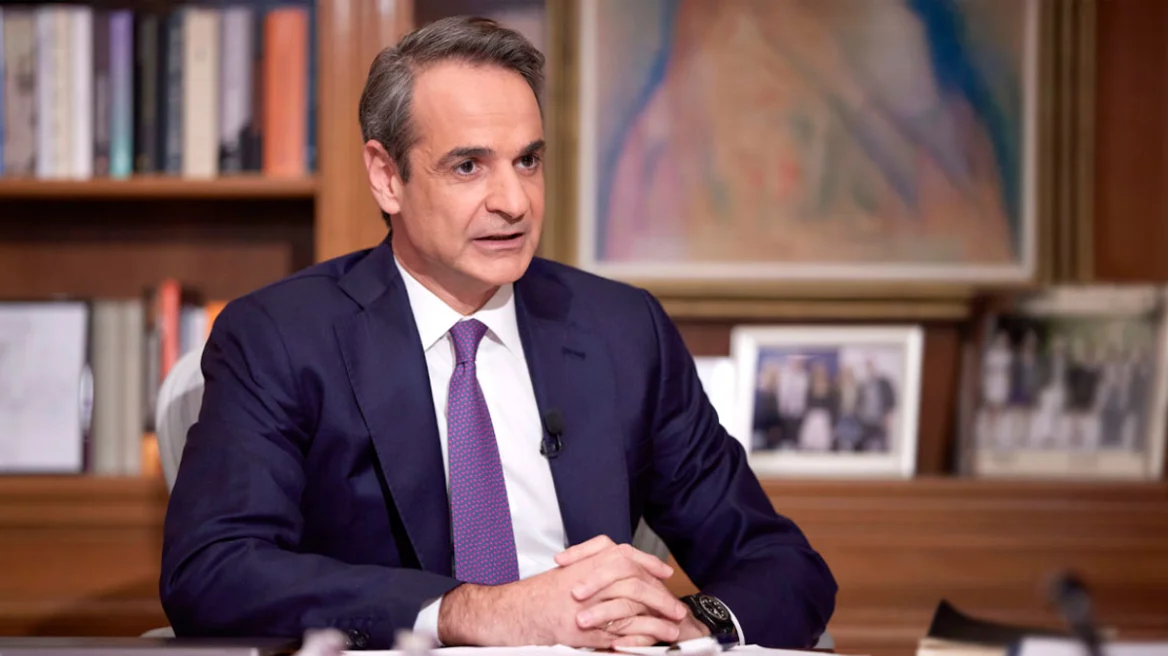
Dialogue cannot take place with ultimatums, Kyriakos Mitsotakis stressed on Sunday morning, following the farmers’ refusal to come to the Maximos Mansion on Monday afternoon after the invitation he extended to them from the floor of Parliament.
At the same time, in his Sunday post he notes that “the roadblocks, which in practice turn against other social groups, do not serve the farmers’ demands. On the contrary, they undermine them. And the occupation of roads and other public infrastructure that belongs to everyone is not responsible action, but moves that harm the country—and, of course, local economies in the regions.”
Expressing surprise at the farmers’ refusal, he adds that “solutions arise only through discussion. Whoever rejects these principles of reason and democracy assumes a great burden toward the rest of society.”
“For my part,” he continues, “I reiterate that the government’s door remains open to any farmers and livestock breeders who wish to meet either with me, or with the Vice President of the Government, Kostis Hatzidakis, and the Minister of Rural Development, Kostas Tsiaras. This is something that the farmers and livestock breeders of Crete did recently,” the prime minister adds, foreshadowing a new package of support measures.
As he writes characteristically: “the government takes every fair demand into account. Thus, it is already examining a set of additional support measures. Always, however, within the limits of the national economy’s capabilities and in accordance with European rules. Measures that will mainly be based on resources from the reallocation of unused funds that arose from the new framework for agricultural subsidies. It is evident, moreover, that a positive response to the demand of a specific social group could not derail the positive economic course of the entire country. Just as it is evident that no measure outside the framework of the Common Agricultural Policy could stand in Brussels.”
Mr. Mitsotakis also makes clear that “non-negotiable, in any case, remains my position on cleaning up OPEKEPE through its integration into the Independent Authority for Public Revenue (AADE). This is because it constitutes the catalyst that will modernize the primary sector as a whole in the country. As a result, on the one hand, EU funds will finally strengthen national production, and on the other, honest farmers will receive more money every year.”
He comments in this context as well that “it seems, however, that this bold decision of ours has inconvenienced quite a few who had become accustomed to operating by exploiting the gaps and dysfunctions of the old system. I regret this, but this pathology of 40 years and cross-party responsibility must come to an end. After all, no one wants certain opportunists to live at the expense of honest professionals and at the expense of the state itself.”
Ask me anything
Explore related questions