The highest advisory bodies of the Ministry of Culture—the Central Council for Modern Monuments and the Central Archaeological Council—unanimously approved all the advanced preliminary studies—architectural, structural, electromechanical—for the expansion and upgrade of the National Archaeological Museum, the most important and richest repository of ancient Greek art worldwide.
The architectural design of the project has been undertaken by the Chipperfield-Tombazis offices. The preparation of the studies began after the ratification in April 2024 by the Greek Parliament of the sponsorship contract worth 40 million euros, granted by Spyros and Dorothy Latsis in memory of Ioannis and Erietta Latsis, which funds the entire set of studies. These studies concern the entire building block and museum complex, which includes the Epigraphic Museum, unique worldwide in its kind.
Minister of Culture Lina Mendoni stated:
“Greece is getting the National Archaeological Museum it deserves. The architectural identity of the National Archaeological Museum is a complex outcome combining neoclassical principles and later modernist interventions. The existing building, while preserving its historical character, has adapted over time to the functional and museological needs of each era. The existing exhibition spaces were designed in the second half of the 19th century and met the needs, visitor numbers, and museological views of that time. However, the more than doubling of visitors has made the revision and modernization of architectural data imperative. The expansion and upgrade of the National Archaeological Museum, through the proposed interventions, will give the monument a unified and coherent character by removing the irregularities and disjointed additions made over time to the complex buildings. It will restore elements of the original structure and improve its functionality to satisfy the requirements of a modern museum of global significance.
Moreover, the building complex itself, along with the public garden, will become a landmark and attraction for the capital. The redesign aims to highlight the Museum as a dynamic hub of outward-facing activities, including a research center dedicated to antiquity and an open, universally accessible center of culture and entertainment with a public garden. Special attention is given to addressing existing building pathologies such as humidity and water ingress, strengthening seismic protection, improving energy performance, accessibility, and sustainability. For the first time, suitable environmental conditions will be ensured for the display and preservation of antiquities, such as humidity, sunlight, and temperature, both in the museum extension and in several rooms of the historic building.”
Closing
The architectural proposal for the expansion and enhancement of the National Archaeological Museum has three main goals:
a) the creation of a public park as a gift to the city,
b) the promotion of Greek identity to an international audience,
c) the expansion of the museum’s functions and exhibition spaces, establishing it as a beacon of national culture.
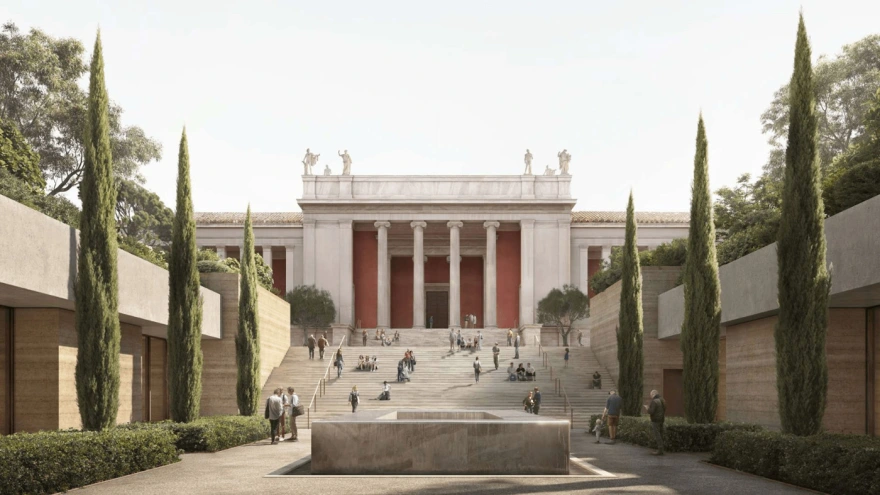
The strategy includes a building extension to develop new infrastructure and exhibition spaces while respecting the neoclassical façade, creating a new imposing main entrance on Patision Street with a square and public foyer, enhancing internal coherence and accessibility through connections with the historic building, and designing an open, green public park with a bistro and courtyard that offers high-quality urban space.
Simultaneously, the historic building will be highlighted through the renovation of the 1950s rooms, interventions along the central axis to improve structure and orientation, and strengthening the research center with modern labs and offices. Visitor facilities will be upgraded with a central foyer, lockers, cloakroom, restrooms, restaurant, amphitheater, museum shop, and spaces for temporary exhibitions.
The plan foresees the upgrade of exhibition and support areas: about 17,000 antiquities will be displayed in two thematic areas, 13 sections, dozens of subsections, and focused narratives. The areas for the three Prehistoric Collections (Neolithic, Cycladic, and Mycenaean) will increase from 1,100 sq.m. to 2,500 sq.m. The temporary exhibition area will more than double (from 429 sq.m. to about 1,033 sq.m.), with dedicated storage and logistics spaces. New educational program rooms will grow from 50 sq.m. to 178 sq.m.
Storage for antiquities and general use will be modernized and increased from 3,367 sq.m. to 4,296 sq.m., and conservation laboratories will expand to 1,707 sq.m. from 856 sq.m. Library spaces will grow from 201 sq.m. to 289 sq.m., and the historic photographic archive from 39 sq.m. to 91 sq.m., with new storage of 142 sq.m. Internal courtyards will be utilized to create a modern, functional, and educationally rich environment.
The preliminary architectural study aims to upgrade the Exarcheia, Patision, and Metaxourgeio areas, creating a new cultural axis linking the Museum with the National Technical University of Athens, the Acropolis, and Pedion Areos.
The project aspires to establish the Museum as a city landmark, create a research center dedicated to antiquity studies, and provide an open, universally accessible public garden serving as a cultural and entertainment hub. Expansion is imperative because the existing exhibition spaces, designed in the 19th century, no longer meet contemporary needs, while visitor increases demand new architectural solutions. Simultaneously, building pathologies will be resolved, seismic protection enhanced, and energy performance improved for sustainable operation.
The new study allows exhibitions in two thematic areas and dozens of subsections, with the Prehistoric Collections and temporary exhibition spaces more than doubling, alongside expanded educational and conservation areas. Modern workspaces for staff, special entrances, pathways for artifact movement, and state-of-the-art labs and storage will also be created.
For visitors, the study includes modern reception facilities, a museum shop, amphitheater, and restaurant with extended hours, full accessibility, and an open public garden with refreshment area. The presentation follows a cohesive chronological narrative from the Neolithic to Late Antiquity, offering a comprehensive visitor experience.
The proposed park next to the museum extension aims to dialogue with the historic Ziller building (1889) and revive the romantic park aesthetics of that era. The design features spiral paths that create a sense of infinite movement and depth. Lawns are shaped in concave or raised forms, while shrubs limit views, enhancing curiosity and spatial perception.
The approved museological concept includes a full visitor route tracing the development of Greek civilization from the Neolithic to Late Antiquity across four building levels: two in the extension and two in the historic building. To provide clear narration and orientation, a central axis is introduced.
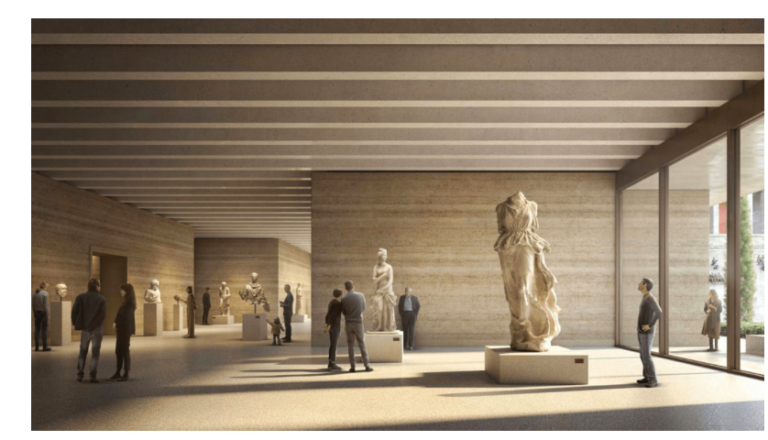
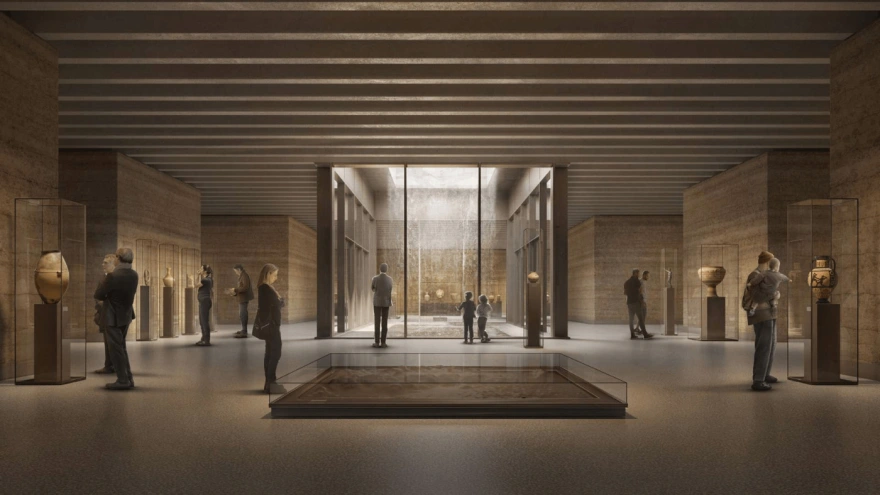
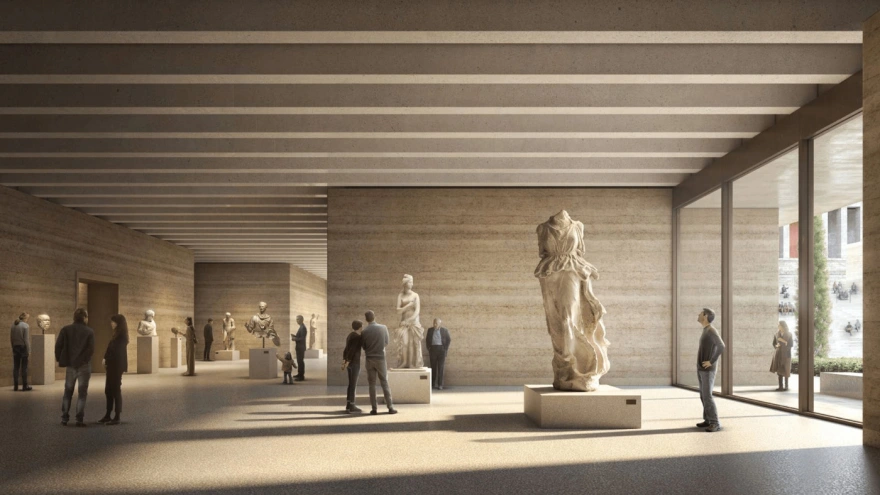
The axis at the lower level of the extension centers on an atrium that offers natural light and orientation, while displaying key artifacts representing different exhibition eras. In the historic building, the sequence of exhibition halls along the central axis provides varied scales and natural lighting conditions to enhance visitor experience. The evolution of Greek sculpture from Archaic to Classical periods is presented as visitors move through the rooms.
In the extension, the permanent collection features two spatial qualities: 1) open-flow rooms offering large flexible spaces with diagonal views and natural light where possible, and 2) smaller isolated cabinets allowing diverse finishes and contemplative visitor experiences. A remarkable water feature in the basement provides orientation and natural light ambiance.
Adjacent to the Archaic hall, side rooms include four educational spaces that can be flexibly combined or separated based on group size. Their central placement emphasizes the importance of cultural education within the museum. Direct access to the café courtyard above allows outdoor learning.
Combining all spatial qualities and natural lighting conditions, the variety of rooms enables the museum to exhibit each object optimally while enriching the visitor experience. Internal connection between the historic building and the extension is key for the chronological museological route, visitor flow, experience, and daily functions, including secure staff and artifact pathways.
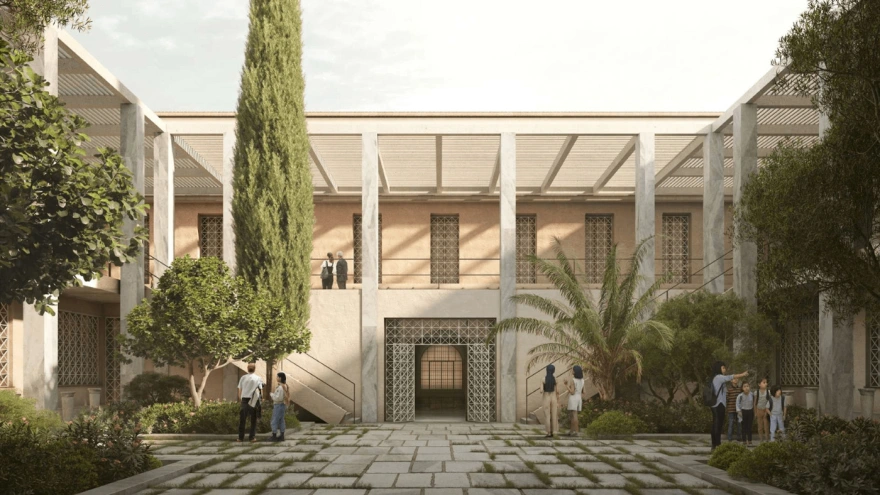
At the Patision Street entrance, a plane tree grove is designed to follow the sidewalk levels, with tree crowns horizontally developed to maintain unobstructed views of the building. This planting reduces airborne dust from nearby streets, limits direct sunlight and surface temperatures via evapotranspiration, ensuring a welcoming and pleasant space even on hot summer days. It also acts as a “vestibule” or waiting area before entering the museum.
Park accessibility is guaranteed via stairs, elevators, and ramps, with main paths 2.5 meters wide and different levels connected by ramps using reused existing marble blocks. The park closes after midnight, with fences integrated into vegetation on the north, south, and west sides, and gates at the three main stairs.
The electromechanical preliminary study principles align with architectural, structural, and museological designs, cooperating fully with planting and lighting studies. Proposed installations were selected based on a) artifact protection, b) maintaining appropriate temperature, humidity, and air quality for people and artifacts, c) energy saving and sustainability, and d) ease of maintenance and future expansion. These include hydraulic installations, active fire protection, special facilities for natural gas, argon, vacuum, and compressed air in museum labs, HVAC, electricity, and elevators.
The existing building is divided into two parts with fundamentally different structural systems. Over the decades, both parts underwent successive interventions and renovations, creating a heterogeneous structure assessed thoroughly in the structural study. Based on this analysis, along with architectural and museological adaptations and electromechanical requirements, necessary structural interventions were optimized to meet all seismic capacity and functionality requirements.
Historical and architectural evolution of the National Archaeological Museum
The National Archaeological Museum was inaugurated at its current location in 1889. The main facade faces Patision Street, and the building complex is bounded by Vasileos Herakleiou, Bouboulinas, and Tositsa streets. The original architectural design was created in 1865 by Ludwig Lange, later modified by Panagis Kalkos, Armodios Vlachos, and Ernst Ziller, preserving the basic layout with two internal courtyards. The chronological development is as follows:
- 1871–1889: Construction of wings (Kalkos, Vlachos, Ziller). By 1889, the western facade and central hall were completed with neo-Hellenic style and principles of the Athenian Trilogy.
- 1903–1906: Extension of the eastern wing (Anastasios Metaxas).
- 1932–1939: New three-story eastern wing (Georgios Nomikos) for halls, storage, labs, and offices. Academic style externally, minimalistic internally.
- 1940–1941: Hiding exhibits due to World War II.
- 1947–1964: Interventions by Patroklos Karantinos with modernist principles, remodeling the entrance hall, technical infrastructure, moving away aesthetically from the 19th century.
- 1970–2016: Structural interventions, reinforcements after the 1999 earthquake, upgrades for the 2004 Olympic Games.
Ask me anything
Explore related questions